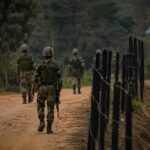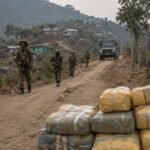

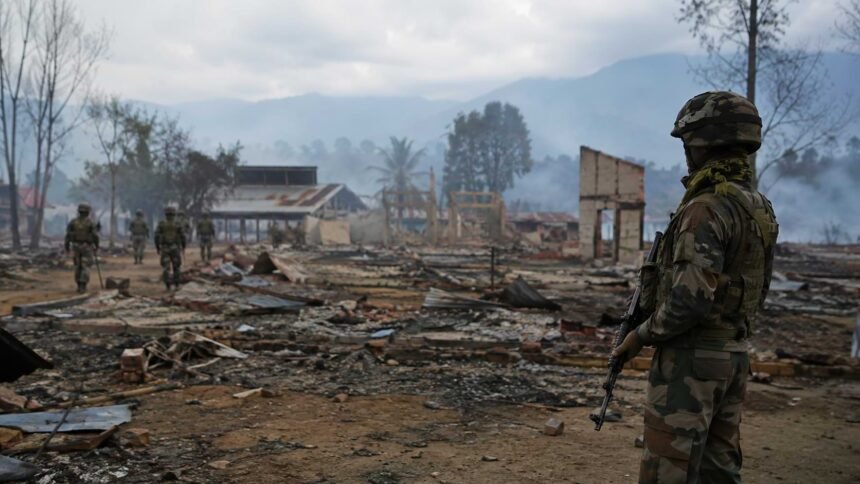
The recent two-day counter-insurgency operations in Manipur on 11-12 May has again exposed the collapse of governance under Narendra Modi and the BJP rule. More than ten suspected cadres of banned outfits were rounded up by the State security forces and a huge cache of arms, ammunition and communication equipment were seized from ‘vulnerable’ areas of the state.
But no sooner than the promise of a “successful operation” can be trumpeted, the stark truth emerges: under BJP rule, Manipur has become one of the most militarized and volatile parts of South Asia.
The confiscation of weapons, far from being proof of stability, is a very grim testimonial to massive state failure. A government that constantly harks on “national security” has brought an entire state to the brink of ethnic conflict insurgency large scale displacement and consequent institutional breakdown. Even two years and over that violence continues in Manipur, in pain, partition and militarisation.
A State Flooded With Weapons Under BJP Rule
This recent eliciting of fire arms and explosives, reveal that stark reality that despite the presence of Indian armed forces, there is lots of weapons in Manipur. Since the onset of the ongoing ethnic violence in the year 2023, thousands of sophisticated weapons have been stolen from police armories and state stockpiles.
Though the state government’s official records recorded the theft of more than 6,000 weapons and lakhs of rounds of ammunition, a large number are yet to be recovered.
This is not a minor law and order lapse. It is one among the highest internal security embarrassments in the contemporary history of India.
Reports over the last two years have consistently shown the use of :
– Assault rifles
– INSAS and AK family weapons
– Tube-launched rockets.
– Improvised explosive devices (IED’s)
– Mortars and military ammunition7.
The question which the BJP government refuses to answer is, relatively simple: How do you turn the whole state into a battlefield while the center remains uninvolved?
Far from preventing escalation in 2023, the state allowed armed ethnic militias to form and consolidate control over swathes of territory.
Without even trying, entire districts became ethnically divided. Villages were razed. Highways were sealed.
Communities were turned into armed, militarized islands fortresses, defended by armed volunteers, not civil institutions. Raids merely ratify. In reality the crisis was never resolved, we contained it by force.
Human Cost Hidden Behind Security Narratives
The BJP government used ‘counter-insurgency ‘and ‘anti-terror operations’ in Manipur like a mantra but hardly acknowledged the tragic Humanitarian fallouts of its failed policies in the region. More than 250 killed. A large number of homes disbanded by the military, thousands have been torched, over 60,000 people have been displaced; the destruction of hundreds of temples churches public buildings.
Duration of Internet shutdowns were among the longest in democratic history.
Families are still stuck in relief camps with poor health care, sanitation and employment prospects. Children lost years of education. Enterprises failed.
The trauma continues to permeate already compromised neighborhoods plagued by decades of militarization. Though, during the height of the crisis, the BJP leadership appeared stunningly uncaring; Prime Minister Modi sat silent for weeks after the violence first broke out in 2023, even as terrifying images from the state spread around the world.
The single question on the minds of India’s critics was whether the center was quick to respond to an international public relations crisis than a humanitarian catastrophe within India. Rather than political reconciliation, it was troop levels curfews arrests, and surveillance that were in the forefront of the response.
What result do we see today? Security operation: now they have become mundane, because peace itself has been lost.
Militarization Cannot Replace Political Solutions
Northeastern states have suffered from policy of viewing political grievances as security threats for decades. But under BJP government, the trend has reinforced by a significant extent.
The sheer scale of taking the ‘central forces’ into action once the violence started has increased exponentially across the whole of Manipur. Central armed units of the Assam Rifles, CRPF, BSF and Army are continuously in charge of conflict sensitive areas.
Still even with heavy militarization clashes ambushes weapons trafficking and functioning of militants are happening. This points to a fundamental concern: if one of the world’s largest security structures has been unable to return a small country to order, then the problem must be a political one and not simply a military one.
Communities accuse both the state and central governments of reacting selectively, biased policing, and not protecting civilians impartially. Confidence in institutions has broken down.
The BJP has repeatedly promoted its “Act East” vision, portraying Northeast India as India’s gateway to Southeast Asia. Yet Manipur today reflects the exact opposite: instability, insecurity, collapsed governance, and militarized fragmentation.
Even more alarming is the normalization of ethnic separation. Buffer zones now divided communities, refuges. Internally displaced persons still cannot return to their homes. Arms-carrying civilian groups are still functioning illegally in most areas.
Educational institutions, markets, and transportation routes continue to be in disarray. Such conditions are more akin to indefinite siege, and failed state, than those of a peaceful, model democratic state.
The BJP has been pushing for its ‘Act East’ vision from quite some time, with a narrative that the Northeast should position as India ‘s gateway to SE Asia. Though Present day Manipur model stands diametrically opposite, instate turbulence and insecurity, fragmented and collapsed governance, militarization.
BJP’s Nationalism Cannot Hide Administrative Failure
BJP government touts itself as a non-compromising on-security. But Manipur tears that story apart.
- Looted weapons numbering in the thousands.
- Ethnic militias patching the roads Large-scale civilian displacement.
- Extended period of internet blackouts for several months.
- Recurring insurgent recoverys and raids Cult of communal separation.
The recent operations of 11 and 12 May cannot be taken as proof of success.
They are confirmation that the state continues to be highly volatile after BJP rule. Every fresh arms recovery is a reminder that the war machine is still functioning.
Every arrest is a reminder that rebellion still has life within it. Every counter-force raid is a reminder that political reconciliation still eludes us. Manipur’s tragedy is not just violence happened. The tragedy is the normalcy still remains far away for people despite of huge state power, huge security deployment and several assurances from New Delhi.
Until accountability dialogue rehabilitation and authentic political engagement can trample under the boot of the militarized optics, Manipur will remain chronic of a periscope of endless raids, recoveries, ‘Fear’ and funerals.