
Election talk is going on all over India, but a serious and pressing issue is coming to light in the far northeastern state of Manipur. Besides election publicity and fancy politics, the state is still experiencing a never-ending series of violence, grief, and a lack of government. Now, the crisis doesn’t just exist; it has been going on for a long time in silence, denial, and weak reaction. The problem is no longer the existence of the crisis but the duration of its continued silence, denial, and weak response. Recently, the killing of two Meitei children in a rocket attack has again revealed the extent of the security breakdown. Although seriously wounded, their mother survives and she is a living evidence of the tragedy which should never ever have happened. It was not some random cross fire among armed groups but targeted killing of the civilians. Normally, a similar event would trigger the immediate responsibility, in depth investigation and strong actions by the Government. However, what really happened was the polar opposite: people protest and those in power remain silent.
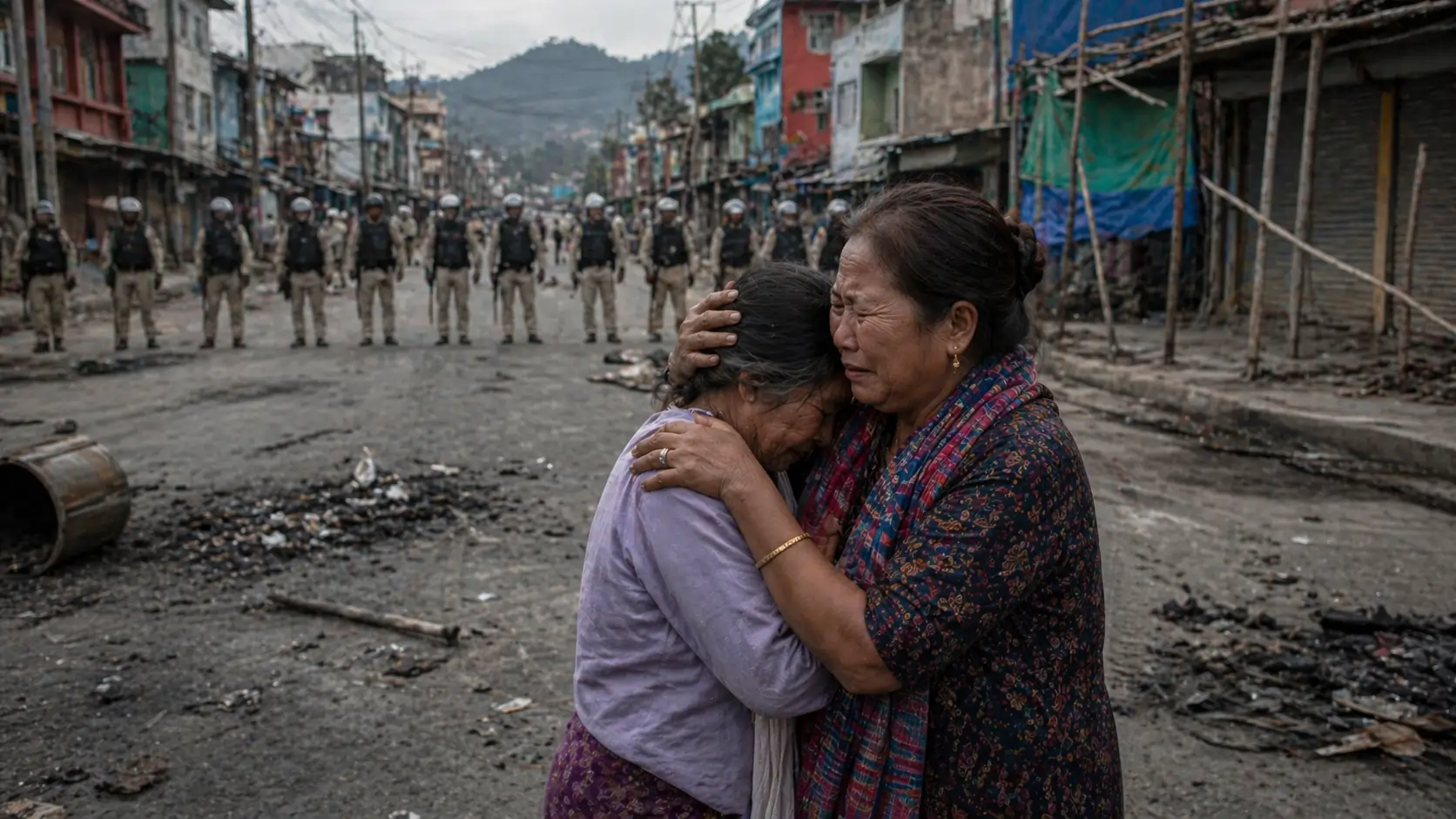
Three years since the Manipur crisis began, the continuing slaughter of innocent civilians is the main factor for people’s disbelief in the state’s capacity or willingness to provide the very basic level of security. The continuation of such events points not only to some failures here and there but to a total breakdown of the system. When children cannot be safe even at their very homes, it is the whole idea of governance that is seriously shaken. People’s anger, quite rightly, was expressed in the streets. They wanted justice for the victims and were asking questions, holding people responsible. Nonetheless, the way the authorities reacted to these protests has caused major worries. According to some sources, the protests were dealt with in a very harsh manner, including baton charges and arresting large numbers of people. 127 or so protesters were taken into custody, and at least 42 protesters were hurt during the confrontations with the police.
The optics of this response cannot easily be overlooked. Instead of comforting those mourning the death of innocent people, they were met with threats. The shouted lines ‘Go Back Central Forces’ in protest venues indicate an increasing level of mistrust among the people towards the very bodies that are supposed to ensure their safety. Misinterpreting the cry for justice as a matter of maintaining law and order is almost like ignoring the main message. More violence only adds to the unrest in different neighborhoods. In just one of the latest episodes, two Naga natives were allegedly shot dead, further exacerbating the already horrendous figures of fatalities. Since May 2023, the rough count tables that more than 532 persons have been killed in the violence, out of which 253 Kuki, 98 Meitei, and other persons from various communities have been identified. Besides, the disruption of people’s lives has led to a situation in which thousands have left their homes and either have to live in relief camps or extremely uncertain living conditions, with their future deeply uncertain.
However, despite the presence of eyewitness accounts and repeated incidents, justice remains elusive. Police either do not arrest the perpetrators immediately or at all, do not disclose their investigating methods, and the families of victims remain deprived of a sense of closure. Seeing the criminals as being beyond the reach of the law only serves to shake people’s faith in the government and separate them even more. Besides, the central government’s chief executive has been the focus of criticism these days. Some people believe that while Manipur is experiencing a humanitarian disaster, the country’s politicians seem to be spending their time on election meetings, cleverly designing their message, and shaping the media. For that reason, no one will be surprised if the government’s lack of presence in this matter together with no plan made public for peace will be seen as further proof of their withdrawal.
This gap, as understood, between crisis and response does not come without multiple consequences. It can even be argued that Manipur is not only experiencing unrest here and there, the fact is that the state is running a humanitarian crisis at large. To solve, at one step, it is not possible to work with the statements of leaders or some mere administrative changesit is political determination, wide-ranging discussions, conflict resolution methods that work one after another and are really efficient. Additionally, the trust, which is broken, needs to be rebuilt. It is one thing to tell people who are victims of violence, who have been forced to flee and who have suffered a lot that it is time to trust the system again. Rather, on the basis of a track record, doing justice openly, and continuously showing a determination to protect everyone regardless of who they are, trust is gained. This case also mentions a more general problem of governing: how to give due attention to national political priorities and at the same time address regional issues effectively. When the people living in the regions think that they have been forgotten or that they do not even have a place in the times of difficulties, then this creates a situation when the alienation of these people gets even stronger. And the question which has been very popular lately in the public discussions, Does Manipur even still belong to the national conscience? is a reflection of the above feeling.
At the centre of the Manipur crisis lies not merely a local problem. Rather, it is an examination of how strong the institutions are, whether politicians will be held responsible for their actions, and the primary duty of the government to safeguard its people. Delaying justice and security any further can lead to making the level of violence that is really not acceptable in any democracy, almost like a normal thing. Things may get even worse if patience totally wears out resulting in a much more forceful call for change. And while the term “rebellion” may well express the feelings of the moment, it also highlights the need for urgent intervention.
Presently, Manipur is at a pivotal moment. What is happening is more than just random episodes. In fact, these are interconnected indicators of a much broader ailment. Simply overlooking them, or responding on a piece-meal basis, will be detrimental to the coming peace. Justice postponed is justice denied as the proverb goes. A denial for the people of Manipur has gone on for too long. What is in question is whether substantive measures will be done to break the long silence or if the unchecked cycle of violence and neglect will be the new norm.