
The threat of insurgency is no longer the only challenge in Northeast India. A much more dangerous crisis is playing out in the thick forests, leaky borders, and isolated mountain passes of the region, that of the convergence of narcotics trafficking, cross-border militancy, and organized crime networks. The issue used to be considered as a local security problem; now it is a geopolitical threat that has national and international implications.
The Northeast has emerged as a strategic route in Asia’s growing narco-economy from the conflict zones of Manipur to the jungles of Arunachal Pradesh and the border areas of Mizoram and Nagaland. Now, the drug gangs, armed insurgent groups and foreign networks are gaining greater access to the Indian east, which analysts call the “triple threat.”
There is a geographical element to this crisis. Northeast India has almost 5,300 kilometers of international boundaries with Myanmar, Bangladesh, Bhutan, China and Nepal. Most of this area is hilly, wooded and hard to maintain. The India-Myanmar border, however, is the most fluid especially near the borders of Manipur, Mizoram, Nagaland and Arunachal Pradesh. The area is also near the notorious “Golden Triangle” an area in Myanmar, Laos and Thailand that is home to the world’s biggest drug-producing zone.
The military coup in Myanmar made the situation much worse. Within Myanmar, the weak state and the growing illegal economies, along with armed ethnic groups facilitated the production and smuggling of narcotics. Indian markets and lines to Bangladesh and Southeast Asia are now being trafficked by methamphetamine tablets, heroin, opium and synthetic drugs in increasing numbers in Northeast India.
To put it into perspective, the number of security agencies’ seizures of drugs in India has increased but so has the scale of the problem.
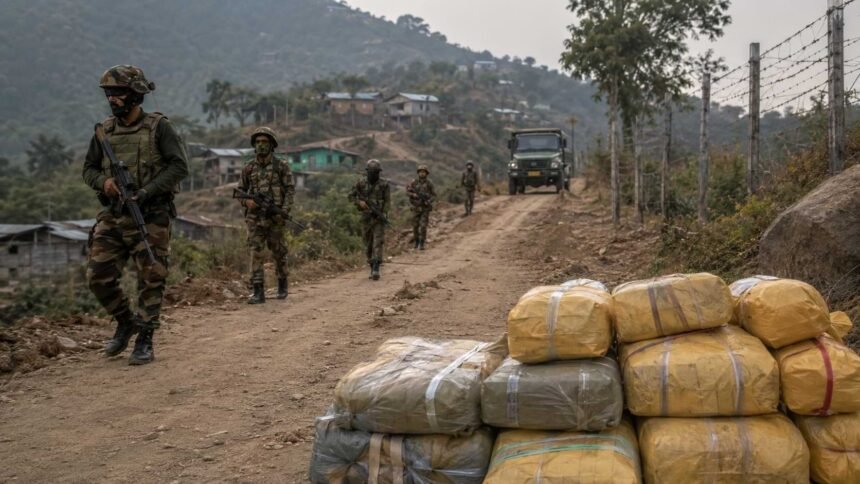
Official statistics released by the Ministry of Home Affairs and Narcotics Control Bureau show that the number of narcotics seized in the Northeast region has increased manifolds in the past three years. In Manipur, several drug seizures worth hundreds of crores took place. In one of the biggest operations in recent times, security forces have also recovered methamphetamine tablets and heroin consignment near Myanmar’s border town of Moreh.
The narcotics trade is not an independent trade. Militant groups have been increasingly piling into the drug economy to fund insurgent efforts, buy guns, and maintain underground networks. Several of the insurgent groups in the Northeast are said to extort “taxes” from drug traffickers transiting their areas, and some groups are engaged in transporting and protecting the drugs.
It is a merging of militancy and narcotics that has changed the face of insurgency in the region. Political and ethnic ideologies have now become increasingly survival-based in traditional ideologies. Underground groups which are losing popularity and recruitment have found other means of income, such as extortion, drug trafficking, the movement of arms, and smuggling.
This was the reason that the recent rise in militant activities in Arunachal Pradesh and Manipur is indicative of this shift. Security forces have issued numerous warnings about cross-border camps where militants regroup, as well as about narcotics logistics.
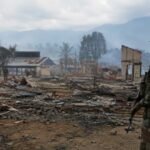
Manipur continues to be the hotspot of this perilous convergence. Ethnic conflict broke out in the state, leaving significant governance gaps in some parts of the state that allowed armed groups and criminal syndicates to grow in influence. Sophisticated weapons, explosives and narcotics have been variously retrieved from the hands of the security forces in conflict area districts. The police and intelligence services suspect that the longstanding instability allows for more close cooperation between the various militancy groups and international drug gangs.
The violence also hindered the normal functioning of the border controls. The situation is complicated by the large numbers of displaced civilians, the lack of effective local administration and ethnic polarization, which have hindered intelligence and law enforcement activities. It is an emptiness which is exactly what the organized trafficking networks feed upon.
However, narcotics are no longer a security problem, but a social disaster on par. Narcotics, however, are no longer just a security issue, but a rapidly growing social disaster on par.
In several Northeastern states, drug addiction has become a serious public health issue affecting youth. Heroin and methamphetamine addiction rates have dramatically increased in border districts where unemployment, conflict and poor health care systems already pose social vulnerability. Manipur and Mizoram’s rehabilitation centers are seeing a rise in the number of teenagers and young adults using synthetic drugs.
The implications are dire, with HIV transmission due to injection drug use, organized crime flourishing, school absences, and community disintegration.
But even as the crisis gets worse, the Northeast problem with narcotics does not get the national focus it deserves. These issues are generally confined to the periphery of the mainstream agenda until violence breaks out or significant seizures take place, due to the remote location of the region from the Indian political and policy-making heartland.
In the interim, security forces are rampaging through their operations.
The Assam Rifles, the Border Security Force, Narcotics Control Bureau and the police units in the border states have stepped up their intelligence gathering efforts in the border belt. Authorities have stepped up their surveillance efforts including drone watches, highway checkpoints, satellite surveillance, and coordinated raids. During several operations in the past year, security forces have stopped vehicles carrying narcotics in their fuel tanks and in their commercial goods products that were being transported through remote border routes.
Infrastructure development, as part of the long-term solution, has also been highlighted by the government. The improvement of the road infrastructure, linkage via digital devices, and economic investment are critical in the fight against local reliance on illegal economies. Lack of development increases the susceptibility of isolated communities to the influence of militant recruiters and traffickers, according to officials.
But the experts warn that it’s not just a matter of infrastructure. Corruption, inadequate border security, ethnic and political conflicts and the intricacies of local insurgent politics continue to impede enforcement. In contrast to the heavily barricaded western border with Pakistan, the India Myanmar border is open for the most part in many sections. In particular, the Free Movement Regime (FMR), which allows people residing within a specific distance from the border to enter and stay in the country without needing to obtain a visa, has contributed to the promotion of ethnic and cultural relations. However, analysts say trafficking and militant networks are taking advantage of these transactions increasingly.
Tightening of border controls has been a hot topic. Some have called for tighter fencing and surveillance systems, while others have argued that the militarization of borders could impact local tribal communities that rely on people crossing the border for their sense of self and way of life.
This tension is a symptom of greater complexity in Northeast India, where security issues, ethnicity, economy and geopolitics are all strongly interlinked.
A combination of China’s strategic presence near Arunachal Pradesh, the instability in Myanmar, the trafficking routes in Bangladesh and the insurgency in the country poses a volatile situation that makes it an ideal ground for narcotics trafficking. Thus, any long-term solution must go beyond military action to regional diplomacy, economic change and institutional reform.
The battle against insurgent attacks alone is no longer an issue in India. The actual fight is to a shadow economy that can finance violence, corrupt governance and destabilize whole border areas.
The drugs-militancy relationship is growing out of hand and potentially will alter the security situation in the region for years to come. The Northeast, however, could emerge as a strategic economic gateway between South Asia and East Asia if India is able to successfully integrate the four aspects border security, intelligence coordination, development and political stability.