
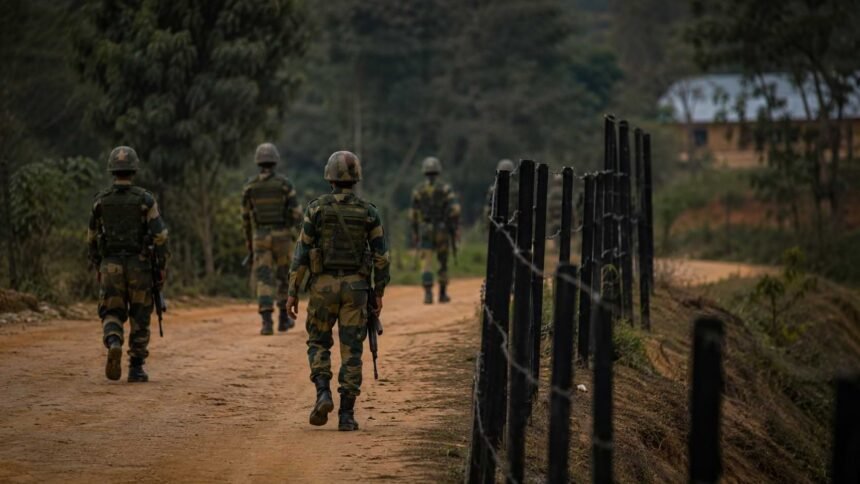
Once again, the killing of two alleged NSCN-K (National Socialist Council of Nagaland-Khaplang) “cadres” in the quiet district of Changlang, Arunachal Pradesh, is being presented by the Indian state as a “successful counter-insurgency operation”. The Assam Rifles troops sent out on a night operation to Songking village following a tip-off on terrorist movement, killed two cadres called Lt. Col. Umkong and Sgt. Enu, and recovered guns and ammunition.
Though, the true story of Northeast India is gloomier. It is characterized by years of police and army presence, political indifference, failed peace agreements and a security agenda that has led the region into an even more volatile state under the BJP government.
This is not a one-off event. It is a link in the inexorable chain of violence and bloodshed that has gripped Arunachal Nagaland Manipur, and Assam over the last number of decadesa cycle that persists despite New Delhi’s on-going pronouncemengt that “peace has returned” to the Northeast.
Militarization Has Expanded, But Peace Has Not
Since coming to power in 2014, BJP government has set in for the Northeast a period of unabated infiltration of the militaries into the border states, Mainly in the Delhi- Tirap Changlang (TCL) belt of Arunachal Pradesh. But, the pattern ofoperations has not reduced the number of insurgency incidences.
Between 2023 and 2026, there were several incidents of arrests, encounters and gun battles at several locations in Arunachal Pradesh, between NSCN factions, ULFA-I militants and several other insurgent groups.
The security forces confiscated weapons, ammunition and extortion money on a regular basis and the various militant factions kept regrouping to the IndiaMyanmar border. Because of this, this reveals a basic inconsistency in the BJP’s policy in the Northeast. If so-called years of militarized governance and deployment of large number of army troops have been so successful, then why insurgency should still continue unabated?
The fact is that Delhi refuses to confront the political origins of the problem. The Naga problem has not been resolved even after so many years of negotiation. The 2015 Structure Agreement signed by the Indian government and the NSCN-IM was felt to be a “historic deal” by by then Indian Premier Narendra Modi.
Still, more than 10 years later, the Naga condition continues to be one of limbo, factional violence and military watch.Even in the latest occasion, the NSCN-K (AM) stated that their cadres were functioning deep inside their “ancestral homeland”, while Assam Rifles was show the provocative action despite the commitments towards peace.
In a sense or another, the survival of armed resistance in a context of longstanding negotiations is a total failure in political settling of conflicts, regardless of whether one is willing to embrace insurgents or not.
The Northeast Continues to Pay the Price of Delhi’s Security Doctrine
The voice of the BJP government mask its realities of conflict. Instead of being the architect of peace in the region, statistics and ground realities tell a different story. The Northeast continues to be one of the most heavily militarized areas of South Asia.
The Armed Forces (Special Powers) Act (AFSPA), which offers immunity from prosecution and offers enormous legal powers to security forces, remains a disturbing presence in most Northeastern states. Amnesty International and other human rights groups have consistently criticized AFSPA for encouraging a culture of impunity and leading to illegal detention, fraud, and the use of excessive force.
Exactly as when it comes to this larger trend, the official news reports announcing victory in the Changlang encounter seem to overshadow other independent accounts and the possibility of thorough accountability.
Recently the T.C.L. has evolved from being an area defined by empires of extortion, armed camps, and border chaos to a space in which individual farmers are caught ‘between the devil and the deep blue sea separated by insurgent taxation First and relentless counter insurgency operations on the other’. Development indices in these sector of Indo-Myanmar Border continue to be below the national average.
In particular Arunachal Pradesh still suffers from large infrastructure deficit, high unemployment, poor health access and connectivity problems. Whoever being in the earning side of ‘Act east policy’ (newspapers military peace propaganda) were ruled within a pretext of it. They invested a root of resources including the BJP government to bring the optics of region’s summit, speech and any other symbolic peace or developments.
A Region Treated as a Buffer Zone Instead of Equal Citizens
“The greatest anger that is often encountered in Northeast India is the sense that Delhi still sees in the region largely from a security perspective, not as equal political and cultural partners.”
Starting from the ethnic violence in Manipur to the continuous insurgency in Arunachal Pradesh and Nagaland, the response of the central government has been predominantly militaristic and has hardly ventured into democratic ways of governance.
This has only heightened alienation. Instances of discrimination against Northeasterners have been reported from outside the Northeastern states as well, and act as reminders of the tenuous nature of India’s assertion to be an inclusive nation. The past few years, have witnessed recurring episodes of racial taunting against Northeasterners in mainland India.
This gap between nationalist language and reality on the ground puts many already politically felt marginalized groups resentful. The death of these two NSCN cadres might be celebrated as a strategic victory, but it also stands for something Quite a bit more; the ongoing inability of the Indian state to reconcile itself with peace in the Northeast. Victories in the military cannot be seen as replacement for political outcomes.
For over ten years, the Delhi governments (even the present BJP one) have been resorting to counter-insurgency measures, technological and military surveillance and militarization, This way delaying any real political reconciliation. What Delhi has been left with is a state caught in a vicious cycle of violence, distrust, and instability. As long as the Northeast is perceived not as a front to be managed, but as a region to be defined by justice, honour and political engagement, situations such as the killings in Changlang will recur and the bloodshed on India’s marginalised frontier will recur.