
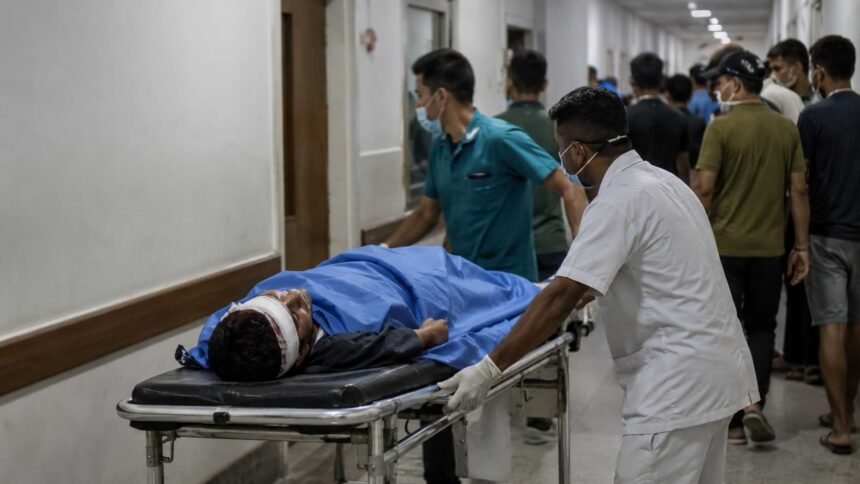
Armed groups in Leilon Munlui and Konsakhul villages in Manipur’s Kangpokpi district clashed over a few bullets before dawn on Monday, injuring three men from the Kuki tribe. Under the escort of Army and CRPF, they were rushed to the only hospital in the region that was equipped to treat such injuries and it was called the Regional Institute of Medical Sciences (RIMS) Imphal. A massive mob had gathered around the hospital gates within hours and the police had started firing tear gas gas to disperse the rioters who were angry at the hospital bringing in wounded Kuki patients to the Meitei capital, reports Outlook India.
A hospital, a place which should be a neutral ground even during war, has now become a place of ethnic confrontation revealing the dire situation of Manipur more than three years after the start of the conflict in May 2023. This is not a one-time occurrence. The latest in a series of ticking time bombs that the Bharatiya Janata Party-led central government has failed, or failed to make the effort, to stop.
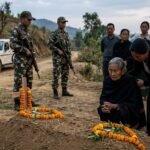
The RIMS stand-off was not an isolated incident. A Kuki village volunteer was shot dead by the insurgents in fresh violence in Sadar Hills area just two days ago on June 13, India Today NE reports. The wider picture is darker: The brutal killing of six Naga civilians, who had been abducted from a forest near Kharam Vaiphei on June 10, just a week after the incident, thrust the Joint Tribes’ Council Manipur into an indefinite shutdown of its operations throughout the Zeliangrong area and had authorities scrambling to deal with the fallout.
Back a little bit and it’s obvious.Step back further and it speaks for itself. Twenty members of different Kuki and Naga tribes were abducted by rival armed groups after the ambush of three church leaders on 13 May, which killed three of them while they were attempting to negotiate peace between the tribes, Amnesty International said. Six Naga hostages were still missing even after a partial prisoner exchange, which was completed weeks later as their mutilated remains were found. This is the texture of President’s Rule in Manipur which President’s Rule was imposed on Amnesty in February 2025, leaving a tacit acknowledgment that the state government had lost its governance capacities.
What are the changes since then? On February 4, 2026, a new BJP government was sworn into office, following the revocation of President’s Rule by the Centre, with Yumnam Khemchand Singh being sworn in as Chief Minister, PM Narendra Modi expressed his confidence that the new government will bring ‘development and prosperity’. Four months later, the state’s single major trauma center is being overrun by mobs, villages are being attacked by militant groups, and the 2023 displacement has effectively yet again come to a standstill as tens of thousands remain in relief camps, unable to return to their homes.
This paralysis has manifested itself in concrete and steel, and now it has become apparent at an economic cost. The bandhs and economic blockades are linked directly with the current conflict and have come in the way of the progress of the construction work in the New Integrated Terminal Building (NITB) at Imphal International Airport, an important infrastructure project, India Today NE notes. As the state explodes, the same news cycle on June 15 saw a government outreach event celebrating ‘12 years of Modi-led NDA government’ which juxtaposed sharply with the picture on the ground in one of the BJP’s own states, critics allege.
The failure trend is familiar. In 2023, more than 100 persons lost their lives and over 60,000 were forced to flee their homes within weeks, even as the violence continued to rage, including one incident that was reported just hours before Congress leader Rahul Gandhi made an appearance at the city of Imphal, the BJP-led state government unable to stop or at least adequately respond to the violence, as the Deccan Herald reported. So it goes after three years, two changes of government and one President’s Rule: gunfire, casualties, hospital sieges – and statements of concern from Delhi.
The Centre’s policy of ‘heavy security’ and the regular rotation of politicians have failed to bring security or reconciliation to the country. Villages on both sides accuse the central paramilitary forces stationed in them of either failing to protect them or of deliberately allowing the militants who attacked the villages near a CRPF post, which was just 100 metres away, to operate. Irrespective of whether or not that particular claim is true, it is certain that allegations have become commonplace against forces deployed by Modi’s own government.Even if it’s not that specific claim, it’s apparent that allegations are now commonplace against forces deployed by Modi’s own government in three years of central management.
Today, when the people of Manipur get admitted to any hospital, they are subject to a security check; when they are murdered, they are swept from news reporters’ itineraries the following week; and when they are to see ‘normalcy’, that’s measured on the days of absence of bandh. BJP had pledged good governance and ‘muscular’ home security. Today, in a state that its own party rules, that promise is being put to the test in the corridors of RIMS and it is being broken.