
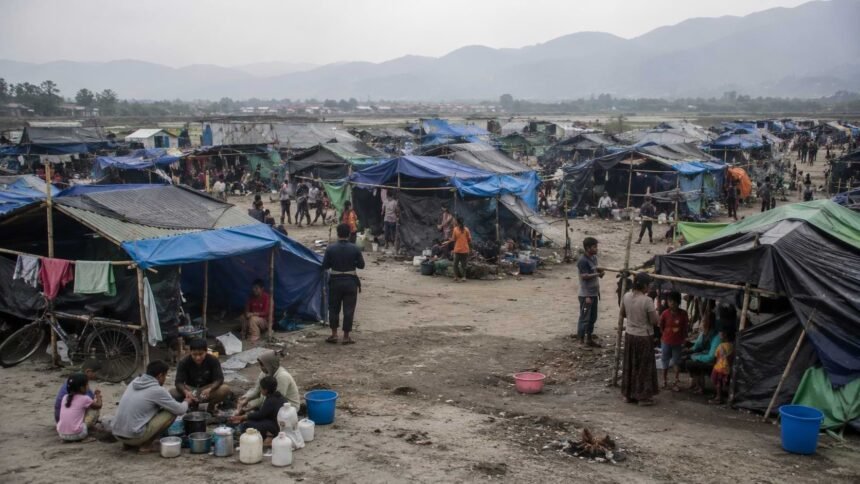
In 2026, India’s longest ethnic crisis worsened, introducing perilous new divisions, establishing a new administration -while leaving 60,000 individuals still residing in tents.
On the morning of April 7, 2026, in a narrow street in Tronglaobi, Bishnupur district, a five-year-old boy and a five-month-old baby girl lost their lives. Their mother rested fatally injured alongside them. No one took responsibility. No one was detained. In a matter of hours, the valley exploded barricaded roads, flaming cars, closed shops, and a curfew that no one thought would last.
Manipur, now three years into its most destructive ethnic clash, had fallen again. The murders were not an exception. In the harsh language of this conflict, they represent a clause in a continuous dialogue of brutality -one that commenced on May 3, 2023, has resulted in the deaths of over 250 individuals, forced more than 60,000 people to flee, harmed nearly 400 churches and defaced 132 temples, and has thwarted every effort at resolution with a tenacity that should shame the world’s largest democracy. “Thousands of guns stolen from police armories during the early months of the conflict continue to circulate — a hidden arsenal that renders every dispute possibly deadly.”
A new government, the same old fire
February 4, 2026, was intended to signify a pivotal moment. Following almost a year of President’s Rule enacted after former Chief Minister N. Biren Singh stepped down in February 2025 due to audio recordings suggesting, with 93 percent certainty from a forensic lab, that he had instigated the violence himself the Centre set up a new elected government. Yumnam Khemchand Singh, a Meitei and BJP leader, took the oath of office as Chief Minister. In a move of symbolic inclusion, Deputy Chief Ministers were appointed by Kuki and Naga politicians. The alliance was meant to serve as a connection. The bridge fell down before it was finished. Within three days, demonstrations broke out in Kuki-Zo-majority Churachandpur and Ukhrul against the three Kuki BJP representatives who had aligned with the government. A confrontation between Tangkhul Naga and Kuki youths from adjacent villages sparked a fresh wave of conflicts. The establishment of the government had turned into a challenge. The struggle did not cease for the initiation of peace.
The third party: when Nagas enters the equation
What renders the crisis in Manipur particularly perilous in 2026 is that it transcends being merely a two-community struggle. The initial divide Hindu Meiteis from the Imphal Valley versus Christian Kuki-Zo hill tribes has been accompanied by a third, more ancient rift. Beginning in early 2026, the resurgence of Kuki-Naga conflicts, which had been inactive for many years, has significantly complicated the situation. On May 13, armed insurgents attacked vehicles transporting individuals from a Thadou Baptist Association in Kangpokpi. On May 31, a villager from Naga was wounded in an alleged assault related to a disagreement over a water pipeline. On June 5, three Kuki civilians lost their lives, and seven homes were set on fire in Loibol Khullen village. The NSCN-IM and the Zeliangrong United Front Kamson have been involved in multiple events. According to a senior security official speaking to Al Jazeera: “Insurgent groups from all three factions – Meitei, Kuki, and Naga- are involved.” “However, in reality, it is very challenging to distinguish.”
A governance failure in plain sight
The Northeast of India has experienced insurgent movements in the past. What sets Manipur apart is the almost complete breakdown of the notion of the state as an unbiased guardian. The Meitei community claims that hill militants are freely attacking valley civilians. The Kuki-Zo community references recorded proof – videos, testimonies, forensic reports — indicating that state forces either ignored or, more alarmingly, assisted in assaults on their villages. The Nagas perceive themselves as trapped between two warring groups and a central government that has long used tribal divisions for its own ends. Each community holds a valid complaint; each community likewise possesses armed individuals who have turned it into a weapon. The “double engine” model in New Delhi, with a BJP government at both the state and central levels, has led to not a faster peace but heightened paralysis.
What must happen now
Three elements are essential if this crisis is to conclude. Initially, a reliable, impartial mediator neither a BJP politician nor a current IAS officer should initiate official discussions among all three communities at the same time. The structure of the conflict is triangular; peace talks that focus on just one pair will be unsuccessful. Second, the countless stolen weapons need to be retrieved via a verified, time-sensitive disarmament initiative with tangible incentives and actual repercussions. Third, the 60,000 displaced individuals – who have now endured three monsoons in relief camps must be sent back to their villages with international humanitarian oversight. Without restitution, there is no resolution; there is merely a forgetting that permits the subsequent slaughter to occur as planned. Manipur is not a marginal issue. It serves as a reflection of each assertion India makes regarding pluralism, federalism, and adherence to the law. The baby who died in Tronglaobi had no political affiliations, no ST request, and no land dispute. She possessed just one life, which the government was legally required to safeguard. Three years later, that duty continues to be appallingly unfulfilled. The blaze in Manipur requires no additional fuel — it urgently and seriously needs someone ready to put it out.