
In the lexicon of the art of the state, there is no such thing as unintended silence. If the head of state of a nation will not speak, will not visit, and will not act, then that nation’s silence is a political statement more harmful than anything that they could say. The current ethnic crisis in Manipur, a Northeastern Indian state with a large number of tribal residents, is one of the most egregious instances of flagrant governmental neglect in recent Indian history. The silence of Prime Minister Narendra Modi in the face of ethnic carnage that has engulfed India, leaving more than 260 people dead, nearly 60,000 displaced, and almost 5,000 homes razed is not a failure of information, it is a calculated abandonment of the most vulnerable tribal communities of India.
The crisis began with ethnic violence in May 2023 between the majority group of Meiteis living in the Imphal Valley and the major group of Christians of Kuki-Zo tribes living in the hill districts. The immediate reason was a Manipur High Court order, which seemed to confer the status of a Scheduled Tribe on the Meiteis, a tribe that historically has been underprivileged. This to the Kuki-Zo tribes meant a threat to their existence given the dominant valley tribes’ access to the hill lands and reserved government seats. It was not a riot but a systematic ethnic conflict that followed. But the word was still spoken loud and clear in the most turbulent of his early years, when Modi was silent. The Prime Minister uttered not a single word for more than two months, during which villages were set alight and women were marched around in the nude by mobs. It was only when a video of the assault went viral and sparked outrage throughout the country that he finally broke that silence for the wrong reasons: under pressure from the public.
In principle, the constitution of India was intended to stave off such abandonment. The Sixth Schedule of the Constitution has established autonomous governance system for tribal communities in the north-eastern States including Assam, Meghalaya, Mizoram and Tripura, and Article 371 (C) grants special protection to the hill districts of Manipur. It is not just cosmetic measures, it is solemn pledges given to communities that agreed to stay in the Indian Union if they are protected in their territory, their identity and their autonomy. But the Modi government has hardly spoken and is even less active as far as Manipur is concerned. There was no national commission set up. No Reconciliation Framework was offered. The central government’s response troop deployments, arms recovery drive, and bureaucratic funding allocations made a very political and ethnic crisis appear as a law-and-order issue, and intentionally neglected the underlying structural issues of land rights, tribal identity and equitable representation that are at the heart of the crisis.
Ideological foundations of this silence should not be ignored. The Meitei community are mainly Hindu whereas Kuki-Zo communities are mainly Christian. Modi’s party, the BJP, has always been a party of the Hindu majority. State-level BJP government under Chief Minister N. Biren Singh faced wide allegations of partisan bias in comments allegedly leaked from a tape that latter was found to be 93% genuine by forensic experts, and which accused the Congress of orchestrating communal violence. Modi’s decision to not censor his own party’s chief minister, or even visit the state during the worst days of violence, poses an uncomfortable question was it simply negligence or a political protection given to an ally, at the cost of a tribal minority?
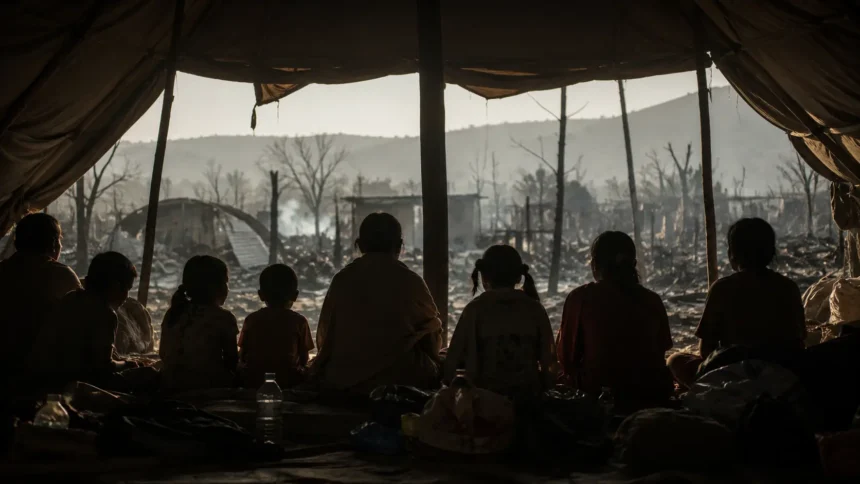
The repercussions of this extended silence are not theoretical, they are real: in human lives, in shattered communities. More than 60,000 people are still displaced. Churches, temples and whole villages have been flattened. This generation of the Kuki-Zo has been born in relief camps without school, where they lack security and childhood. This is fittingly described as “normalization of abandonment” by The Indian Express. On the eve of Singh’s final resignation in February 2025, after 20 months of crisis, no top official or militia leader had been brought to book. President’s Rule was applied, but the Manipur under the central administration was already splintered and beyond repair. The first visit by Modi to the state since the violence began was in September, in excess of two years after the carnage, and it provided no accountability, apology or justice, only development project launches.
The critics of the Modi government will argue that there is engagement in the form welfare schemes, higher budget allocation for tribal communities and eventual deployment of President’s Rule. The following arguments are not sufficient. Political will is not to be replaced by welfare spending. Budget lines cannot rebuild burnt churches, or bring back the dead. When implemented two years late, without any justice system, President’s Rule is a mere administrative reaction to a moral disaster. Long neglected, the Northeast is India’s geographically most remote and ethnically most complex and politically most inconvenient region. But Modi’s silence did not cause that neglect it has institutionalized it, and that is a legacy of his government that will define its impact in the region for decades. It is not governance that speaks, it is the loudest form of silence when the Prime Minister of 1.4 billion people cannot find the moral urgency to visit a state which has been in ethnic war for more than 2 years.
The demand of the tribes from Indian state was nothing more than the protection they had offered to them. All they heard were the voices of silence a Prime Minister travelling to foreign capitals and organising rallies around the country while their houses burned, a Parliament which went to work on other things, and a national media who had had enough of a story that was not in keeping with the ruling establishment. A democracy is not judged by its treatment of the strongest, but its treatment of the weakest. To that extent the record of the Modi government in Manipur is a huge failure of democracy a failure that will not be erased from memory even the memory of the present