
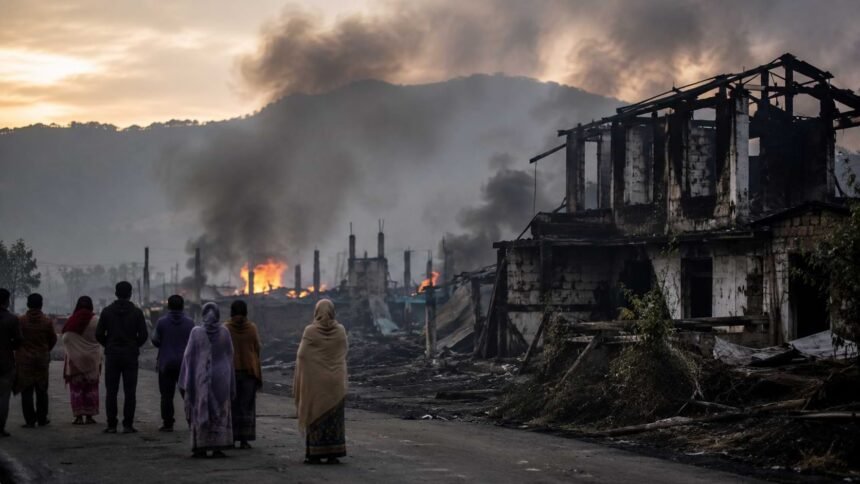
There is nothing Manipur can claim as its own story in Delhi to be owned after three years, 250 lives lost and nearly 60,000 people still living out of the relief camps. In Imphal West, suspected Kuki militants, on July 11 this year, set ablaze abandoned Meitei houses in Kanto Sabal. It had little impact on the national news stream. In miniature, that is Manipur since May 2023 violence has become too common to be news.
These figures ought to shame the so-called world’s biggest democracy. The number of people displaced, according to government data, is more than 58,800 and many are in their third year of living in prefabricated camps where sanitation is inadequate, education is interrupted and they have no realistic plan to return home. Civil society groups estimate that is a bigger number. It is one of the most militarized areas in South Asia, with over 250 companies of central armed police stationed in the state a remarkable confession that the Indian state is in fact in the process of dividing Manipur into ethnic spheres it cannot rule.
This is not so different from India’s other interstate conflicts in terms of the scale of violence, because Kashmir and some central parts of the nation have seen more severe violence over a longer period; rather it is in terms of the quality of silence surrounding it. Two young children were killed by a bomb (which appeared to be an improvised rocket propelled grenade) in Bishnupur in April and when the news of the incident reached New Delhi, the response was procedural instead of political. In the height of the violence, there was no prime ministerial visit to the state, while the prime minister made public appearances in Sikkim and reaffirmed comments about the conflicts thousands of kilometers away. The government that can speak eloquently of ceasing hostilities in West Asia has found it hard to speak of a war that rages on its own territory.
The traditional perspective of Meitei versus Kuki-Zo, valley versus hills, Hindu versus Christian is correct but limited and perhaps more convenient for the politicians who will want the narrative to be interpreted as an ancient tribal animosity rather than a certain set of administrative failures. It was a procedural observation by the Manipur High Court in 2023 which prompted the state to look at granting Scheduled Tribe status to the Meitei people who are already in majority in the valley in terms of political and economic power. In the hill districts, it was seen as an attempt to weaken the land, and job guarantees which form the last real barrier to Meitei economic domination. It’s a squabble over land law, reservation policies and constitutional protection and that’s barely a dispute, let alone a war, between a working state.
Rather, the state government headed by then Chief Minister N. Biren Singh was alleged by a Kuki civil body of fanning the flames, citing leaked audio files which a forensic lab allegedly linked to him with 93 per cent certainty. He was forced to leave in February 2025 under threat of a no-confidence motion, not because he accepted the blame for the bloodshed. He only left because he was threatened with a no-confidence motion – and he did not accept responsibility for any bloodshed in the interim period of twenty months. Then there was the President’s Rule, a tacit center confession of failure of the state apparatus. It was canceled one year later, February 2026, when a new chief minister was appointed, but a change of face is not a change of policy, and the violence of this July is ample proof.
Without a doubt, one of the most disturbing facts of this entire conflict is the accountability price: virtually none. Police and paramilitary armories were robbed by thousands of gunmen and weapons are still being used in the early weeks of the violence. Armed groups affiliated with the Meitei, Kuki-Zo and even Naga groups are now making overlapping and competing claims to territory and the security forces themselves concede that it is often difficult to distinguish between civilians and combatants. For three years there have been no prosecutions against any senior member of militia groups with known ties to the security establishment. If they can’t or won’t identify one of the hundreds of “unidentified assailants,” then it’s not a fog of war. If it was a matter of choice, it would be that they wanted to clear the fog, but they didn’t want to subject anyone to consequences.
This is where the government’s defenders are apt to point to a fair one: Manipur’s terrain, its 400-kilometre porous border with Myanmar, the flow of arms and fighters from across the border and the complexity of thirty-four tribal groups with differing and sometimes conflicting claims make it an unusually tricky problem, rather than just a lack of will. That’s true. No government in the world resolves this sort of ethnic conflict without mishaps, and to suggest otherwise would be a lie. Difficulty, however, is not the same as effort, and three years of no credible process for truth and accountability, no real disarmament, and no high-level political involvement is not the record of a government that is trying to solve an impossible problem: it’s the record of one that has decided that the political price of a durable peace is too high to pay, and the price of a slow-burn crisis they can only look on too long to pay the price at the ballot box.
It is the calculation which is the actual scandal. Not that ethnic conflict can be easily solved it can indeed be easily solved but that a state can burn for three years, in the presence of a fully functioning press and a government that is resource-rich and yet does not produce any kind of sustained national reckoning that will bring about a different set of results. There were never any shortages of facts in Manipur. Unfortunately, it lacked a country that would continue to read them.