

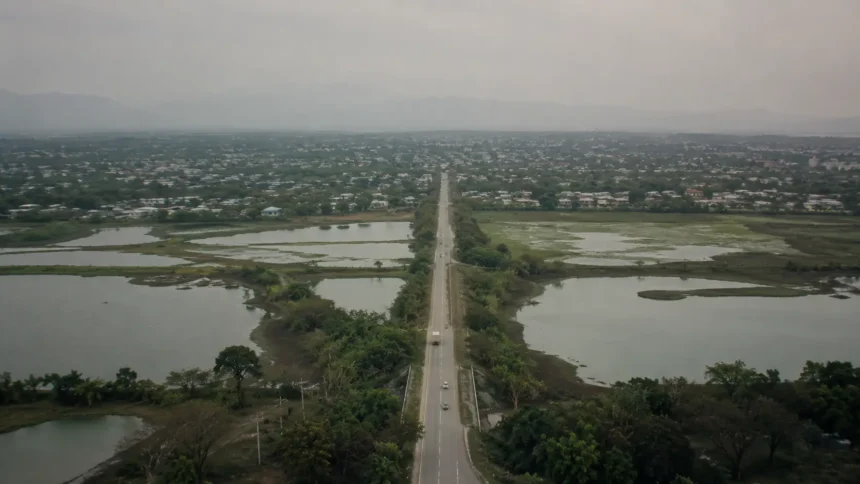
Geography is not just about maps for millions of people in Northeast India, it’s a question of life and death. The area is still linked with the rest of India by a fragile corridor in northern West Bengal, which is aptly named the “Chicken’s Neck” or Siliguri Corridor. The narrowest section of the corridor is just 20km wide. But it is a thin thread that lets through the military supply lines, fuel pipelines, trade and supply routes, internet cables, railway tracks, and emotion that connects over 50 million people of the Northeast with the rest of India.
A mere geographical inconvenience on the map has now become one of India’s most serious strategic concerns. Northeast today is not only fearful of insurgency/ethnic conflict. The idea of being cut off from the rest of the world almost overnight if a geopolitical event, border dispute or collapse occurs is what it is all about.
The northeast is gradually becoming the most sensitive border of India.
The need for the Chicken’s Neck has markedly increased in 2025 and 2026. The Indian authorities now take the threat seriously and take part in the recent fencing exercise at the sensitive areas of the border in the Siliguri region. In a recent development, West Bengal recently handed over a massive chunk of land to the Border Security Force to get it fenced and military infrastructure built in the area close to the corridor.
This increasing militarization is not taking place in isolation. The Siliguri Corridor is caught up in one of Asia’s most sensitive geopolitical triangles. The strategically important Chiumbi Valley in China is just 100 kilometers away in the north and west are Nepal and Bangladesh in the south. China’s strategic Chiumbi Valley is just 100 kilometers away in the north while Nepal and Bangladesh are in the south.
Indian strategists have been worried over many years that the corridor will be at risk in the event of a serious military confrontation with China. The fear was particularly evident during Doklam standoffs in 2017 when the Chinese military presence near the India-Bhutan-China border brought the issue of the Northeast’s vulnerability to the fore.
But the threat today is no longer purely military. The more profound problem is the psychological and political one.
For many in the Northeast it represents their ‘conditional’ relationship with the Indian state, the ‘Chicken’s Neck’. The region still relies on a single weak link for connection to the mainland, after decades of promises regarding integration and development. Insecurity arises from dependence itself.
In other states, such as Manipur, Nagaland and Mizoram, this sense of isolation has been exacerbated by high levels of ethnic tension and instability for long periods of time. The Northeast as a whole, and Manipur in particular, is now a testament to the dangers of internal conflict and increasing the strategic vulnerability of the region. At least 58,800 persons are reported to have been displaced, thousands of houses razed and hundreds killed since May 2023 when ethnic violence broke out between the Meitei and Kuki-Zo communities.
Three years later, the violence did not come to a full stop. It has only been transformed into a low-grade war. In 2026, there are still reports of abductions, armed confrontation, disappearances and ethnic conflicts in the various hill and valley areas of Manipur.
The instability has repercussions beyond Manipur. Each long-drawn crisis in the Northeastern region validates the apprehensions that the region is not in Delhi’s radar. The Indian state’s policies are becoming more security based, and many residents feel it is looking at the region primarily from that perspective.