
In 2016, the India-North East border areas of Nagaland and Manipur have once again becomea flash point. What had previously been regarded as isolated, ethnic and security issues in each state are now beginning to merge, as localised militant activity, community self-defence initiatives and inter-state tensions converge to create a volatile environment. It is a region where the conflict is no longer a localised affair but is gradually seeping into neighbouring areas.
The conflict in Manipur, which started in 2023, is the main source of regional instability. In 2026, despite political efforts and bureaucratic changes, Meitei-Kuki-Zo clashes continue to rage. While major skirmishes have diminished from the early stages of the conflict, skirmishes of targeted killings, intermittent gunfire and armed skirmishes continue to be reported in various districts. The last three years of security estimates indicate hundreds of fatalities and massive displacement, placing it among India’s longest running internal conflicts.
This ongoing conflict has spilled over into neighbouring districts of Nagaland, especially in districts such as Mon, which is geographically and culturally close to Manipur. The open border facilitates easy movement of people and the spread of rumours and misinformation. On a number of occasions, local clashes have flared up as a result of the presence of armed village defence forces, resulting in a spiral of mistrust and retaliation across administrative borders.
Within Nagaland, the last 10 years have seen a marked decrease in large-scale insurgency, but it is not immune to regional influences. Although large-scale insurgency has declined as a result of peace agreements and surrender, there are still small armed units and community protection groups operating in places. These are often self-organised for defence, but can play a role in igniting inter-community conflict, particularly when regional tensions shape local narratives.
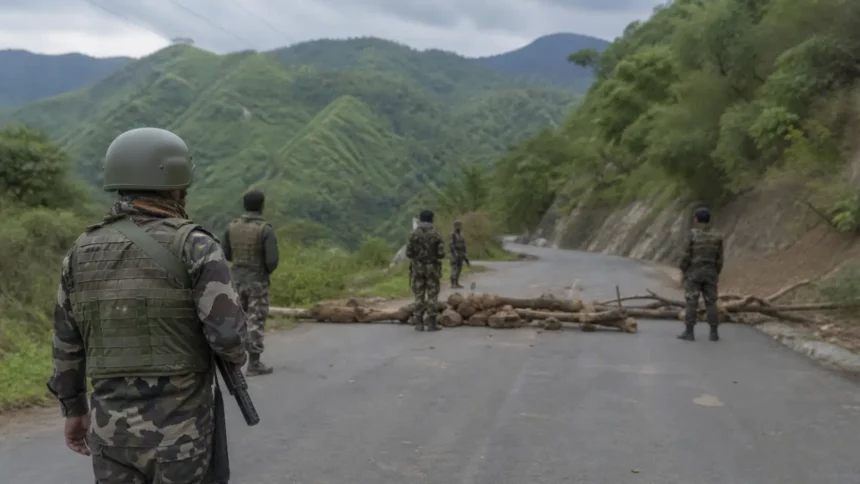
In 2016, security forces have raised alarms that armed groups are moving with greater ease along the Manipur-Nagaland-Myanmar border. The rugged geography and lack of monitoring capacity facilitates movement that is difficult to track. This allows for the risk of escalation, even from small incidents, if they are viewed through the prism of ethnic or political differences. This means that localised tensions could be incorporated into the regional narrative of conflict.
Another crucial factor of instability is the emergence of localised armed or semi-armed groups. These groups, unlike traditional insurgents with well-established hierarchies, are often not coordinated or disciplined village volunteers or security forces. Some aim to defend their villages, but the absence of centralised control and coordination raises the potential for misunderstanding and unintentional escalation. In border communities, this has resulted in clashes over everyday disputes.
The ongoing turmoil has compounded humanitarian consequences. Families living in affected areas have been subjected to sporadic displacement, loss of livelihoods and basic services. Educational institutions and markets in high-risk areas operate intermittently based on security threats. For many people, particularly in rural and hilly regions, uncertainty is a way of life. Even in the absence of active conflict, the looming threat of violence is ever-present.
At the administrative level, the problem is a complex one for both state and central governments. Geography, multiplicity of ethnicity and jurisdictions complicate enforcement and peacebuilding measures. Law enforcement may act in response to events, rather than in anticipation. Also, the overlap between civilian populations and armed forces make targeted responses challenging, as civil self-defence groups are difficult to separate from militant groups.
The major concern in 2016 is that the unrest in the Nagaland-Manipur border area is increasingly interdependent. Rather than being able to solve issues individually within states, conflicts are increasingly shaped by events in the other state. This means that an incident in one district can create a reaction in another, and so on, in a process that is hard to control.
And finally, the incident highlights the tenuous balance in India’s North East. While Nagaland has seen steps towards peace and Manipur struggles to maintain stability, the intermingling of the two states illustrates that peace in one state cannot be separated from peace in another. Only through collective political engagement, community building and sustained engagement can long-term peace be achieved.
Until then, the Nagaland-Manipur border will continue to be a place of both peace and conflict, a reflection of the past and present, of identities and unresolved issues.