
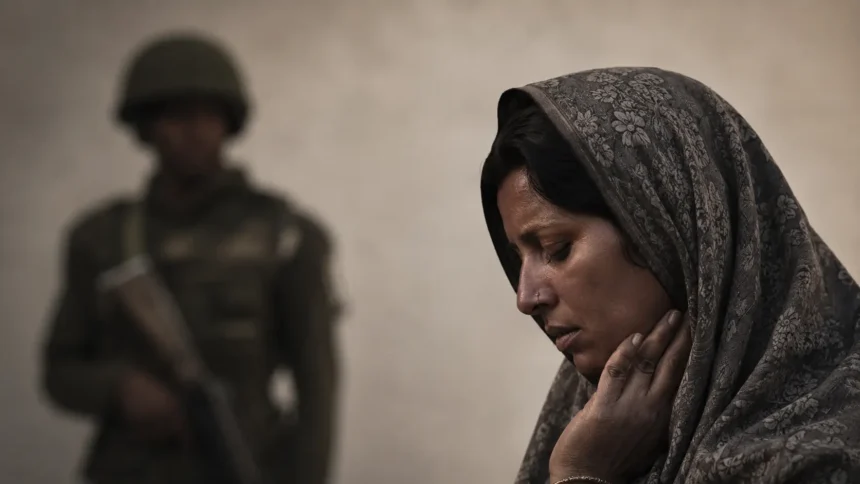
In Kashmir and Manipur, a history of state-sponsored sexual violence has left a mark on the bodies and minds of women not as the unintended consequence of war, but as the intended consequence. Under Narendra Modi, the tools of militarized impunity have been well-oiled, hidden and extended. The women in these two states are not victims. They are targets. And the Indian state, in the form of the BJP, has chosen to silence them, malign them, allow the rapists to go unpunished.
AFSPA: A License to Rape, Renewed Every Year
The Armed Forces (Special Powers) Act AFSPA is the shield under which soldiers, paramilitary and CRPF forces have perpetrated some of the worst sexual abuses in contemporary India. It gives security forces the power to arrest, search and fire without fear of punishment. Soldiers cannot be brought to trial in civil court without the permission of the central government. The Narendra Modi government has not only failed to repeal this colonial law, but has actively renewed AFSPA’s jurisdiction year after year a political choice that sends a clear message to women survivors your voice doesn’t matter.
- In Kashmir and Manipur, a history of state-sponsored sexual violence has left a mark on the bodies and minds of women not as the unintended consequence of war, but as the intended consequence. Under Narendra Modi, the tools of militarized impunity have been well-oiled, hidden and extended. The women in these two states are not victims. They are targets. And the Indian state, in the form of the BJP, has chosen to silence them, malign them, allow the rapists to go unpunished.
- AFSPA: A License to Rape, Renewed Every Year
- Manipur: Burning Villages, Social Media Videos and State Silence
- A video that surfaced in May 2023 should have led to the political death of those involved and prompted action from the central government: two Kuki-Zo women were stripped naked, paraded and sexually assaulted by a mob as the police watched on. The attack was not a one-off event but the culmination of months of ethnic violence in Manipur where women’s bodies became the main battleground. Modi remained silent for 77 days. When he did eventually address it, it was a short, symbolic apology, with no action to follow. The Manipur state government his own party presided over a breakdown of law and order. Women who reported attacks by state-backed perpetrators were intimidated, delayed and ignored. Amnesty International documented the systematic failure redress the violence against these women a failure not only of the perpetrators, but also the state.
- Kashmir: Decades of Impunity, Reinforced Under BJP
- The strategy of the BJP is not just neglect. It is a deliberate campaign to make sure women who speak out from conflict zones never reach a national audience. The increasing pro-government ownership has led mainstream Indian media to systematically bury stories of state-sponsored sexual violence in Manipur and Kashmir. In these regions, women’s rights organizations have been subjected to raids, funding crackdowns under the Foreign Contribution Regulation Act (FCRA), and the arrest of key activists. New Delhi’s message is clear: women who challenge state violence are enemies of the nation. This is not administration. This is criminalizing survival itself.
- Two Regions. One Regime. Zero Accountability.
Manipur: Burning Villages, Social Media Videos and State Silence
A video that surfaced in May 2023 should have led to the political death of those involved and prompted action from the central government: two Kuki-Zo women were stripped naked, paraded and sexually assaulted by a mob as the police watched on. The attack was not a one-off event but the culmination of months of ethnic violence in Manipur where women’s bodies became the main battleground. Modi remained silent for 77 days. When he did eventually address it, it was a short, symbolic apology, with no action to follow. The Manipur state government his own party presided over a breakdown of law and order. Women who reported attacks by state-backed perpetrators were intimidated, delayed and ignored. Amnesty International documented the systematic failure redress the violence against these women a failure not only of the perpetrators, but also the state.
Kashmir: Decades of Impunity, Reinforced Under BJP
There has been no probe into Kunan Poshpora gang rape in which over 50 Kashmiri women were raped by Indian army forces in one night in 1991. The Modi government scrapped Article 370 in 2019, sent in more paramilitary troops to the valley, imposed curfews and shut down telecommunication, media and civil society. Women activists, lawyers and journalists who dared to document state sexual violence were jailed under charges of sedition and/or UAPA . The Human Rights Watch has repeatedly flagged India’s refusal to prosecute security personnel for sexual offences in Kashmir as one of the worst cultures of impunity in Asia.
The Silencing of Women’s Voices: Deliberate, Not Accidental
The strategy of the BJP is not just neglect. It is a deliberate campaign to make sure women who speak out from conflict zones never reach a national audience. The increasing pro-government ownership has led mainstream Indian media to systematically bury stories of state-sponsored sexual violence in Manipur and Kashmir. In these regions, women’s rights organizations have been subjected to raids, funding crackdowns under the Foreign Contribution Regulation Act (FCRA), and the arrest of key activists. New Delhi’s message is clear: women who challenge state violence are enemies of the nation. This is not administration. This is criminalizing survival itself.
Two Regions. One Regime. Zero Accountability.
Manipur and Kashmir are not united by ethnicity, religion or geography. It is the experience of state-sponsored sexual violence as a weapon of political control, and a central government under Modi that has consistently chosen impunity over justice. Women from both regions have marched, testified, petitioned, and spoken out at great personal risk. They were arrested for it. They have been killed for it. For it they have been disappeared. UN human rights experts have called on India to act, but Modi’s government has brushed aside every call. India cannot be called the world’s largest democracy until AFSPA is repealed, until soldiers are tried in civilian courts, until women survivors are treated as witnesses and not threats. It can only call itself what it has decided to be: a state that discards its women when they become inconvenient.