
For many years, Indian classrooms were spaces where the “Idea of India”a complicated and multicultural India was taught through the perspective of shared struggles and synthesis. But today, the narrative in our textbooks is changing. From primary schools to prestigious universities, a quiet but thorough transformation is happening. Sometimes called “Saffronization,” it is a process of harmonizing the national curriculum with a particular ideological narrative that is moving from a history of diversity to one of a more homogenized, nationalist past. By the time we get to 2026, the magnitude of these changes can no longer be considered a topic for debate it has become a matter of their documentation.
The NCERT “Rationalization”: A Surgical Strike on History
The change has been made under National Council of Educational Research and Training that has full support for this. What was initially a “rationalization” measure to lessen the pressure on students after COVID-19 pandemic has turned into a permanent rewriting of the Indian narrative?
The Removal of the Medieval Age
A shocking erasure is in the curriculum if 7th class which do not includes about Delhi Sultanate the entire Mughal Empire has also been removed. Besides, the focus chapter “Kings and Chronicles: The Mughal Courts” in Class 12 is not there now. According to the critics, this is far from “reducing load”instead, it is like treating 500 years of Indian history as a simple bystander here or, even worse, those years of “foreign occupation” to be “such a period” only. By omitting the administrative, architectural, and cultural contributions of this era, students are given a gigantic temporal gap ignoring the fusion of Indo-Islamic culture. Erasing the “Uncomfortable” Truths the alteration is not limited to the medieval history; the recent history has also been trimmed.
The Exclusion of Gandhi from Historic Roots
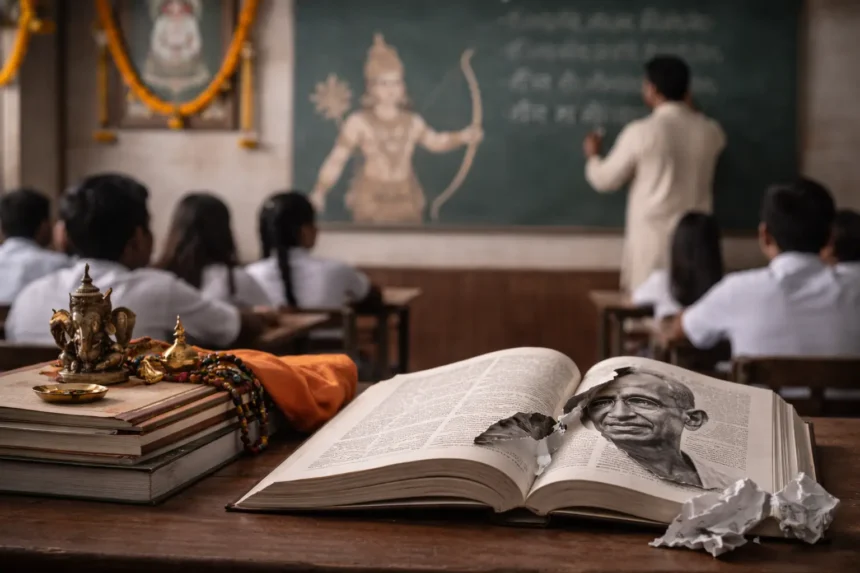
Not even the books misses about the Gujarat Riots in 2002. It totally ignores the historic figures who has great contributions in history. For instance, Mahatma Gandhi has been totally removed and the responsible for his murder Nathauram Godse has no words in the books. Also, there is no talk about the ban that has been made against RSS, the extremist organization that was involved in Gandhi’s murder. Sociology and politics classes don’t talk about it anymore. Instead, they say “1,000 persons were killed” instead of specifying mostly Muslims died. That hides how violent and sectarian it really was. Babri Masjid gets replaced with “a three-domed structure.”
All talk of the ram Rath Yatra and the fire it lit in communities fades into thin air. Meanwhile, something new is rising: Indian Knowledge Systems. The NEP 2020 pushes hard to weave Vedic wisdom into math, science, even history lessons. It’s not just theory – it’s meant to become part of daily teaching. This shift isn’t neutral; it shapes what students learn first hand. What happens when truth gets buried under tradition? You start seeing only one version of reality shaped by policy and power.
The “Out of India” Theory
New history textbooks are increasingly supportive of the native Aryan theory, which asserts that Vedic civilization gave birth to the world’s culture, on the other hand, they largely ignore the archaeological and genetic findings pointing out migrations from the Steppes. The UGC and the Battle for the Campus This change is not only affecting school children. The University Grants Commission (UGC) has recently implemented new “Equity Regulations” and syllabus drafts for 2026, which have caused a massive outcry across the country.
The Equity Debates
The UGC Bill for 2026 has changed the definition of “caste-based discrimination” so radically that it has raised the concern that the existing institutional safeguards for SC/ST and OBC students might be weakened. Opponents say that by making grievance redressal systems central, the government is getting even more leverage over campus dissent. The overall funding for social science research is changing. More funds go to projects that promote “Nationalist History” or “Traditional Values,” whereas administrative barriers are erected for the research of caste, gender, and minority rights.
Conclusion
The Cost of a Filtered Past Education ideally should open up a view to the outside rather than shut one in. If we continue to filter out “unwelcome” historical figures, depict communal violence in a sanitized manner, and put ideological pride on a higher pedestal than critical inquiry, we may end up with a generation that is practically “history-proof”. Besides, a country that is so scared of its own complexities that it refuses to acknowledge them won’t be able to learn from its errors. While “saffronization” may provide cultural comfort to some, it does so at the expense of academic excellence and the multifaceted truth that India is known for. If we keep on rewriting our history, it might turn out that the future we are creating is groundless.