

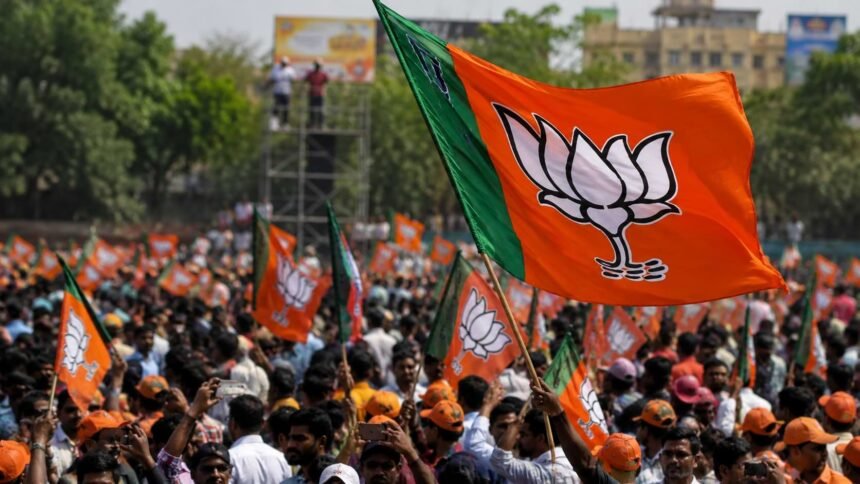
As the dust settles on the 2026 Assam Legislative Assembly elections, political analysts are busy dissecting the Bharatiya Janata Party’s (BJP) sweeping victory. It is not easy to have set a new record by winning 82 seats out of a total of 126. Besides various aspects like Chief Minister Himanta Biswa Sarma’s leadership, his welfare schemes, the strategic mistakes made by the opposition, the one factor that clearly stands out is the 2023 delimitation exercise.
The basis of this segmentation of the electoral constituencies was the 2001 Census that extensively changed the demographic composition of the entire State. But as political researcher Nayan Moni Kumar points out in his recent article, it is an oversimplification to attribute BJP’s victory only to delimitation. The key to discovering why delimitation became a very successful tool for the BJP lies in questioning the decade-long socio-political engineering that paved the way for this change in the institutional system..
The Delimitation Exercise: Transition or Continuity?
Many people have seen the 2023 Assam delimitation exercise as a mere administrative move to reduce the voting power of the minority community. Yogendra Yadav, a political scientist among the critics, even stated that Indian elections nowadays are a shift from “doubtful to dubious.”
Yet, Assam viewed with “continuity” helps a lot to understand it properly. The changes in the electoral map were not a sudden solution; they were the natural progression of a political plan that was started more than ten years ago. At the national scene this was clear through the debates over CAA-NRC-NPR. In Assam, it took the form of a thorough remaking of the “demos” (the population). BJP has almost totally changed what it means to be Assamese, by linking it very strongly to the Hindu religion and thereby making the Muslim minority the ultimate “other.”
From Regional Pride to Hardcore Hindutva
It is So necessary to trace back the historical roots of BJP’s 2016 state victory to understand why the new electoral map heavily favored them. The BJP came to power on the narrative of the “Last Battle of Saraighat”a campaign framed as a fight to protect indigenous rights against illegal immigrants. The local Assamese society largely read this not as religious polarization but as regional identity politics. As Akhil Ranjan Dutta (a scholar) put it, the state, at first, did not perceive the “saffron hue” of this movement.
The mask of soft Hindutva had totally fallen off by the 2021 Assembly elections. Instead, the ruling party presented a hardcore ideological agenda. The political slogan went on to describe a “clash of civilizations” between Assamese (Hindu) cultural elements First and “Miya/Muslim” civilization, on the other. Basing on different political tropes like “Miya poetry” and “Civilizational enemies”, the BJP also greatly exaggerated occurrences like “Love Jihad” and “Flood Jihad”. In fact, though the buzzwords kept changing, the main enemy stayed the same: the Muslim community.
The “Ethnicization” of Assamese Hindus
This leads us to the fundamental question: how did the BJP reap such great results from the Assam delimitation?
Electoral boundaries can only be effective when the voting blocs in those boundaries behave in a predictable manner. Based on the scholar Nani Gopal Mahanta, Hindu voters in Assam are divided along many primordial lines (caste tribe ethnicity) making their electoral consolidation very difficult. But, the Muslim community has been able to vote as a faction quite cohesively in many occasions.
In order for the 2023 delimitation to bring the BJP an 82-seat landslide victory in 2026, the party needed to find a way to get past those internal Hindu divisions. They did this by “ethnicizing” Hindusi.e. the socio-political move of uniting different Hindu groups into one single identity of shared vulnerability. Through the constant reinforcement of the idea that the “othered Muslim” is a threat, BJP managed to create a united Hindu vote bank. Delimitation But was just the tool that gave the institutionally perfect space to this new demographic that was ready to deploy its newfound electoral power.
The Opposition’s Debacle and the Depoliticization of Assam
The success of BJP’s ten-year plan was majorly hit by the complete failure of the opposition. The Indian National Congress among the opposition parties failed to develop a strong counter narrative. Rather than giving a positive alternative vision for indigenous protection or economic development, the opposition forces were effectively cornered and labelled as “Muslim/Miya appeasers.”
As a result, this has created a very dangerous situation of socio-political depoliticization in Assam. The debates on alternate citizenship, development, and indigenous rights are not only not discussed but rather they are almost immediately attacked or rejected. The very questions of “Who is an Assamese?” and “Who is a citizen?” have been taken over by the state machinery so that there is hardly any space left for democratic dissent.
The Triumph of a Decade-Long Project
The BJP’s emphatic triumph in the 2026 Assam Assembly Election cannot be solely attributed to cleverly redesigned maps. It is the result of a patient, decade-long political project that transformed the very structure of the society of the state. Delimitation was the formal hurdle, but the effective consolidation of Hindutva politics was the secret that unlocked it.
In the future, those who want to defeat this political dominance cannot simply grumble about institutional manipulation. They have to participate in the socio-cultural aspects of Assam on a daily basis and work towards creating inclusive, alternative narratives that the people can identify with before the socio-political environment is completely sealed off.