
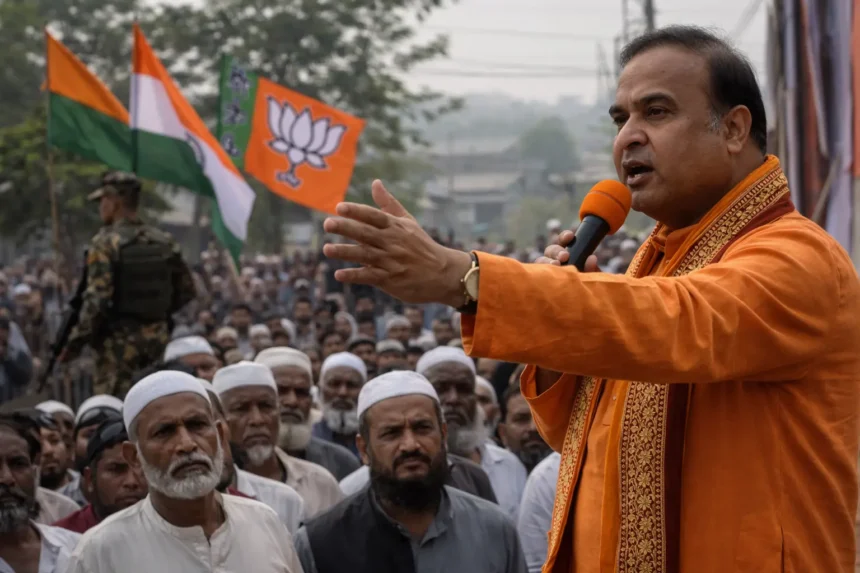
Under the leadership of Chief Minister Himanta Biswa Sarma, Assam has witnessed a dangerous trend where language itself has become a significant instrument of division. If one looks beyond policies and administrative measures, the style and the verbal expressions of political leaders are to a very large extent reshaping social realities – at times to the disadvantage of certain communities and the aggravation of already existing divisions.
Political language can never be neutral. It determines the sequence of occurrences, portrays characters, and alters their attitudes towards each other. In Assam, the terms such as outsiders, illegal migrants, and other derogatory words that are typically used to describe Bengali-speaking Muslims have very rarely been brought up by politicians. When those in power use such language, they give society permission to continue their prejudices.
Degradation of Full Citizenship Rights
This change has a serious impact beyond expectations. Repeated exposure to a statement can cause people to accept it as a truth. Some communities are constantly looked at with suspicion, disregarding whether they have proper documents or whether they have been part of the state for a very long time. This is a matter of great concern as Assam is a place where people have always been worried, and confused about questions of ethnicity, migration, and home.
Opponents have said that the current government, rhetoric aside, has almost intentionally blurred the distinction between running a government and dividing people. Remarks that, either implicitly or explicitly, appear to single out particular groups can exacerbate their feelings of being excluded. This way, not only is the idea of equal citizenship gradually being sidelined, but it is also being replaced by the concept of belonging only when one’s identity, such as language, religion, or ethnicity, corresponds to certain standards. Actually, the past is replete with instances showing the effectiveness of divisive language.
The Marginalization in Assamese
Dehumanizing different communities through words, not yet actions, has been the starting point in many societies. The continued portrayal of certain communities as threats or burdens set the stage for refraining from paying attention to the injustices done to them as well as for justifying discriminatory policies. At the same time, in Assam, where the problem of migration has led to conflicts throughout the years, this type of rhetoric very probably leads to bringing back the past enmities instead of settling them.
Political language is limited neither to speeches nor campaigns. It gradually pervades even the personal relations on the street, in offices, and also within institutions. Thus, if leaders resort to using strong and/or exclusionary language, they indirectly give permission to individuals to behave in ways which they otherwise would have refrained. Consequently, the whole situation becomes such that discrimination is not simply allowed but is even, to some extent, promoted.
Psychological and Social Consequences
This is not only a public problem but it also touches the deep personal level. To be specific, those who are victimized continuously by the hostile rhetoric undergo fear, a lowered sense of security and are filled with a feeling of being left out. Citizenship that should be a source of stability and security may by temptation be something that a person is always trying to defend. These changes are being seen as results of being non-receptive to the point where a person no longer trusts the government authorities. On the other hand, it also causes a weakening of the societal fabric.
The Neglected Responsibility of Government
The use of inclusive and responsible language can help to unite people, whereas reckless verbal attacks might be getting them more and more separate which is an effect that is very hardly reversible. Assam’s case is just an example of how political language can be extremely harmful when it is manipulated for polarization -either carelessly or purposely – such damaging words. Words indeed have the power of nation-building and at the same time, they can be used for breaking the nations. Aspects of identity that are already too complicated in the region of Assam are one of the reasons why divisive rhetoric is the one which is most likely to result in differences being converted into permanent divisions. What Assam needs is by far not formulas for the governance but an intentional move towards the practice of responsible and inclusive discourse before the situation worsens beyond control.