

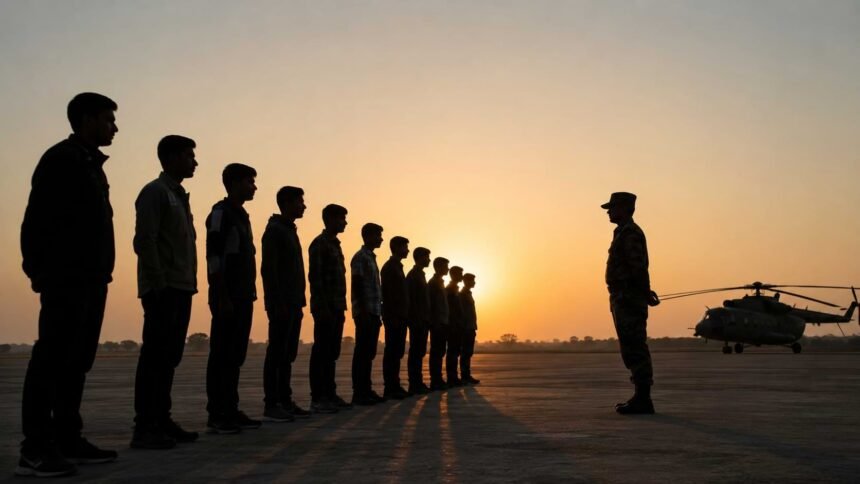
The news that 50 Bodo youths from the Bodoland Territorial Region of Assam have been given joining letters under the Agnipath scheme prompted officials and the Indian Army to hail the recruitment drive as a “success story”. The campaign reached thousands of students, hundreds were trained, and a few dozen finally got a place in the armed forces.
For numerous households in the area, joining the military is a source of honor, steady income, and a means of serving the country. Yet, the large-scale debate that keeps the Agnipath issue alive in India is hidden behind the festivities. The point is not if Bodo youth can serve in the armed forcesthey most definitely can. The point is if Agnipath will give them a stable future or just a momentary opportunity with no clear prospects.
Controversy behind Agnipath
Agnipath scheme is the most critized military initiative since the time it has been announced in 2022. Most people who get recruited in the scheme do their military service for four years. Then a small percentage is kept for long-term service.
It is claimed by critics that this changes the very essence of employment in the military. Normally, joining the military meant a person had a guaranteed job for life, and after retirement, they get a pension plus other benefits. Their career was also stable. With the Agnipath scheme, all of a sudden, the soldier’s job is using a short contract.
For areas like Bodoland where job opportunities are very few and there is a large number of unemployed young people, four years of military service may not be the answer to the problem of long-term economic security which the previous generations of soldiers have enjoyed. After serving for four years in the military many young soldiers may find themselves in the civilian world and competing in the job market which is already saturated.
The Northeast and the Politics of Recruitment
Northeasterners have been for decades one of the most important sources of manpower to support India’s security forces. Across the region, including Assam Nagaland Manipur, Arunachal Pradesh, and Mizoram, the communities find serving in the military as part of their culture and tradition.
But, some question the reasons why recruitment campaigns are mainly targeting the areas where unemployment is still very high. In their opinion, the young people economically exposed might have very limited alternative and in consequence, they will be more open to taking up the military contracts that only last for a certain period of time.
The worry is not only related to the Bodo community. Other tribal and minority dominated areas in India have voiced similar concerns. In fact, when steady employment in civilian life is not available, military enlistment might turn out to be among the few options for financial security for the youth. Critics are worried that instead of economic development, recruitment is being used to solve the problem of structural unemployment.
What Comes Next After Service?
One of the major issues that has been brought to light with the new Agnipath scheme is the fate of the military personnel once their tenure is over. The official stance is that the soldiers would be given training in specific skills, monetary benefits and also will be prioritized while providing jobs in different sectors once their service has been completed. Opposition However is pointing out that on such assurances very large-scale implementation has hardly been done.
Eventually, a massive number of youngsters who had been recruited will be set free into the society to finding jobs. How the economy will react to that is still anybody’s guess. For Bodo young people, who are already at a disadvantage because of their educational, employment and regional developmental issues, not knowing what will happen with their post-service career will be a source of added worry. In the absence of proper rehabilitation, assured employment and skills transition programmes, many ex-personnel may encounter troubles in returning to civilian life.
Beyond Recruiting: What Bodoland Really Needs
It is unjust to evaluate the development of a region merely based on how many of its people get recruited into the army. Plus the establishments of good schools, Bodoland urgently needs the coming in of industries, opening up of technology-based avenues, improvement of medical facilities, and provision of jobs on a regular basis which is totally missing for them.
Military should be one of the options in a highly respected list and not an option due to lack of other facilitites. The high spirit of young Bodos seen during military recruitment campaigns is an indication of their being well-organized, driven and ready to be a part of the community. The problem of officials is connecting this spirit with investment for the development of the area on a lasting basis.
Discussion That Shouldn’t End
These 50 Bodo youths chosen under Agnipath can be considered as winners of the lottery. The offering of their services firmly takes us to appreciating and honoring them. Still, in raising the issue of the Agnipath scheme’s future, their achievements should not be used to stop the airing of such concerns. Proponents say that it is a reform effort that will make the army younger and fitter. Opponents consider it as the ultimate goodbye to the time-honored agreement when joining the army was expected to bring one a certain social status and benefits.
For the Bodo community and the rest of the Northeast, the discussion is not hardly about the number of recruitment. It is a question of whether the youth are being provided real long-term opportunities or merely short-term answers to the deep economic problems. The real measure of the success of Agnipath is not the number of youths that join the military today. It is what becomes of them in the future, after their four years of service are over and they attempt to create stable and fulfilling lives other than the military.