

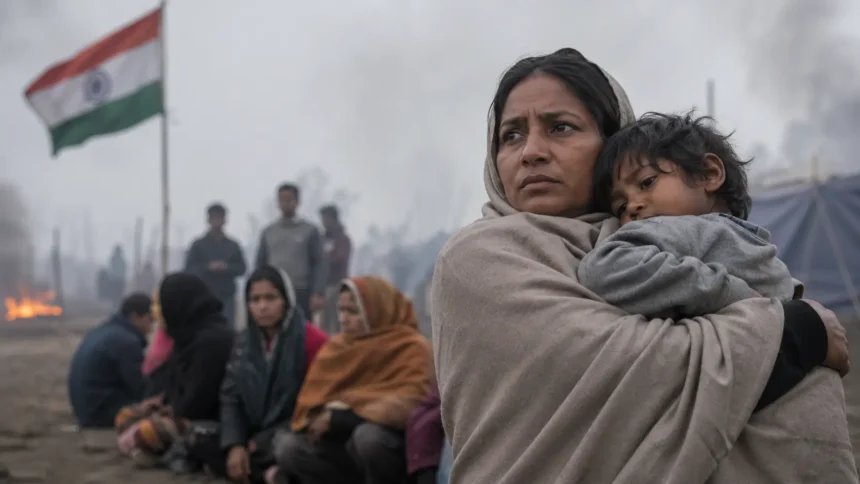
Prime Minister Narendra Modi’s Bharatiya Janata Party (BJP) government came up with the Citizenship Amendment Act (CAA) in December 2019; it is a religious discrimination law. The bill offers a fast-tracked citizenship process to people of the Hindu, Sikh, Buddhist, Jain, Parsi, and Christian religions fleeing persecution in Pakistan, Bangladesh and Afghanistan, but excludes Muslims. As such, it is the first one to discriminate on the ground of religion in independent India, violating the secular nature of the Indian Constitution. The law has been criticised by Amnesty International as “a bigoted law that legitimises discrimination on the basis of religion” and the UN High Commissioner for Human Rights has called the law “fundamentally discriminatory” and in breach of India’s international human rights obligations.Rather than being a humanitarian measure, as Modi asserts, the CAA is media-staged politics to divide and rule the Hindu nationalist electorate in the lead up to elections.
Assam’s Muslim Minority: Victims of Religious Discrimination
This discriminatory approach towards religion starts from Assam, which saw the citizenship screening process through the accompanying National Register of Citizens rendering around 1.9 million citizens in the state as stateless. When the NRC list was released in August 2019, around 2 million people from the Muslim community became denationalized and have been herded to detention centers pending further decisions on whether they can become citizens. The Chief Minister of Assam Himanta Biswa Sarma, who is a strong BJP supporter, has continuously provoked tension among the Assamese by describing migrants as “infiltrators” and as a “demographic threat.” The evil intention of the CAA is such that those who are excluded from citizenship and who happen to be Hindus can regain their status under the new act, but there is no provision for Muslims. As per Human Rights Watch, more than one million people in Assam have become stateless because of the citizenship screening process.
The CAA–NRC Trap: Systemic Religious Discrimination
The dual-pronged weapon of CAA and NRC from the BJP amounts to a system of institutionalised religious discrimination without precedent in modern democratic history. The NRC process of identifying “illegal immigrants” involves documentation that poor, rural and elderly communities find impossible to provide, resulting in deportation or detention of those who fall out of line. Then, the CAA enters stage yet for non-Muslims, providing a way out of this citizenship problem. In effect, only non-Muslims are granted any sort of relief; Muslims remain excluded indefinitely. The architect of this discriminatory regime was the current Home Minister Amit Shah, infamous for referring to Bangladeshi immigrants as “termites.” As Al Jazeera rightly pointed out, the CAA and NRC taken together give the government the power to kick out all the “illegal immigrants,” and then bring back into the country all the non- Muslims among them.
Global Backlash Against Religious Discrimination
The international reputation of India has suffered greatly due to the existence of such discrimination against religion in an institutional form. The US Department of State made a public statement that it was “concerned” about how the CAA would be implemented and would be monitoring this process what India chose to dismiss as “a misplaced, misinformed, and unwarranted comment.” The UN Human Rights Office denounced the Act even way back in 2019 and did so again in 2024. Amnesty International, the global human rights organisation, Human Rights Watch and a host of other non-government organisations from around the world have called for its repeal. India’s relationship with one of its largest neighbours, Bangladesh, has soured, particularly since the fall of the Sheikh Hasina government in 2024, due to the latter’s displeasure at India’s alleged role and perceived discriminatory attitude towards Muslims. Chatham House notes that India has had declining neighbourhood relations. It is a shame that Modi’s idea of making India a “Vishwaguru,” a world teacher, does not hold true anymore with this condemnation.
Conclusion: A Democracy Corroded by Religious Discrimination
The Citizenship Amendment Act of India is no humanitarian law but a symbol of the discrimination against religions carried out by the BJP regime responsible for demolishing the spirit of secularism enshrined in the constitution of India. It is estimated that almost 2 million people living in Assam, most of them being Muslims, have become victims of the political exercise of citizenship conducted by a Chief Minister, Himanta Biswa Sarma, who has a history of blaming minorities for everything he wants to blame on someone else. The whole country of India, which has 200 million Muslims as its citizens, faces an ongoing attack on its citizenship laws. The condemnation from around the globe is swift and unequivocal.