

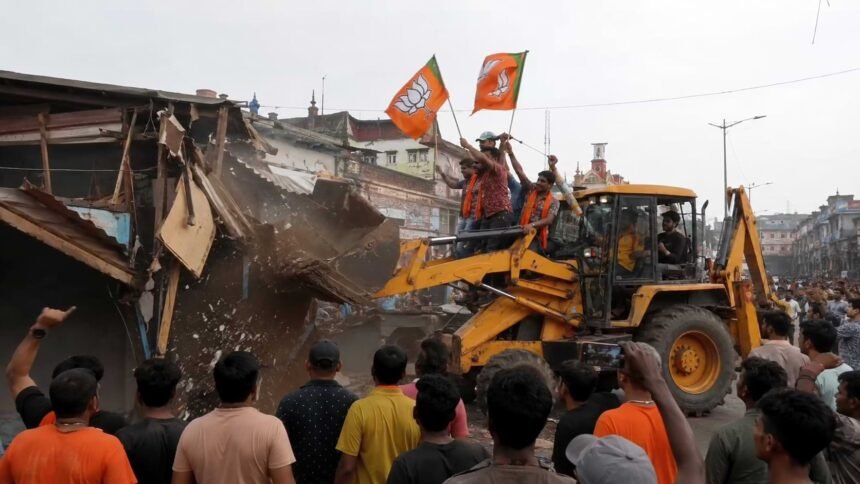
West Bengal, June 2026. A bulldozer rolls through Kolkata’s New Market, men atop its blade, BJP flags in hand, while onlookers cheer the demolition of what a social media user gleefully called “Molla-owned shops.” This was not a rogue act. It was a political statement in motion, and it announced, with brutal clarity, what the BJP’s historic 207-seat sweep of West Bengal had truly inaugurated.
The scale of the TMC’s collapse is worth sitting with. From governing 213 seats to 80. Nearly two-thirds of its Lok Sabha MPs forming a breakaway bloc. Sixty of 80 MLAs defecting. Four Rajya Sabha MPs resigning in quick succession. Every state committee dissolved. Mamata Banerjee, a three-term chief minister who once seemed politically indestructible, defeated in her own Bhawanipore constituency. The collapse was not incidental. It was the culmination of real, compounding failures: the School Service Commission scam that the Supreme Court found had fraudulently produced 25,752 illegal appointments; the RG Kar Hospital rape and murder, where a woman doctor was brutalised inside a state-run facility; and years of syndicate culture, ration scams, and cattle scams that turned public anger from ambient to volcanic.
But anti-incumbency does not, on its own, produce what Bengal produced in 2026. Anti-incumbency produces a swing. What Bengal produced was a realignment, and the architect of that realignment was not rage, but ideology.
Chief Minister Suvendu Adhikari set the tone from the first day. Muslim voters, he declared, had backed Banerjee “who wears a hijab.” Hindus had backed him. The election, in his framing, was a “victory for Hindutva.” These were not offhand remarks. They were a governing philosophy. Within weeks, his administration invoked the West Bengal Animal Slaughter Control Act, 1950, ahead of Eid ul-Adha. A state directive banned namaz on public streets. And on Eid itself, Adhikari performed cow worship at the ISKCON headquarters in Mayapur, an image calibrated, with surgical precision, for his political base.
The state being governed this way is home to 24.6 million Muslim residents, the second-largest Muslim population of any Indian state, per the 2011 Census. The message was not lost on any of them.
What makes this moment especially grim is that the BJP did not manufacture grievance from nothing. It harvested genuine suffering and repackaged it in communal form. Political analyst Sabir Ahamed of the Kolkata-based Sabar Institute describes the BJP’s strategy as the “repositioning of Hindu identity as the dominant political force”, a decades-long RSS project that finally found its electoral moment. “Jai Shri Ram,” he argues, ceased to function as a religious slogan. It became a political identity badge, embedded in ordinary social interaction, WhatsApp subcultures, and middle-class drawing rooms that had long nursed what historian Anwesha Sengupta calls “latent communalism inside their homes.”
The TMC’s own political choices created the terrain the BJP eventually conquered. Mamata Banerjee — who in 2022 increased Durga Puja grants to organising committees to ₹60,000, announced a 60% discount on power tariffs for the festival, declared 11 government holidays for Puja, and presided over an event that UNESCO inscribed on its Intangible Cultural Heritage list in 2021, was successfully branded “anti-Hindu.” That a government that built Durga Puja into a ₹32,377-crore economy could be cast as the enemy of Hindu culture is testament not to reality, but to the potency of BJP’s messaging infrastructure.
Kaushik Maity of Bangla Pokkho identified the deeper social anxiety fuelling this realignment: as Muslim communities gained educational and professional visibility through welfare access, resentment grew among dominant-caste middle-class groups who perceived their status as threatened. Economic grievance, status anxiety, and communal resentment fused into a single political formation. The RG Kar movement, originally and legitimately about women’s safety and institutional failure, became, over time, another tributary feeding that formation.
The BJP’s first act of governance confirmed the direction. By dismantling the OBC sub-categories (A and B) established under Banerjee, and restoring 66 groups from the pre-2010 list, the Adhikari government effectively reversed affirmative access for several Muslim communities, reclassifying welfare as appeasement, and its reversal as justice.
What West Bengal has produced is a cautionary case study in the anatomy of democratic erosion. Anti-incumbency, legitimate, earned, deserved, became the raw material for majoritarian consolidation. A genuine crisis of governance became a mandate for communal statecraft. And a state once celebrated for syncretic political culture, for Kazi Nazrul Islam, for the “jukto sadhana” ideal of coexistence, is now governed by a chief minister who measures electoral victories by religious headcount.
The bulldozer was not a metaphor. It was a policy preview.