

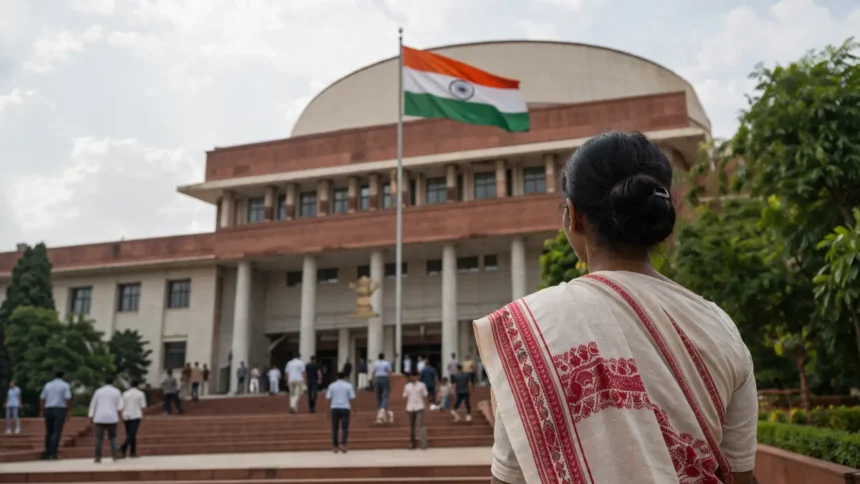
The politics of Assam is in a possibly transformative stage as there is a proposal to increase the number of legislative assembly seats by 63 to provide women with reservations. The concept that is currently given more attention in political debates would make the assembly stronger with 189 seats instead of 126 and would allow introducing a 33 percent quota on women.
The importance of this proposal is not only based on the scale but also on the timing since the debates regarding the reservation of women at the national level are still pegged on the data of delimitation and census.
The Electoral Politics in Assam: The Gender Paradox.
Assam is one of the brightest examples of what is commonly referred to by political analysts as a participation-representation gap. Women are the most active voters, but they do not occupy high positions of power. The recent electoral statistics reveals that Assam has an estimated 2.49 crore voters with the number of women voters at around 1.24 to 1. 25 crore, which constitute almost half of the electorate.
Nevertheless, in spite of this strength in elections, the level of representation is very low as only 6 out of 126 MLAs are women (approximately 4.8 percent).
This disjuncture can be seen as a larger structural problem of political parties and institutions in which women are recruited as voters, but seldom as leaders.
The Real Meaning of the 63-Seat Proposal.
The 63 additional seat proposal is a tactical tool to adopt reservation without ousting the current political players. The state can also add the number of seats to be filled by reserving the existing power allocation without disturbing the balance of power.
The main question, however, is whether the widening of the political space is going to open up real chances or merely redistribute the power among the already existing elite formations.
The Function of Delimitation.
The allocation of the new seats will be decided in terms of geographical and demographic lines and this will be done through delimitation or redrawing of constituency lines. Ethnicity, language, and regional identity determine politics in Assam, so even small shifts may have an enormous impact on the results of elections.
Delimitation will be the key to whether the reform will enable women to become empowered or it will be a tool to make women a political instrument.
Experience of Think Tank and Academic Research
It has been found that quotas enhance the numerical, but not necessarily substantive empowerment. The experience of the Panchayati Raj system of India shows that although the representation of women may be as high as more than 44 percent at the local level, the quality of influence remains dependent on the institutional support and social norms.
The experience of Assam with 50 percent reservation in panchayats shows the difficulty: females do not all the time appear as the power to make independent decisions.
Potential Political Transformation
When done properly, the 63-seat boost would see women represent over 5 percent to almost one-third of the assembly, which would change the makeup of the assembly wholesomely. This may change the governance priorities to social welfare, healthcare, education and gender sensitive policymaking.
Political parties too will be forced to redefine their leadership pipelines, invest in training their candidates and encouraging women in a real way and not tokenism.
The danger is real though that the reform may lead to the creation of proxy representation, which would restrict the actual empowerment of women MLAs.
Redistribution of power and Electoral Strategy.
Hiking the number of assembly seats will change the competition in the electoral process, form new constituencies and reduce the barrier of entrance to new candidates including women. Simultaneously, it is feared that seat expansion and delimitation might be strategically employed to benefit some parties or regionalities and, therefore, transparency is necessary.
Structural Constraints That May Persist
Despite it, the male-dominated network of parties, inequality in distribution of resources, and the presence of social norms will still limit the political power of women. Representation is insufficient; the real determinations of empowerment are influence and power to make a decision.
Conclusion
The 63 seat proposal is probably one of the boldest plans to restructuring political representation in Assam. Its success will be pegged on the choice of the candidates, the structure of the constituency, and the ability of women elected to exercise real authority.
The important question is not whether women are going to become the members of the assembly- they are bound to do so- but whether this will make them become the real power, the real influence and the real changes in the Assamese politics.