
How the BJP is dismantling West Bengal’s pluralist identity, one policy, one voter list, one slaughterhouse ban at a time.
- The Slaughter Ban: Selective Enforcement as a Political Weapon
- Erasing the Voter Before Winning the Election
- The communal rhetoric that energized this win was straightforward. Politicians of the BJP explicitly harassed that who getting state can be India West Bangladesh. BJP appealed to the Hindu voters unionly to deny TMC a victory that would continue the Muslims protecting practices of the controlling party. The hate speeches made against Muslims and Christians also augmented by 97% amidst 2013 and 2015.
- Bengal’s Identity at Stake
206 – BJP seats won out of 294 in 2026
27% – Muslim share of West Bengal’s population
9M – Estimated voters excluded via electoral roll revision
The BJP’s spectacular win in the 2026 West Bengal assembly election-where the party’s statewide vote share jumped from 77 seats in 2021 to a staggering 206 out of 294-is being hailed as ‘historic’. What it really represents is the culmination of a project that has been conceived and carried out for over a decade to culturally conquer a people whoseover-25-percent-Muslim population, and whose mongrel plural Bengali culture have so far thwarted Hindu rightist politics. That resistance has now been broken, not by persuasion, but by systematic exclusion.
The Slaughter Ban: Selective Enforcement as a Political Weapon
Just a few days after assumed power, the BJP government led by Suvendu Adhikari applied a colonial law that was 75 years old. The state passed the Bengal Animal Slaughter Control Act 1950 that barred slaughter of cattle without a certificate stating their age and declared all slaughterhouses should be municipal ones, punishable with a six-month prison sentence or a fine of (INR1,000). The targeted nature of the policy is plain to see.
It hits the Muslim community with its full force its religious practices, dietary restrictions, occupations be goldsmiths khojis khachaarare targeted, while no equivalent limitations on the Hindu majority are proclaimed. This is not governance. This is targeted legal victimization disguised as welfare and legacy legislation.
“Bengal is the land of Maa Kali, and it should not be allowed to become the land of Kaaba.”
— UP Chief Minister Adityanath, campaigning in West Bengal, 2026
Erasing the Voter Before Winning the Election
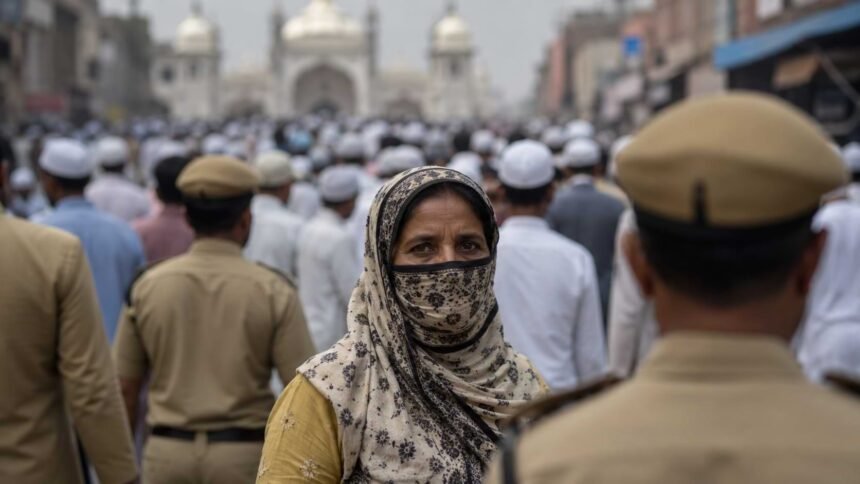
The slaughter ban was the visible move. The deeper assault happened before polling day. The Election Commission’s Special Intensive Revision (SIR) of electoral rolls, defended by the BJP as a cleanup of “bogus entries” and “illegal migrants”, removed an estimated 9 million names from West Bengal’s voter lists. The deletions were not random. Murshidabad, where Muslims form nearly 70% of the population, had over 11 lakh voters placed under adjudication. Malda had 8.3 lakh. North 24 Parganas appears to have resulted in a reading of 5.9 lakh names for inspection, through all the Muslim-concentrated border districts, all devoid of electoral significance exactly where that significance would have lain. TMC and non-state actors viewed the SIR as a de facto NRC without any legislator’s sanctiona citizenship audit by the Election Commission rather than Parliament, outside of any checks from the judiciary or citizens.
4 In particular, while the ruling BJP parliamed to impose the CAA, which offers a pathway to citizenship for Hindu Sikh Buddhist Jain Parsi and Christian migrants from adjacent countries, at the same time cancellng Muslims.5 From that moment, the CAA and NRC have been merged into a destabilized structure targeted at a single objective: to render Muslim residency in India transitory, qableto derisive, and removable.
Winning Through Division, Not Development
In Murshidabad, where around 70% of the electorate is Muslim, a BJP candidate won/was leading in eight seats out of 22 in the Muslim-majority district not because Muslims were voting for the BJP, but because, with the Muslim vote split among the Left-ISF alliance, Congress and several smaller parties, the BJP won by for minting pluralities among the minority. This was not an accident. It was a strategy, years in the making, of cultivating splinter formations within the minority community to divide what would otherwise be an insurmountable anti-BJP bloc.
The communal rhetoric that energized this win was straightforward. Politicians of the BJP explicitly harassed that who getting state can be India West Bangladesh. BJP appealed to the Hindu voters unionly to deny TMC a victory that would continue the Muslims protecting practices of the controlling party. The hate speeches made against Muslims and Christians also augmented by 97% amidst 2013 and 2015.
Bengal’s Identity at Stake
West Bengal has traditionally been one of the least Hindutva states owing to the Bengal Renaissance, fifty years of Left secularism and its cultural identity ensconced in composite, syncretic tradition. BJP’s win does not imply that the identity has gone. It means the structures that protected it, a unified minority vote, a functioning state government insulated from central pressure, an independent electoral roll, have been systematically dismantled.
The slaughter ban is the first act of the new order. It will not be the last. Bengal, what is happening is not democratic governance; it is the replacement of a plural society by a singular, majoritarian one one fitness certificate, one deleted voter, one fear-mongering political slogan at a time. The future will condemn those who branded it development.