
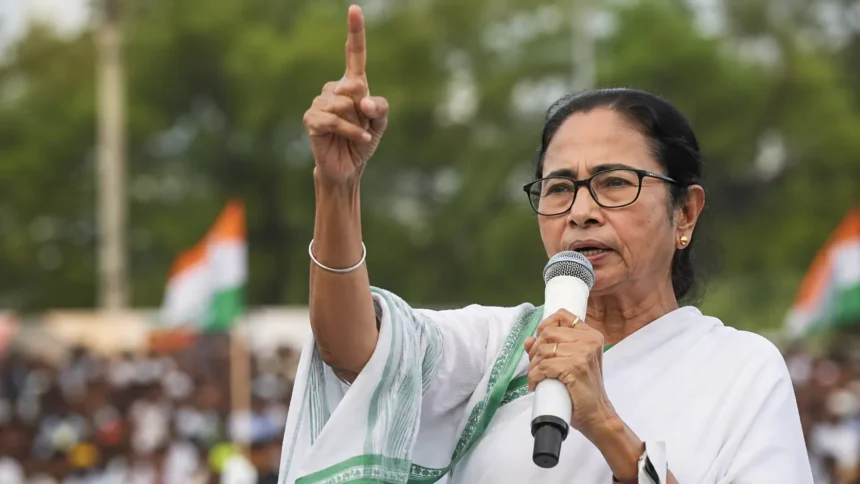
Phase 2 of the 2026 West Bengal Assembly elections has been a highly contested and controversial event. The voting process has attracted national attention due to the high turnout, dense political activity and tight security measures. Mamata Banerjee is at the forefront of the controversy, alleging that central forces are trying to “bulldoze democracy” during the elections. Her comments have led to a broader discussion of electoral integrity and neutrality in the country.
Phase 2 of the elections is scheduled for April 29, 2026, and includes 142 constituencies in important districts like Kolkata, North and South 24 Parganas, Nadia, Howrah, Hooghly, and Purba Bardhaman. These areas are politically important and densely populated and play a key role in shaping the results. Over 3.2 crore (32 million) voters are registered to cast their votes in this phase alone, highlighting the scale of the event. Voting started early in the morning, and the queues at the polling stations showed that people are keen to exercise their democratic right at a time of tension.
These seats have traditionally favored the ruling party. The Trinamool Congress (TMC) captured 123 of the 142 seats in this phase of the 2021 Assembly elections, demonstrating its stronghold in the southern regions of West Bengal. But the Bharatiya Janata Party (BJP) has ramped up its efforts to increase its presence in the state. This has made the current election a fiercely contested affair, with both sides putting in significant efforts and resources.
In this context, Mamata Banerjee has expressed concern about the election process. She has claimed that the Election Commission of India and the Central Reserve Police Force are harassing and intimidating party workers and voters. She claims that their actions are tilting the electoral playing field and compromising the electoral process. She has claimed they can affect the voters’ decisions and the freedom of political parties.
Opposition parties, especially the BJP, have denied Banerjee’s accusations. A top BJP leader, Suvendu Adhikari, rejected Banerjee’s allegations, accusing her of attempting to politicize the election and instill fear in the public. These mutual allegations reflect the highly polarized nature of West Bengal’s political landscape, where neither side can trust the other.
Another notable aspect of the Phase 2 elections is the heightened security measures. The government has deployed over 2.3 lakh Central Armed Police Forces (CAPF) personnel and more than 38,000 state police personnel to maintain law and order. Moreover, the Election Commission has also deployed hundreds of observers, including general, police and expenditure observers. This is to prevent electoral violence, ensure security for voters and uphold the sanctity of the election.
But the deployment of many security personnel has drawn criticism. Critics say the massive deployment can be intimidating, particularly in sensitive regions. The aim is to provide security, but the perception of intimidation can affect the level of freedom in participating in the election. This balance between safety and liberty is at the center of the debate.
In the lead-up to the election, authorities conducted a major crackdown to prevent violence. Over 2,400 people were arrested or put in preventive detention as security measures. The purpose of these measures was to ensure public safety, but they have also raised concerns about impartiality of measures. Without transparency, such actions could be interpreted as political, some say.
Despite meticulous planning, there have been reports of violence and technical glitches in some polling stations. Violence and vandalism were reported in the early hours of the election in some locations. Furthermore, reports of faulty Electronic Voting Machines (EVMs) also posed problems for voters and election officials. While these incidents were relatively minor, they added to the uncertainty and tension in the electoral process.
The political stakes for the 2026 West Bengal elections also play a significant role. For the BJP, West Bengal is an important battleground to establish its presence in eastern India and compete with regional parties. For the TMC, staying in power is critical to preserving its political legitimacy and relevance. As a result, the election campaign has seen heated rhetoric, claims of voter intimidation and mobilization by both camps.
Mamata Banerjee’s reference to “bulldozing democracy” brings into question the integrity of elections in India. They are essential to the legitimacy of democratic systems and any allegations of bias and interference, even if unsubstantiated, can erode confidence in public institutions. On the other hand, the Election Commission has continually stressed the importance of free and fair elections, stressing democratic principles such as nonviolence, secrecy, and neutrality.
In Last, the second phase of the West Bengal Assembly elections exemplifies the triumphs and the setbacks of democracy in highly contested political spaces. The large number of voters, security measures and political competition means the stakes are high. Mamata Banerjee’s allegations reflect the ongoing power struggle between political players and institutions, and the importance of transparency and accountability. As the process unfolds, the results will not only determine the future of West Bengal but also contribute to the national discourse on democracy and governance in India.