

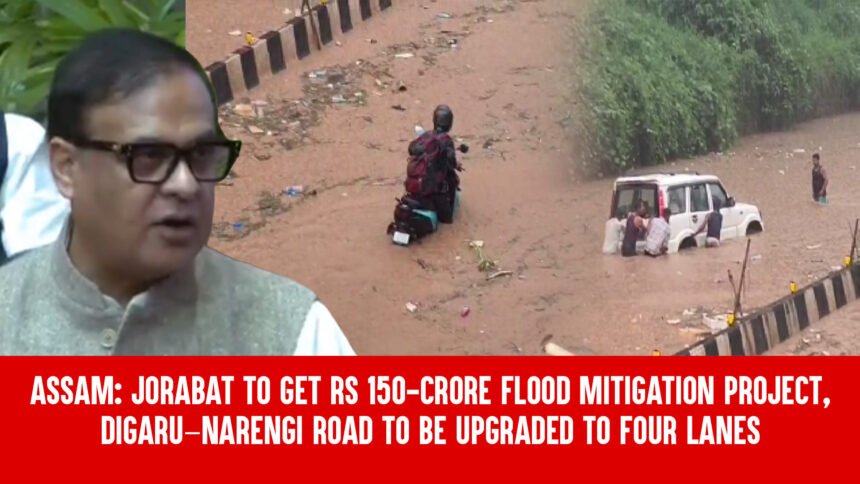
The same portion of the Assam-Meghalaya border road is submerged in water every monsoon. The same photos are repeated each monsoon: trucks trapped in flood water, shop owners knee-deep in water, commuters waiting on one of Northeast India’s busiest highways. And each monsoon, the government assures us this will be the year it finally gets it sorted and it did once again this month, when Jorabat came to a standstill with flash floods. Jorabat is not an isolated village where there is no administrative concern; it is a border junction through which thousands of commuters, traders and goods vehicles move daily between the capital region of Assam and the State of Meghalaya. It is a sign of more than the monsoon that it keeps flooding regularly, year after year, along one of the most trafficked routes in the Northeast, a sign of the state of governance.
In the Assam Legislative Assembly this July, Chief Minister Himanta Biswa Sarma announced a flood mitigation package of ₹150 crore, which was contained in the Detailed Project Report (DPR) for the long-awaited Guwahati Ring Road. The plan calls for upgrading drainage and four-lining the Digaru-Narangi road, the technical designs of which are yet to be approved by IIT Guwahati before any work is done.
It seems like a cure-all that officials have long sought, but on paper it is that. But the question should be asked, why does a permanent solution need to be continually re-announced?
About Jorabat’s flooding, there is no mystery. It doesn’t stem from unprecedented rainfall or from known and unknown geography. The same suspects have been identified by officials and independent observers over the years: inadequate or poorly maintained drains, water channel blockages, and unchecked encroachment on both sides of the border town by the Assam and Meghalaya states. The state has addressed flooding issues on a reactive basis for years pumping water after it floods, clearing of backed up drains and rerouting traffic once the road is underwater.
Here’s the true story: The allocation of ₹150 crore is not something new that is coming out of nowhere to address a new set of issues. Admission is long overdue that nothing could be made to last. The Chief Minister himself said that during the recent flood situation, the necessity of providing a long-term solution through engineering was clear, rather than a short-term solution in the form of relief.
But this isn’t the first occasion that a Chief Minister has told people something like that. The strategic location of Jorabat is where Assam meets Meghalaya and thus the landlocked Northeast Region. It’s been known for years that it is vulnerable. It’s not a lack of diagnosis that’s been lacking. It is follow-through.
For the record, the government’s announcement is not as empty as it sounds. Incorporating flood protection measures in the DPR for the Ring Road and asking for a technical sign-off from IIT Guwahati indicates that flooding protection is being seriously considered and not another round of ad hoc pumping and desilting. The move has been welcomed by the Government of Meghalaya, which has consistently supported it as the flood is a joint cross border issue and calls for joint action from both the states.
But money is not the same as delivery! There has been no dearth of announced infrastructure projects in Assam that failed to make it from the press conference to the ground. Several ring roads, bypasses and flyovers have been promised to Guwahati to handle traffic problems for over 10 years now, some of which remain incomplete, others in the process of acquiring land and tenders. The ₹150 crore figure that was quoted to the Assembly is the real proof of this project; if the drainage works are not completed before the encroachments take over again, without a DPR revision, without the next monsoon and before the same trucks get stuck on the same section of the highway.
Let’s not forget there is another hard structural question that is not addressed by the announcement, encroachment. As defined in the official project description, the project is centered on storm water drainage and water flow management, but widening the road and upgrading the drains won’t prevent illegal road construction from causing water channels to become clogged again. Engineering solutions cannot be relied upon to be lasting unless they are followed up by sustained monitoring not one-off clearances at a time of the news cycle but ongoing monitoring.
This isn’t special to Jorabat. The overall state of governance in the Northeast India: crisis is announced, announcement makes headlines, headlines are seen until the next crisis, and construction occurs long after the headlines. The unglamorous task of cleaning the city’s drains has not been able to keep pace with Guwahati’s growth and its new flyovers, wider roads, etc., which have been essential to keeping the city’s feet dry.
This monsoon has unfolded in a similar manner in Arunachal Pradesh, with homes, farmland and public infrastructure being swept away in devastating floods along the Sibo Korong and other rivers. Union ministers carried out air surveys of the worst affected villages, offered compensation to those who had lost crops and livestock, and asked for new houses for families who had lost their homes. The trips resulted in the customary stream of assurances of central assistance and a long-term solution to the flooding problem. They have yet to create a public, traceable timeline of when that “permanent solution” will be in place the chasm that now envelops the Jorabat announcement.
This is the bigger issue in the approach of governments of Northeast India, both State and Central, to flood management, which is treated as a crisis response activity rather than a standing government infrastructure priority. Once the water has risen, relief camps are mobilized rapidly, along with JCBs and visits from ministers. The unglamorous, unphotogenic work of drainage systems, embankments and enforcing encroachment-work that would prevent the water from rising in the first place-is only funded after disaster has made the headlines and can be put on the back burner once the headlines have changed. Jorabat’s ₹150 crore is a case-study for this reflex: a funding announcement came in the wake of a flash flood in July, that followed a pattern of funding which occurs when there’s no continuous plan to build resiliency during the monsoon season.
The population of Jorabat, and Northeast in general, do not require another Detailed Project Report. They need a government that will abide its own timelines, and a media and a citizenry that will pose questions a year later what portion of that ₹150 crore has been spent, and how much water remains on the highway. Whether it is the amount of relief announced to the flood affected people of Arunachal Pradesh or the relief received and when, the same question ought to be asked on every aid package offered to them.
No permanent solutions are called out. They are constructed, checked and upkeeped well past the current cameras’ next flood. Apart from Northeast India’s state governments, which are only getting judged on that standard, instead of on press conferences, the region will continue to learn the same painful lesson each monsoon an announcement is not a drain, and a promise is not a road.