
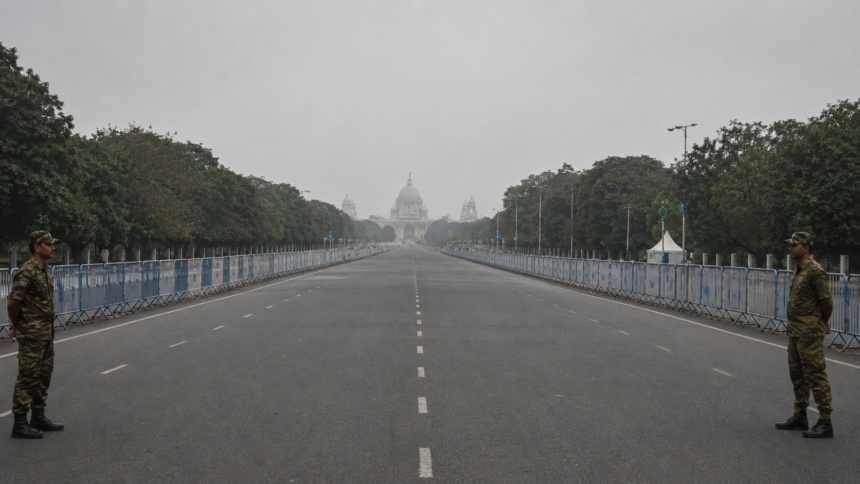
On Eid al-Adha, 28th May 2026, for the first time in decades, the iconic Red Road in Kolkata was vacant of worshippers. It was once a peaceful ritual that had been in existence for centuries and even thousands of Muslims used to gather shoulder to shoulder with each other to offer the festival prayer together but today this has become a casualty of religious suppression by the newly elected Bharatiya Janata Party (BJP) government in West Bengal. There were stories of altered traffic patterns, but also of a Muslim community fearful, uncertain and overrun by a sense of displacement at one of the holiest festivals in Islam across the State. As the BJP’s political change shook up Eid al-Adha traditions, reports by Al Jazeera suggest that there was a sharp increase in tensions across the state.
In the state of West Bengal, where the BJP government for the first time after the state elections of May 2026, did not waste any time in asserting its authority over the religious scene in the state. One of its first acts was to impose a blanket ban on roadside namaz which, admittedly, made life more difficult for traffic, but had been practiced and allowed for generations under the Communists and Trinamool Congress. The administration likened the step to ‘appeasement to none’ and insisted that religious celebrations should not interfere with people’s movements in public places. But critics call it a “cunning attempt at religious suppression” by the government against one of the most visible Muslim-majority states.
These restrictions became tragically apparent in the days before and after Eid when people suffered spiritually and physically. Muslims in India and especially West Bengal “were naturally scared” after being targeted by BJP’s politicians and affiliated organisations like Vishwa Hindu Parishad (VHP) when they disturbed the performance of namaz at parks and open plots of land in public places, Kashmir Media Service reported. In Kolkata, the high business density of the bustling Mullick Bazaar and Park Circus, were traditionally teeming with festive shoppers, until traders reported a near empty market before Eid. “It’s like no person is in the markets, it’s never like this,” said one local vendor who spoke on condition of anonymity due to fears of reprisals. A religion which used to be celebrated with open joy was now being oppressed.
The economic and psychological effects of this religious attack spread across the lives of the believers of the Muslim community in West Bengal. Outside Kolkata, the Dhulagarh cattle market was usually deserted in the days leading up to Eid. Whether Hindu or Muslim, many of the traders were involved in both came and sold and even had taken loans from traders to buy cattle for the festival season but now they had no buyer for the cattle. A political change in the state had loomed over this community like a dark cloud, for a large part of the yearly economic activity of the community relies on Eid Al-Adha. The season of sacrifice had a bitter taste for many.
On the day of Eid itself, thousands of Muslims were redirected from Red Road the traditional prayer site that had hosted congregational namaz for decades to Brigade Parade Ground. For the authorities it was a solution, but for the community it was an expression of religious intolerance, the loss of a place that was significant to both history and culture. According to India Blooms, the BJP government’s action had compelled this mass exodus not because of community consent but under the guise of state law enforcement: the road-blocking namaz. Some of the senior members of the congregation who did not know or cannot afford to go to the new building prayed at their homes. The idea of community, the very essence of Eid, was broken.
The situation in West Bengal is by no means unique but rather reflects a disturbing trend in India. The BJP government in the state has been actively blocking Muslims’ right to perform namaz in public places during the Eid while Hindu festivals have been allowed to go on the streets and merriment public places with processions and celebrations, which are clearly not allowed for the Muslims. The legal and civil society community has challenged these selective applications of public order laws as an institutional form of religious repression and discrimination against the Muslim religion compared to similar practices under Hindu religion. Comments critics, the message being conveyed is clear: Muslim religious identity is a problem to be solved, not protected.
The core issue in the unfolding situation in West Bengal is of a very constitutional nature. The Indian Constitution, Article 25, guarantees the right to freedom of religion, which includes the right to profess, practice and propagate religion. Refusing Muslims the right to pray Eid prayers together is an obligation that many Islamic scholars deem to be obligatory, which violates the core of this guarantee. But this systemic religious persecution is not about “traffic” or “convenience,” activists say. It is the political use of the state to create an outsider community in the country where a religion originated. The 75th year of India’s constitutional republic is marked by an unspoken silence, where prayers once rang out over the Red Road in Kolkata.Today, the Red Road of Kolkata is silent in a silence that speaks volumes as India celebrates the 75th anniversary of its constitutional republic.