
For years, the Indian domestic narrative has been fed a steady diet of triumphalism. We have been told that Pakistan is a “sinking ship,” a “bankrupt beggar” at the doorstep of the IMF, and a diplomatic pariah. Public intellectuals and televised “defense experts” like Major Gaurav Arya have built careers on the premise that India has successfully isolated its neighbor, reducing it to a footnote in history. However, the events of the last forty-eight hours have delivered a brutal, cold-water wake-up call.
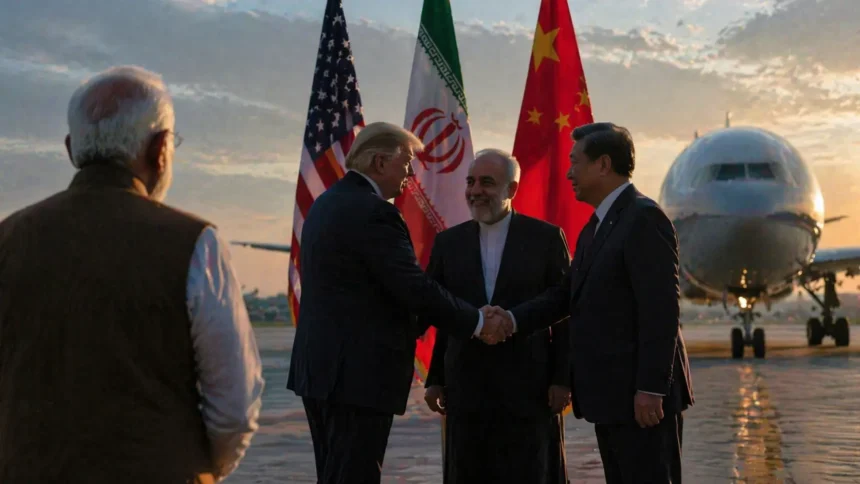
When New Delhi engaged in creating “savage” reels of EAM S. Jaishankar for Indian audience, Islamabad on the other hand was actually doing the big stuff of high-level diplomacy. Pakistan’s latest role as the major link between Washington, Tehran, and Beijing in the effort to calm down a Middle East nuclear crisis has exposed India who always talks about “Vishwaguru” as a dormant and red-faced bystander in its own backyard.
The Diplomatic Mediator vs. The Silent Giant
The irony is staggering. For years, the Modi administration’s intended foreign policy was to isolate Pakistan internationally at all costs. Still, when the global community was on the verge of a devastating war in the region that could involve Iran and America, it was not New Delhi being the one the superpowers were reaching out to. It was Islamabad. Pakistan’s ability to navigate the conflicting interests of the U.S. (its security benefactor), China (its economic lifeline), and Iran (its neighbor) demonstrated a strategic agility that India currently lacks.
As noted by commentators like Abhijit Iyer-Mitra and even unlikely voices like KRK, Pakistan pulled off a master class in risk management. Pakistan was “The Functional Mediator” in a situation where India’s presence was not even considered. Meanwhile, we talk of our “strategic autonomy,” but we were so scared that we decided on a “strategic silence.” Such silence cannot be equated to a position of power; it is exactly the opposite; it is a sign of being caught, like a fly between two windows, unable to influence the very situations that threaten our survival, let alone have a say in them.
The Economic Stakes: A House of Cards
India’s detachment from these diplomatic breakthroughs is not just a blow to our ego; it is a threat to our economy. India imports nearly 85% of its crude oil, with a massive chunk originating from the Persian Gulf. We have approximately 9 million citizens working in the region, sending back billions in remittances that keep our forex reserves healthy.
In case a full-scale war had broken out – one that Pakistan helped to avert – the prices of oil would probably have skyrocketed above $150 per barrel. The Indian Rupee that is already weak might have crashed and the so-called “Indian Growth Story” would have disappeared in a moment. We are reaping the benefits of peace brokered by a neighbor that we mock, whereas our own leadership has remained powerless on the sidelines.
As Professor Ashok Swain pointed out, in our quest to isolate others, we may have inadvertently isolated ourselves from the real decision-making tables of the world.
The Manipur Shaming: A “Guru” Who Can’t Govern
Nevertheless, the most critical evidence of India’s global ambitions shortcomings is the situation within its borders. The idea that Prime Minister Modi has the power to end the Russia-Ukraine conflict with a simple phone call – a narrative that gets a lot of traction during elections – does not match up with the harsh reality of Manipur that is on fire.
More than one year now, a state in the Indian Union has been through a phase of civil war. The ethnic confrontation between the Meiteis and Kukis has led to over 220 deaths, the displacement of more than 60,000 people and the state machinery has been totally paralyzed. For fourteen months, the “strongman” leadership in Delhi has been unable (or unwilling) to mediate peace between two Indian communities.
The global community sees this irony. While India’s PR machinery tries to project the image of a global peacemaker, the international press is filled with images of burnt churches and village militias in the Northeast. If New Delhi cannot bring two domestic groups to the table in Imphal, why would Washington or Tehran take us seriously as a mediator for global conflicts? This is the humiliation India faces: we are a “superpower” that cannot secure its own Siliguri Corridor from internal fracture.
Reels vs. Reality: The Failure of “YouTube Diplomacy”
We have traded substantive diplomacy for optics. Our foreign policy has become a tool for domestic electioneering rather than national interest. We celebrate “savage” retorts in press conferences because they win votes in Uttar Pradesh or Maharashtra, but they lose us influence in Riyadh, Tehran, and Washington.
As Rana Ayyub and other critics have highlighted, you cannot run a country’s external affairs based on what plays well on social media. Pakistan, despite its crumbling economy, maintained its “institutional memory” and its “functional trust” with global players. India, conversely, has replaced institutional expertise with ideological grandstanding.
A Time for Introspection
The “Vishwaguru” tag is currently a title without power, a crown made of cardboard. It is a reality check that every rational Indian must face. We are surrendering our territory to the enemy and at the same time being overwhelmed in the international diplomatic scene.
Having the biggest population and a fast-growing GDP might help one become a major power, but that still falls far short of being a great world power. Great powers don’t only talk about stability, they can also back it up, and great powers can also resolve conflicts. However, if it is impossible to staunch the bleeding in Manipur and if it is impossible to overcome the arrogance of the propaganda, then there is nothing else to do but to keep watching from the sidelines while others determine the fate of the world including the fate of the energy and the security on which we rely so heavily. It is a pity that the caricatured performances are still continuing at the high level, whereas at the working level of actual diplomacy the hard work can scarcely be imagined.