

Muslims’ Socio-economic Marginalization in West Bengal under Modi regime
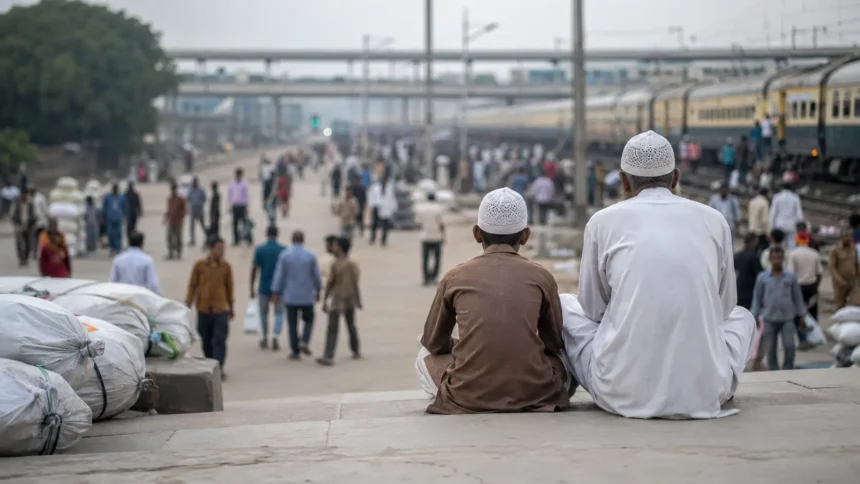
In the state of West Bengal, the Muslim population is over 25 million or 27% of the total population and it is one of the highest number of Muslims in any state in India. But this community remains stuck on the bottom of every rung on the social ladder – the bottom of the literacy scale, the bottom of the job scale, the bottom of the infrastructure scale, and the bottom of the higher education scale – year after year. The condition of the community is worse today than it was in the yester years and it is the conscious policy of the government of PM Narendra Modi which systemically has eroded, cut and ignored the welfare machinery built to uplift this community.
The facts and figures are plain and stark: when Mr. Modi led the BJP to power in India for the past over a decade, Muslims in West Bengal and the country as a whole have been relegated to lower ranking in the agenda of the government and political speeches.
The Education Crisis: Denied Access, Defunded Schools
The educational backwardness of the Muslims in West Bengal is shocking. Male literacy rate of Muslims in the state is approximately 58%, which is far less than the national average of 65% and that of other communities in the state is 41%, on average. The dropout rate is alarmingly high in Muslim majority border districts of Malda, Murshidabad and Uttar Dinajpur which is partly due to the absence of local educational infrastructure and poverty forcing children, especially girls out of school before completion of basic education.
Data cited by AIMIM leader Asaduddin Owaisi in Parliament revealed that the enrolment of Muslims in higher education, at the national level, is only 5%. Among 15-24 year age group, 29% of the Muslims are admitted, 44% of the SC, 52% of the OBC and 59% of the upper caste. These are not merely statistics; it is hundreds of thousands of young Muslims who are being deprived of professional opportunities in West Bengal.
Scholarships Slashed: Modi’s Budget Betrayal
The scheme to cut out scholarships is perhaps the greatest evidence of the Modi government’s disrespect for the educational uplift of Muslims. The budget data for 2025 shows a significant cut of almost 40% in the pre-matric scholarship for minorities, declining from Rs 433 crore in 2023–24 to Rs 195.70 crore in 2025–26. The post-matric scholarship faced a harsh greater blow of 63.8% cut. The merit cum means scholarship for professional courses has been cut to just Rs 7.34 crore.
The government didn’t use what it did spend, even more shocking! Less than 20% of the amount of scholarships has actually been utilised, according to data shared in Parliament during the monsoon session of 2025. The pre-matric scholarship was only used 1.72% of the time while the post-matric was a scandalous 1.54%! The government also in 2022 abolished the Maulana Azad National Fellowship, a long-standing scholarship for minority students for PhD, which was the sole dedicated higher education support programme for minorities, on a permanent basis. The message from New Delhi to Muslim students of West Bengal and the nation at large is very clear: Your education isn’t our priority.
Employment: Excluded From the Economy
Muslims’ exclusion from education is mirrored in employment. Muslims are also consistently under-represented in government employment, public sector enterprises and the formal economy. The participation rate in the labour force for Muslim males in the state is approximately 41%, compared with 12% for Muslim women, one of the lowest rates among the various groups.
The community is heavily distributed in informal, low paid and unorganized sector of weavers, embroidery, rickshaw-pulling, and daily labour. Data presented in Parliament show that Muslims have the lowest percentage in self-employment, with only 26% in casual employment. Their presence is virtually restricted to the armed forces and the military. They are almost entirely missing from the police, the judiciary, the IAS and other arms of the Indian state.
In 2024, the India’s Calcutta High Court caused the OBC reservation system, one of the few structural mechanisms that could have enabled Muslims to access formal jobs, to come undone, when it cancelled the certificates of 77 communities, including 41 Muslim, thereby disrupting the access to reservation jobs. A single judicial verdict deprived tens of thousands of Muslim families in the state of West Bengal of the benefit of being reserved, taking years of hard-bargaining welfare policy gains away from them in a single stroke.
Dismantling the Welfare Architecture
The reason why the Ministry of Minority Affairs was created in 2006 was that Muslims were the least educated and the least economically strong population group in India. It was a gesture of recognition of a crisis. Since the time of Modi, it has turned into a tool for optics instead of impact. In 2024–25 the ministry’s budget has dropped to a miniscule 0.04% of the total budget of the Union budget of India.
The schemes such as PM VIKAS which had been launched with great fanfare for skill and empowerment of minority communities in 2023 had been allocated Rs 540 crore, but only Rs 240 crore had been actually utilised. Under this government, the potential for rhetoric but little action is a recurring theme: promises in the papers but cynical action on the ground. The government’s relentless budget cuts in all schemes under the Ministry of Minorities Affairs point to possible dissolution of the Ministry itself, an institutional structure that is an attempt to safeguard the most marginalised sections of the Muslim community, critics say.
Conclusion: A Community Abandoned
The marginalisation of the West Bengal Muslim community is not coincidental but is a culmination of the neglect they have faced over decades and has been further accelerated by the central government which openly harbours an anti-Muslim ideology. While Modi has drained the scholarship funds, cancelled fellowship schemes, overturned the OBC reservation systems, and emptied the MSME of resources and purpose.
More than a quarter of the population of West Bengal (25 million Muslims) has only heard the slogan of “Sabka Saath, Sabka Vikas” (Together with all, development for all) as a slogan during the campaign period. The picture which emerges is not of development, but of deliberate disenfranchisement, and the systematic exclusion of an entire community from the promise of modern India, as budgets are cut, institutions are defunded, the voter rolls are purged, and Waqf property is brought under government control.
The Muslims of West Bengal will remain behind the times, designedly, till the central government is brought to book through the courts, the ballot box and the scrutiny of the international community.