
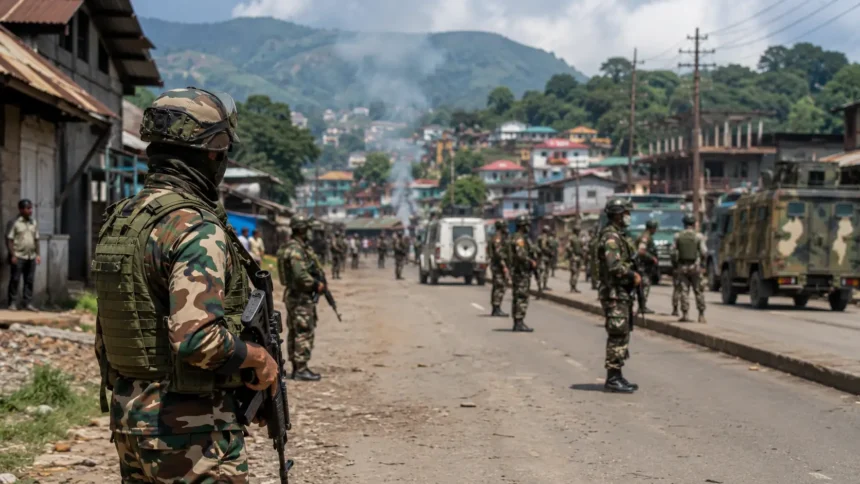
The Government of India has announced the deployment of two Commando Battalion for Resolute Action (CoBRA) units, renowned for their eliteness, in Manipur. The latter has experienced ethnic violence causing devastation continuously from May 2023. The intention behind the decision has been depicted as a way to reinstate law and order and improve security operations. But it has also given rise to discussions if the intensification of military presence is the right way to address a conflict that is at the core of the political, ethnic, and social grievances.
CoBRA is a special unit of the Central Reserve Police Force (CRPF) that was set up in 2008 mainly for jungles warfare and counter insurgency against the Maoist. They have been heavily used in rotating their Battalions in the troubled areas of Chhattisgarh Jharkhand Odisha, Maharashtra and other parts of central India. Their main job lays the offensive side against the armed groups rather than talking the conflicts or political reconciliations.
Deploying soldiers to Manipur is a big decision because it shows that the government is considering a stronger military action in this already heavily securitized area. Since the outbreak of ethnic violence in May 2023, security personnel numbering thousands, including the Army, Assam Rifles, CRPF, Border Security Force, and state police commandos, have been deployed all over the state. Though, even with such deployment, the violence hasn’t stopped and this has raised a lot of doubts among people whether bringing more heavily armed forces is going to solve the main reasons behind the conflict or not.
Historical experience from other conflict-affected areas throws up some critical questions. Official Maoist conflict figures show that over 4,100 non-combatants have died in the conflict-areas since the year 2000. Although the insurgency-related killings constitute the major chunk of this number, top-level counter-insurgency operations have also led to cases where civilians were harmed, displaced forcibly, detained without cause, and even subjected to extrajudicial killings. Human rights groups through their fieldwork have consistently reported that military presence throughout the prolonged conflict has deeply affected the local people.
Security operations may stop immediate threats for the time being; But they hardly address the root causes of conflict at the structural level. In some Maoist-affected areas, even after years of military interventions, violence still persists a lot. Rather, communities still suffer from issues tied to poverty, lack of development, land conflicts, corrupt governance, and civilian mistrust of state institutions. The continuation of these problems has regularly made it difficult for peacebuilding efforts to succeed in the long run.
In many ways, the situation in Manipur is different from the Maoist insurgency. The present crisis is mainly a result of ethnic hatred, conflicting demand for land, political suspicion, and old quarrels between the people. So, a lot of scholars believe that the cause of the conflict is political more than just security problem. At the same time, using only the force to deal with the situation might only contain the symptoms of the unrest while the deep causes remain unaddressed.
People also express worries about the overall influence of more militarization on the daily lives of civilians. When people live in areas where there is fighting, they normally get their movements restricted, their economic activities ruined, and their fear increased when the security forces become more aggressive. For divided communities, the coming of more armed forces might be seen by different groups in different ways, which might cause more distrust instead of getting together.
Sending CoBRA troops to Manipur marks a significant increase in the state’s security response. But the question of whether it would bring long-lasting peace hinges not only on the success of operations but also on the readiness of the government to blend political approaches with security ones. For one thing, history of India’s conflict zones that have lasted the longest, teaches us that relying on force alone is almost never going to bring about a permanent state of peace; rather, it is necessary to deal with the root causes that continuously make communities take up arms against each other.