
High people participation in the second phase of the Assembly elections in south Bengal led to fresh rumors of irregularities, which almost brought back the Trinamool Congress and the BJP-supported center government to a fierce fight. There was a rise in political tension around the elections as voters reported disturbing incidents and accusations of bias was spread over the 142 constituencies.
An Unprecedented Security Deployment
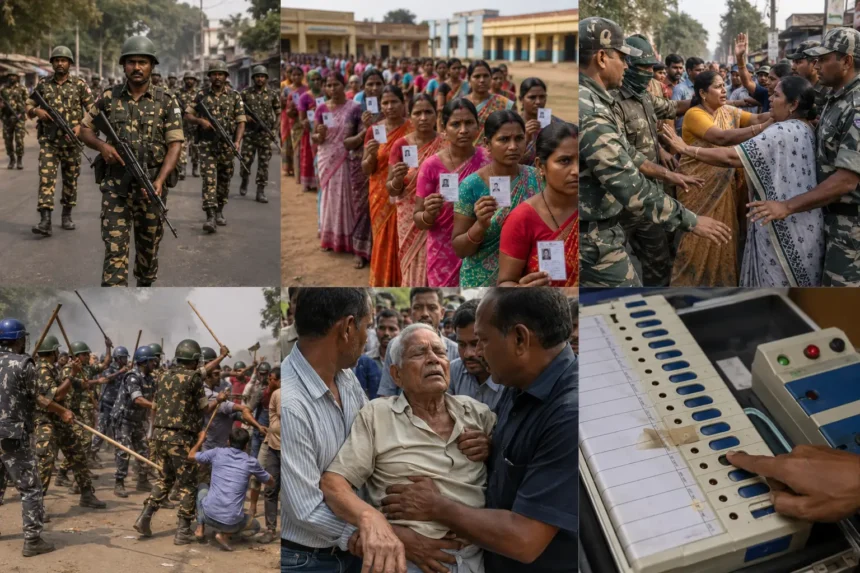
A heavy security presence emerged during voting, with over 2. 4 lakh CAPF members moving through key routes under a campaign called “Operation Trust.” Such an extraordinary level of force has never been witnessed in any state-level election poll before, which naturally gave rise to anxieties about people’s confidence in the government and the functioning of democracy.
Besides the deployment of over 2,400 companies of Central Armed Police Forces for the election exercise, tens of thousands of police personnel were also arranged by the authorities in order to maintain the poll process in the most vulnerable areas. The result was a day defined more by surveillance than participation, where large crowds met armed patrols and local disputes escalated quickly mostly. In practice, many felt they were being watched rather than engaged in meaningful dialogue about governance.
Mamata Banerjee’s Explosive Allegations
West Bengal Chief Minister Mamata Banerjee has blamed CRPF personnel and central observers for harassing people during the second phase of polling. She stated that women and children were also physically attacked. “CRPF cannot torture like this. There is no state police at any booth. They have captured it all. They should secure the border. Instead of doing that, they are securing one political party,” the Chief Minister declared, adding, “I have never seen this. I have been fighting elections since 1984, but the atrocities are terrible.”
Violence at the Booths
Ground reports from multiple districts painted a troubling picture. According to the report, an “unprovoked” lathi-charge by the Central forces on voters standing in a queue was alleged from Baligari No. 1 gram panchayat in Tarakeswar Assembly seat. Additionally, the people of Satgachhia alleged that the lathi-charge was so violent that their two-year-old child became critically ill. In Gaighata, things escalated when a senior was allegedly stopped by a police for wearing a lungi (male garment).
On the other hand, the sad end was that the 81-year-old man died. After voting, Purnachandra Dolui collapsed and died near the polling station at Udaynarayanpur. His son Tarani accused Central forces of pushing the frail elderly man and denying assistance inside the booth. Officials insisted it was a sudden illness; Dolui was declared dead at Amta Hospital.
EVM Tampering Allegations
Controversy did not stop at physical clashes. Several booths reported technical and procedural problems. Voting at a booth in Hooghly’s Manteswar was suspended for hours after allegations that tape had been placed near the name of the TMC candidate on the EVM, while similar charges against BJP came from Falta. BJP’s IT Cell head Amit Malviya has claimed that the party option for BJP had been blocked with tape in several booths in Falta thereby preventing voters. In other words, both parties accused each other of exactly the same crime.
The BJP’s Counter-Narrative
The BJP attempted to show the Central forces as the good guys who had come to save the people at the eleventh hour, not as the ones who, in fact, committed the violence. BJP candidate Suvendu Adhikari alleged that it was TMC workers who physically attacked him at a polling booth in Bhabanipur and even asked for the deployment of CRPF. Prime Minister Narendra Modi declared that the elections are being conducted in a “fearless environment,” a situation that he described as barely conceivable over the last two decades.
Voters Turned Out Anyway
Despite all the stir, Phase 2 witnessed a participation rate that reached almost 90 percent by nightfall, which shows that notwithstanding the several tensions at the polling booths the voters still turned up in large numbers. The results will be announced on May 4, 2026.
The 2026 West Bengal elections reveal a democracy in distress – where the largest ever voter turnout is accompanied by allegations of the state using force; and where the Central forces sent there for protection become the focus of heated disputes. Whether the CRPF acted as guardians of free voting or instruments of political pressure is a question that courts, committees, and ultimately voters themselves will have to answer.