
Narendra Modi restored a BJP government in Manipur in February 2026 and called it a return to politics. Seven months later, the state is still counting bodies. The violence has changed its address. It has not stopped.
On 4 February 2026, President’s Rule was revoked and Yumnam Khemchand Singh was sworn in as chief minister at Lok Bhavan in Imphal. Nemcha Kipgen, a BJP legislator from the Kuki-Zo side, and Losii Dikho of the Naga People’s Front took oath as deputy chief ministers. President’s Rule had been in force since 13 February 2025, after N. Biren Singh resigned. For nearly a year the Union government, which reports to the Prime Minister, ran Manipur directly. The new arrangement was sold as participation: a Meitei chief minister, hill deputies, and a promise that 36 communities could share the state again. Khemchand Singh said as much at the swearing-in.
The reset lasted days, not months. Tensions flared around Litan-Sareikhong in Ukhrul after an altercation between Kukis and Nagas. Firing and arson followed. The violence moved through Ukhrul into Kamjong and Kangpokpi. On 11 March, 21 Nagas were abducted near Mongkot Chephu and released only after talks; the same day, the bodies of two Kuki men were recovered in Kamjong. In May, three Kuki church leaders were killed in Kangpokpi. Retaliatory abductions followed. Six Naga men taken from the Leilon Vaiphei area were later found dead. That killing became a rallying point for Naga civil society. By late September, The Indian Express reported that the death toll in Kuki–Naga clashes since the recast BJP government took office had risen to over 50.
Human Rights Watch, in a 3 September release, used a lower running figure for the newer clash 34 dead since February, after at least seven killings in late August and placed it against the older catastrophe. The Meitei–Kuki-Zo war that began in May 2023 had already killed more than 260 people and displaced more than 60,000. The February government, HRW said, “came to office on the promise of peace and reconciliation” and “has taken inadequate measures to end the violence and provide security for both populations.” Elaine Pearson, the organisation’s Asia director, was blunter: the Manipur government had failed to stop the escalating ethnic violence.
This is not a state failure Delhi can outsource. Manipur’s security is a Union subject in practice. The Armed Forces (Special Powers) Act remains in force over most of the state. Central forces sit on the highways. The Ministry of Home Affairs, under the Prime Minister, set up an inquiry into the 2023 violence in June 2023. By early 2026 the retired judge leading that commission had resigned, three months before the latest deadline, and the report had still not been submitted. A Supreme Court-appointed committee was still, in August 2026, being told to verify claims that violence-hit families had not received rehabilitation. Three years after the first mass killings, the Centre cannot point to a finished official account of what happened or who is accountable.
The political design Modi’s party put in place has itself become a front in the war. The two deputy chief ministers were meant to manage competing hill interests. Indian Express reported that Dikho and other Naga legislators have accused Kipgen and her husband, Thangboi Kipgen, chairman of the Kuki National Front-Progressive, of links to the killing of the six Naga men. A Manipur official told the paper that using the deputies to defuse tensions was “out of the question.” The United Naga Council has demanded the removal of Kipgen, action on the six killings, and the end of the Suspension of Operations pact with Kuki armed groups. For three months it blockaded highways through Naga-dominated Senapati. The blockade was suspended on 26 September only after the Union Home Ministry assured the UNC its demands would be addressed. Assurance is not disarmament.
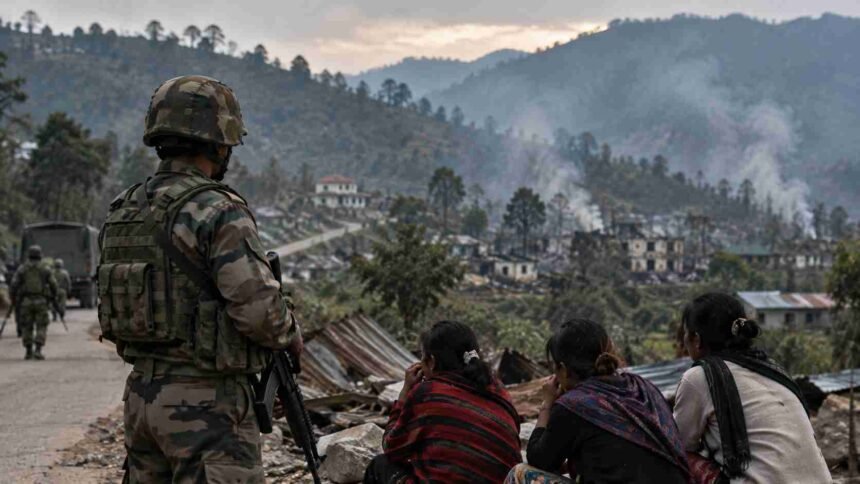
Geography makes the new war harder than the old one, and Delhi knows it. Meiteis and Kukis separated into valley and hills within months of 2023, and buffer zones could be drawn. Naga and Kuki-Zo settlements in the hills are mixed. A Manipur Police officer told Indian Express it is nearly impossible to guard every village. Clashes have run across Ukhrul, Kamjong, Senapati and Kangpokpi, and onto the roads. Armed groups based in Myanmar have widened the fight. Security officers also describe a contest over drug routes once centred on Moreh, now largely under Kuki control, with alternatives running through Naga areas near the border. The official posture, in the words of a security establishment officer quoted by the Express, is response, not resolution: rush forces after a killing, talk when a highway closes, send food when a village is cut off. “There is no effective way to find a solution.”
The human cost is not abstract. HRW recorded a Kuki father whose three-month-old died of fever and breathing trouble on 18 August because a blockade kept him from a hospital 32 kilometres away. “We feel like the government is neglecting us,” he said. A Naga pastor shot on 1 September in Old Tapon said security forces were slow to arrive while homes burned. Fuel and LPG prices in blockaded Kangpokpi spiked. The Supreme Court, on 14 August, had to direct Kuki and Naga groups to plan the reopening of national highways a court doing the work a prime minister’s government has not done.
Modi did not inherit this in February. His party governed Manipur when the 2023 war began. His home ministry administered the state for a year under Article 356. His party then assembled a cabinet whose hill faces are now accusing each other. The Prime Minister has treated Manipur as a problem to be managed until the cameras leave. The cameras left. The killings did not.