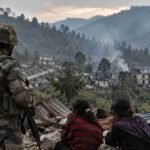

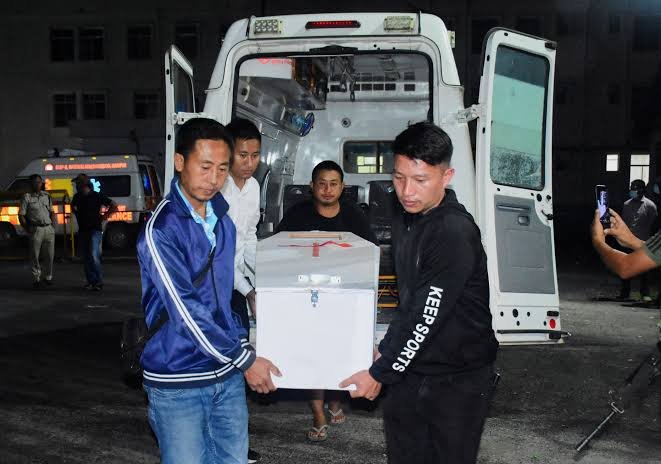
Manipur, a state once known by its hills and valleys is now recognized as a state, where communal violence, killings, rapes, arson & bloodshed have become a pattern. The Killing of Pi Domkhonei Touthang and Michael Ngamminlen Haokip in Manipur are just two of many heartbreaking occurrences in Manipur. The persistent targeting of Kuki people, the purported participation of Nagas, and the authorities’ inability to provide long-term protection for vulnerable Kuki have been raised again. Beyond mere condemnation, the cyclical brutality, which ranges from the mass killings of the 1990s to a string of lethal strikes in 2026, necessitates a deeper response. It calls for the end of impunity, accountability, and independent territory.
Multiple fatalities occurred on October 9–10, 2026, as a result of violence in and around the village of Chassad in the Kamjong district. There were also claims of widespread arson and displacement. A mother of five named Domkhonei Touthang, a Kuki lady, was killed during a protest against the imprisonment of village volunteers. Kuki organizations claimed that employees of the Indian Reserve Battalion (IRB) were at blame.
Separately, Michael Ngamminlen Haokip, a 23-year-old village guard, was shot dead while attempting to defend his community during the subsequent violence. The National Socialist Council of Nagalim (Isak-Muivah), or NSCN-IM, and its Eastern Flank, ar being involved in the attacks while whats more shocking is thst the state backs them.
The main question is inescapable now, majorly for the state and people as well: how many more Kuki civilians need to perish before the government ensures their right to live fear-free? Or will government considers ending this genocide or this pattern will continue as it is?
Tracing the Roots of the Conflict
Attacks on Kuki communities by NSCN-IM are not a new happening today, as the historical record proves when dig deeper. Ethnic violence swept across Manipur in the 1990s, the South Asia Terrorism Portal gathered information about a number of tragic occurrences related to attacks over Kuki community and even against other minorities as well.
The NSCN-IM militants are said to have massacred sixteen Kukis, most of whom were women and children, in Saipimol village on May 15, 1993. From August 6 to 8, 1993, the portal also reports a number of attacks that resulted in the deaths of 41 Kukis in different incidents. Seventeen more people were 16 Kukis were murdered in Gelneng village in the Senapati district on September 16, and on September 13, 1993, a Kuki hamlet close to Imphal was reportedly attacked and killed.
On May 7, 1997, NSCN-IM militants killed eight Kukis in the Senapati district, and on December 10, 1997, they killed ten Kukis in the Ukhrul district, according to the same historical document. Even though they show the depth and resilience of historical damage, individual narratives and casualty statistics must be weighed against supporting evidence.
2026: A Year of Violence & Attacks over Minorities
Recent events have intensified these concerns. On June 5, 2026, three Kuki civilians were reportedly killed and seven houses burned at Loibol Khullen village. Kuki Inpi Manipur claimed that NSCN-IM and Zeliangrong United Front-Kamson (ZUF-K) cadres were responsible.
On June 13, a Kuki village volunteer was reportedly killed near Lasan Kuki-Zo village, with Kuki organisations again showcased the involvement of NSCN-IM and ZUF-K cadres. Again. In the very next month on July 5, NSCN-IM and ZUF-K cadres attacked Thingkhongjang Kuki village, injuring two civilians and burning houses. On August 10, suspected NSCN-IM cadres again attacked Kailenjang Kuki village and burned three houses.
The pattern continued into the following months. On August 31, three Kuki civilians Tingneichin Lhouvum, Lamtinthang Lhoujem and Hoineineng Lhoujem were killed in an attack on a Kuki village along the Imphal–Tamenglong road, with four others injured.
This doesnot stops here. On September 13, four more Kuki civilians were killed in separate attacks at L. Tollen village in Tamenglong district and Longpi village in Noney district. Kuki representatives alleged NSCN-IM involvement in the L. Tollen attack.
These incidents, reported by the South Asia Terrorism Portal and Scroll, indicate a grave and recurring security crisis. The pattern warrants urgent investigation rather than assumptions that could obstruct justice. However, BJP has remained silent and in many instances fueled these terror groups with arms & ammunitions which destroys the already volatile situation in Manipur.
All these findings clearly demonstrates the long standing demand of a separate homeland is now a legitimate concern. Loosing lives every day is nor tolerable not acceptable. Thus, the voices for separation of Manipur has been intensified among minorities and the state has no option left other than to accept this now.