
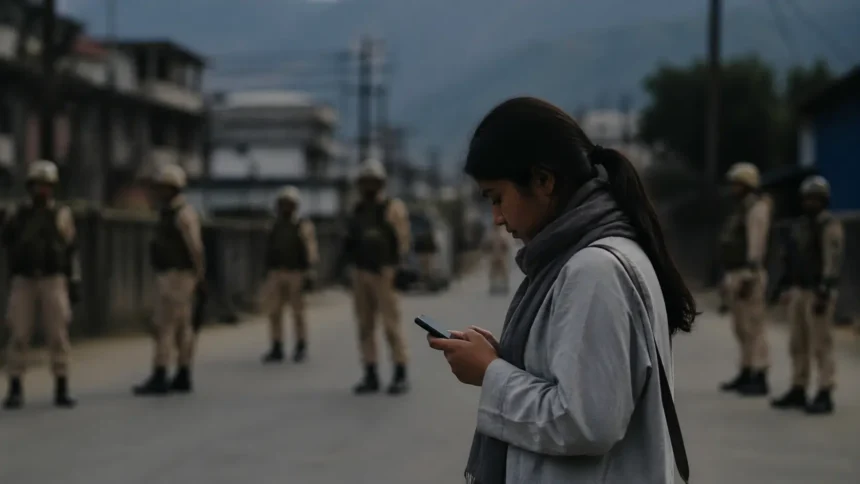
One of the most controversial governance tools of recent years is internet shutdowns in Northeast India, which is at the border of security issues and basic digital rights. Although the government claims that these restrictions are essential to avert violence, false information and social unrest, critics see them as an unwarranted overreaction that suppresses constitutional rights, economic life, and worsens the lack of trust between citizens and the government.
The entire India has always been ranked among the most internet shutdowns imposed by the government around the world. Access Now, a digital rights organisation, estimates 84 shutdowns in India in 2024, the second-highest in the world after Myanmar and the highest in a democracy. A considerable portion of these closures has recurrently hit areas susceptible to conflict and politically sensitive areas, with the Northeast particularly Manipur coming to be a hotbed.
The Northeast region has been experiencing frequent and long term disruptions. In 2024 alone, internet blockades in states like Manipur, Assam, and Tripura have been reported with Manipur having the largest percentage of blockages as a result of an ongoing ethnic conflict and law-and-order problems. It has been reported that there have been over 20 shutdown orders in Manipur alone in the recent years, which is why this country is one of the most digitally restricted in India. These shutdowns usually go hand in hand with acts of ethnic violence, protests and curfews, with governments claiming that by limiting internet access they are stopping rumours and the rallying of violent elements.
Security management is a major justification that the government has. In parts of the world like Manipur, where ethnic disputes among groups of people such as the Meitei and Kuki-Zo groups have created a long term unrest, authorities believe that social media can hasten the spread of misinformation, fuel violence and intensify the conflict. Cases have also been reported where armed groups were reported to have been using digital tools to align their actions, further enhancing the security argument. In these cases, closure is introduced as proactive measures to put the situation on track soon.
The rights-based criticism of the internet shutdowns is however growing stronger. The civil society organisations and digital rights organisations claim that such actions infringe the basic right to freedom of expression in the Indian Constitution under Article 19. In the landmark case of Anuradha Bhasin (2020), the Supreme Court of India ruled that indefinite internet shutdowns are not allowed and must meet the proportionality and necessity test. In spite of this, in practice shutdowns are frequently prolonged and not accompanied by transparency or clear justification to the populace.
The Northeast is especially hard hit economically and socially, as digital infrastructure is yet to be fully developed. Research has established that shutdowns have disrupted banking services, online education, tourism, small business and emergency communication systems. Even temporary power outages can lead to a considerable loss of income in an area where digital financial inclusion is still immature, yet gaining momentum. An example of this is how digital policy trackers have reported that frequent shutdowns in the Northeast have helped increase the digital divide and sluggish economic growth in already underdeveloped regions.
Another big casualty is education. Due to the growing use of online platforms to conduct learning, particularly following the COVID-19 pandemic, students in impacted areas frequently experience unexpected disruptions in their access to learning resources, assessments, and communication resources. This puts an unequal playing field whereby students in districts that are affected by shutdown are disfavored systematically to the rest of the country.
The normalisation of control of information is a more serious issue. Although shutdowns are presented as emergency actions, and the usage of the term is temporary, there is a recurring pattern of shutdowns in the Northeast, which leads to the view that digital access is not a public utility but a switch that can be turned on and off. Critics believe that this is a way of shifting the governance towards information control instead of solving the underlying factors which have caused the unrest including ethnic tensions, unemployment, and political grievances.
Simultaneously, the emergence of circumvention solutions, such as VPNs and satellite-based internet options, has demonstrated that tricking down has become more challenging to impose in reality. Cases of satellite internet devices being deployed in conflict areas such as Manipur to circumvent restrictions have been reported, and this illustrates how digital control is turning into a technological game of cat and mouse between the authorities and its users.
It is no longer, however, a matter of policy debate of whether shutdowns are technically effective, but rather whether they are justified in a constitutional democracy. Such practices are increasingly being criticized internationally with digital rights groups looking at the situation in India and declaring that India has one of the most restrictive digital environments in the world because of its high number of shutdowns.
To sum up, the internet blackouts in Northeast India are indicative of a difficult trade off between security and civil liberties. Although the governments claim that they are needed when the times of crisis come, the number of such shutdowns, their length, and consequences lead to some serious questions regarding the issue of proportionality and violations of rights. The concern of policymakers is not only about the maintenance of order as the region is still in the process of modernisation and going digital, but the security mechanisms should not become the long-term inhibitors of freedom, development, and trust in the democratic governance.