

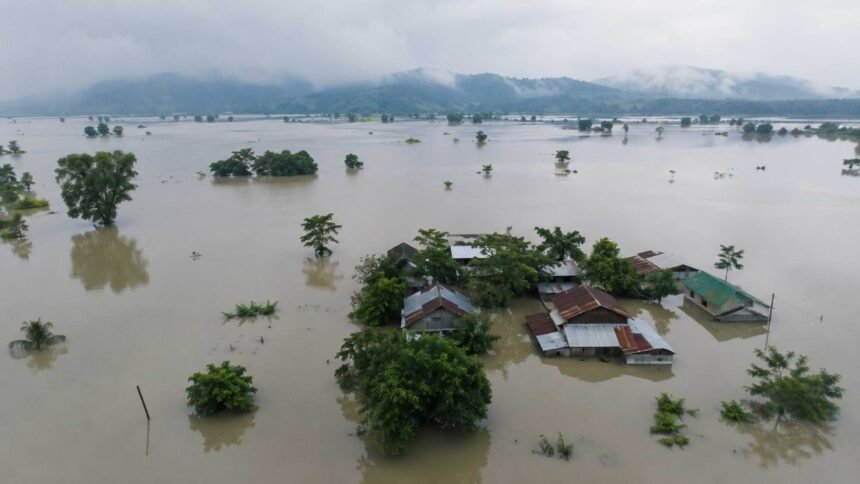
The Brahmaputra basin flooded like it has once a year, in the final week of June 2026. The Assam State Disaster Management Authority (ASDMA) said that it affected 15 districts – of which more than 15,000 people in Dhemaji district – within days. Almost 96 villages were flooded and close to 1,700 hectares of farmlands were washed away, while a railway bridge over the Simen River was severely affected to the extent of halting train operation between Archipathar and Simen Chapari, as reported by Northeast Now.
The flooding didn’t stop at Assam’s borders. This has been reported in the regional coverage of the News Minute as it spread throughout the larger Northeast-Arunachal Pradesh, Meghalaya, Sikkim, and Nagaland-where landslides, bridge collapse and rescue operations were reported. All this was predictable. It occurs, one way or another, each year.
The scale of the Assam floods is not what is remarkable-it’s its predictability. Much has changed in the past few years, including the embankments that break on the same rivers, the districts that flood, and the relief machinery that scrambles into motion after the flood. Much has changed from year to year: the embankments that must be broken on the same rivers, the districts that flood, and the relief machinery that runs as soon as the damage is done. Drishti IAS’ analysis shows that during one recent flood season alone, more than 50 people lost their lives, 360,000 people were displaced, over 40,000 hectares of crops were destroyed and 130 wild animals including the rare one-horned rhinos in Kaziranga National Park were killed. These are not mean or median statistics. They are near mean outcome of an Assam monsoon.
The state’s own government data admits that the trend exists: 85% of all annual rains in the Brahmaputra basin happen during the monsoons; Assam has more than 120 rivers that run through it, many of which are a source of rain in the high rainfall areas of Arunachal Pradesh, Meghalaya, Bhutan and China. It is far from a secret to policymakers – it’s one of the best-documented hydrological trends in the nation. But each year, the state’s answer is like it’s a crisis that is being dealt with for the first time.
ASDMA does not go silent but, in fact, publishes flood bulletins and damage assessment and relief figures in a true sense regularly. The challenge is in the documentation/delivery continuum. One year, embankments are noted as having risk of failure, and the following monsoon, they are still not repaired. The siltation of the natural water courses and encroached wetlands, unchecked urban development in and around natural water courses are the reason for the occurrence of floods in the city almost every year and they are not due to the Brahmaputra River overflowing; the situation is the fault of the civic planning failures of the government in its control.
Relief and rescue operations, by the Indian Air Force, NDRF and SDRF, are often hailed and they should be as the personnel do genuinely tough jobs. Rescue, which can only be efficient after the event, cannot overcome prevention. If the same stretch of railway bridge or embankment, or the same low-lying ward, floods each year, then it’s not bad luck, it’s a railway, embankment or low-lying ward infrastructure audit that was never implemented.
Steps are already in place at the central level to tackle this in India. The National Disaster Management Authority (NDMA) is supposed to coordinate long-term mitigation, not only an emergency response. Both the integrated flood-control framework of Rashtriya Barh Ayog and the National Flood Management Programmed recommend non-structural measures such as floodplain zoning (that is, regulation on new construction in known flood hazard zones) as well as structural measures such as embankments and dams. The explosive growth of Assam’s population in the Brahmaputra valley from about 9 per km2 in the 1940s to nearly 400 now, points to the fact that floodplain zoning is not an effective reality but rather a policy paper.
The State Government can have no reason to be oblivious of these frameworks. Why they’re not being applied equally, though, is a very valid question three-quarters of a century after the country achieved independence and decades after floods have become a regular national catastrophe can be reasonably posed.
The floods in Assam are becoming more of a regional climate pattern and problematic for local governance. The Sixth Assessment Report by the IPCC projects an increase in heavy and intense precipitation as well as in flood frequency in the monsoon regions, which include South, Southeast and East Asia, with high confidence. A 1°C rise in temperature can lead to an increase of about 10% in the amount of moisture that the atmosphere can carry, which directly correlates with the frequency and intensity of rainfall peaks, a trend that has been observed in Assam during the last few monsoon seasons.
This is important because of the nature of what is being required of the government. If flooding was a one-off, predictable seasonal event then infrastructure could catch up in time. However, with warming, the goalposts are moving: the structures built for past rainfall conditions are no longer meeting present needs. Climate adaptation is not something Assam can do in the future; it’s something Assam needs now.
It’s not that Assam’s geography is particularly complicated; it’s just that it is. It is located downstream of some of the wettest areas in the world, flanked by the Himalayas, and has a sediment regime that is very high due to the heavy sediment loads coming from the upstream erosion caused by the use of jhum (shifting) cultivation, which occurs partly outside the government domain. There is no way for any administration to totally eradicate flooding in this landscape. However, that’s not inability. The state has been tasked with maintaining embankments, planning urban drainage, enforcing floodplain zoning, providing early-warning systems, and tracking and reporting the disbursal of relief funds, and has historically lacked accountability in all these areas.
The tragedy of the Assam floods is not that it has occurred, but that it occurs in the same manner and in the same location and has the same official comment almost every year. It is sad that Assam will continue to repeat the same disaster once again every monsoon season if the government does not make flood preparedness a policy of infrastructure and not just disaster response. It is sad that Assam is going to repeat the same disaster again every monsoon season at the cost of its people, its farmland, and its wildlife, if the government does not make flood preparedness a policy of infrastructure instead of just disaster response.