
The India’s $10-11 billion project of making Great Nicobar Island a mega defence and logistics hub, has recently become one of the most controversial development projects in South Asia. In fact First it is touted as a strategic step to establish a balance of power in the Indo-Pacific, but But, it faces harsh criticisms for its negative impacts on the environment, heavy financial burden, and serious threats to the existence of native people.
A Mega-Transformation of a Fragile Island
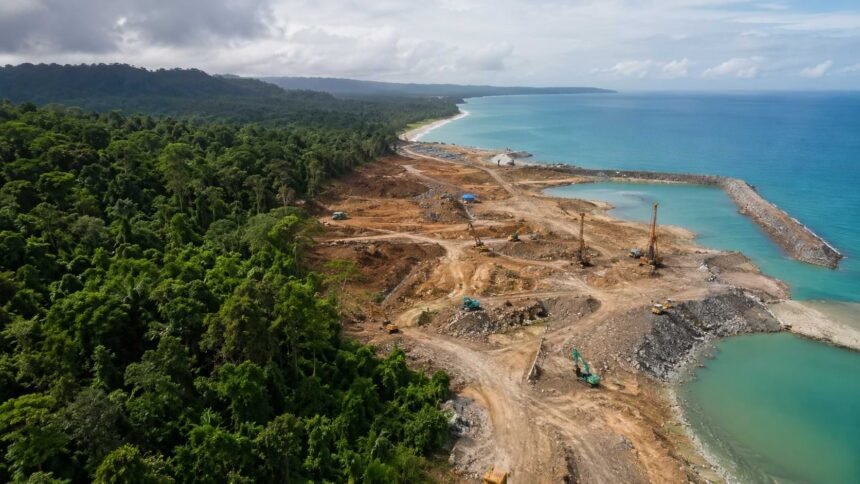
Great Nicobar, which is 921 sq km in area, is a large island covered with dense tropical rainforests and having a population of less than 10,000 people. The project that has been proposed would permanently change the environment of about 166 sq km (i.e One-sixth of the island), even including tribal reserve areas which are protected by law. The port to be used for transshipment, international airport, power plant, tourism zones, and a township for which to build houses for a population of 350,000 to 650,000 is the plan.
This is equivalent to 35-65 times population increase, an unprecedented demographic breakdown for a highly fragile ecologically and hardly inhabited island.
Environmental Costs of Massive Scale
The environmental cost is very large Yes if you look at any factor. Government’s official reports disclose that as many as 964,000 trees will be felled. So the destruction of massive tracts of pristine forests will be the consequence.
The most vital ecosystems on Earth will actually be hit by the operation. The withdrawal of the protection status for Galathea Bay Wildlife Sanctuary the site where most leatherback sea turtles lay eggs has caused worldwide worry. Experts say that making new forests as a form of compensation thousands of kilometers away cannot account for the ecological complexity of the original rainforest which will be lost.
Even the Expert Appraisal Committee, an Indian government body, acknowledged that the selection of the site has given priority to technical and financial issues rather than environmental considerations, which means that there are serious doubts about how legitimate the process of approval was.
Indigenous Communities at Risk
The island is inhabited by the Nicobarese and Shompen, the latter being a Most of all Vulnerable Tribal Group with a population of only 200-300 individuals who live almost completely isolated. Their territory is exactly inside the project area.
The international response has been quite substantial. Thirty-nine genocide experts signed a statement in 2024 expressing their worry that this project could mean “a death sentence” for the Shompen who may be exposed to new diseases, forced to leave their homes, and see their culture disappear. The Andaman area acts as a historical case, showing that some indigenous groups, first encountering outsiders and suffering from diseases with other disruptions, were almost wiped out.
While the Constitution gives the country a setup for protecting the rights of those peoples, and international agreements like the UN Declaration on the Rights of Indigenous Peoples reinforce that, the lack of a genuine process of free, prior, and informed consent is still a source of concern. In fact, inquiry has shown that statements about indigenous endorsement have been incorrectly or even falsely portrayed by local officials.
One of the biggest concerns raised by the experts is that the influx of a large number of people into a community without immunity might not only result in devastating health consequences but also lead to the permanent loss of a culture that is already endangered.
Financial Escalation and Questionable Returns
Originally estimated at $8–9 billion, the project has already risen to $10–11 billion—an increase of over 20% in just a few years. Critics argue this reflects systemic underestimation of logistical and environmental complexity.
The economic justification is also disputed. Regional transshipment hubs such as Singapore and Port Klang already dominate maritime trade routes. Analysts question whether a remote island development can realistically capture meaningful shipping volumes. On a per-capita basis, the investment translates to $15,000–$31,000 per projected resident, an extraordinary figure for infrastructure in a remote region, raising concerns about opportunity costs compared to mainland development needs.
Strategic Ambition and Geopolitical Risks
One angle is that the project is a strategic counter to China’s growing maritime power and its “String of Pearls” network. Proponents contend that Great Nicobar Island could work as a watch and control station near the Malacca Strait, which is one of the busiest shipping lanes in the world.
At the same time, opponents consider this argument quite fallacious. The Malacca Strait, unlike Hormuz, is not a single chokepoint and there are alternative routes available. Besides, it is a joint administration by Indonesia, Malaysia, and Singapore which at the same time limits the unilateral enforceability of the law.
China that relies heavily on the Malacca Strait for its energy imports and trade will most Sure not stand back and do nothing in such a situation and this will increase the risk of counter military buildup in Southeast Asia and the escalation of the Indo-Pacific arms race.
Instead of becoming a symbol of strategic superiority, the initiative might quite well turn out to be a source of conflict in an already disputed maritime zone.
Disaster and Climate Vulnerability
Great Nicobar is situated in a very active seismic zone which was one of the most hard-hit areas during the 2004 Indian Ocean tsunami. Officials’ promises of a long seismic stability are regarded by skeptics as simply guesswork and very limited in view.
Besides issues related to rising sea level and increasing frequency of cyclones, the risks of this location being suitable for large-scale infrastructures and dense residential areas soon are still an unresolved question.
Governance and Transparency Concerns
Besides environmental worries, the project got major issues with transparency and consultation that led to various criticisms. Tribal and local authorities claim the project going ahead without consulting them properly and that they are only given scant information about the changes brought about by the project. Approvals by environmental bodies Mainly face criticism for subordinating nature and people’s welfare to the economy.
Even India’s regulatory agencies have admitted that the reranking of priorities in decision-making was a disturbance of the established order, which further worsened the suspension of faith in institutional supervision.
Is a High-Risk Investment Worth It?
The Great Nicobar development initiative is somewhat a meeting point of national strategic drive and environmental constraints – Actually it seems to miss the mark on both aspects. It risks:
- Massive rainforest destruction in a global biodiversity hotspot
- Potential cultural extinction of one of the world’s most vulnerable tribal groups
- Financial escalation with uncertain economic returns
- Strategic overreach that could escalate regional tensions
- Exposure to seismic and climate-related disasters
Ultimately, the project replaces ecological stewardship and indigenous rights with a high-risk geopolitical vision that may undermine both India’s strategic stability and its environmental future.