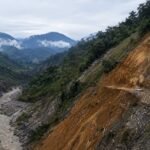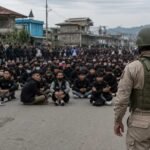

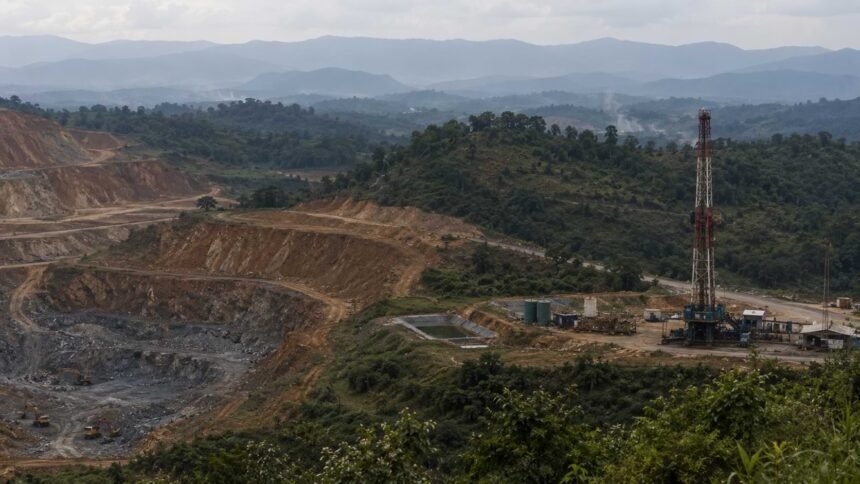
The main narrative of the violence in Manipur is presented as a conflict between the meitei and kuki-Zo communities. Though, the real story behind it is a hidden rivalry over the land that contains oil, natural gas, and other essential minerals. Since May 2023, more than 260 people have lost their lives, over 70,000 have been displaced, around 5,000 homes have been destroyed or damaged, and the police have recovered more than 6,000 weapons with lakhs of ammunition. The most affected areas of Churachandpur Kangpokpi Tengnoupal, Tamenglong, and pherzawl are the ones where drilling for oil and gas, mining operations, and large-scale plantations have been planned. Because of this, this link cannot be ignored.
Oil, Gas, and the Billion-Dollar Stakes Beneath the Hills
The geological surveys in Northeast India indicate that Manipur’s unexplored reserves of oil and natural gas could be as large as 5 trillion cubic feet in the Assam-Arakan Basin alone. For comparison, the total annual consumption of natural gas in India is about 2.3 trillion cubic feet. So, if the resources of Manipur are In fact that sizable, they could supply the whole country’s energy requirements for many years.
This strip of hydrocarbon-bearing land runs through the tribal hill areas – which, by the way, were the very locations of the highest intensification of armed conflicts, burning of villages, and military deployment.
In 2010, the Government of India gave Jubilant Energy the exclusive rights of exploration on two oil blocks in Manipur, which together span almost 4,000 square kilometers. Land Conflict Watch’s probe revealed that quite a few local tribal communities complained that they had never been properly notified about the oil drilling activities. It is claimed that villagers came to know about the exploration operations only when machines and survey teams started using their land.
Reports also accused that NOCs were obtained by exerting political pressure and by bribing local middlemen instead of holding a transparent community consultation.
The row escalated further when issues about environmental clearances came up. Local daily quoting the Imphal-based media claimed that the drilling operations started without complete environmental clearances from India’s Ministry of Environment, Forest and Climate Change.
For the tribal groups whose traditional rights regulate almost 90 percent of Manipur’s land area, these events provoked a fear that they would be gradually deprived of their lands through the system.
Rare Minerals, Green Energy, and the Global Resource Race
The resource equation goes well beyond just oil.The eastern belt of Manipur, most worth noting the section from Ukhrul to Moreh along the Indo-Myanmar border, is located close to the Indo-Myanmar Ophiolite Belt a geological complex which contains various minerals such as chromite nickel copper, cobalt, and platinum-group elements.
These minerals are essential worldwide in the manufacturing of electric vehicle batteries semiconductors solar infrastructure, and defense equipment. The International Energy Agency (IEA) points out that the world demand for copper and nickel might grow by more than 200% by 2040 from the clean energy transition. This adds to the significance of Northeast India on the world mineral market map.
Centre for Research and Advocacy Manipur and apart from that, independent researchers have stated that, a number of mining and extraction projects related Memorandums of Understandings (MOUs) numbering at least 39 were signed in tribal hill areas without proper consent given by the concerned indigenous communities.
Meanwhile, official government documents showed more than 66,652 hectares of land in six hill districts earmarked for oil palm cultivation as a part of India’s National Mission on Edible Oils. Experts on the environment caution that oil palm growth has traditionally caused deforestation, drying up of water bodies, and pushing out of local communities in several Asian countries.
Numerous tribal groups in Manipur even felt that these developments merely added to their worries that demographic and legal changes might one day facilitate the entry of corporate extraction in the hills.
Why the Scheduled Tribe Debate Became Explosive
The problem escalated to worst in April 2023 when Manipur High Court instructed the state government to take up the case of the Meitei community’s ST status for consideration.
At present, Meiteis who make up about 53% of Manipur’s population and mainly live in the Imphal Valley which is only 10% of the state’s land area, are not allowed by the law to buy the protected tribal land in the hills.
The hill tribes saw the demand for ST as not only a matter of identity but also as a possible backdoor for the transfer of land and the arrival of extractive industries and commercial ventures in the resource-rich areas.
In August 2023 ex-Lt Gen Shakti Gurung openly told Rediff in an interview that oil was “not a reason” to the war.
Yet the figures, geological charting, exploration leases, mining contracts, and land-use alteration indicate that the resource elements cannot be disentangled from the series of violent acts that are devastating Manipur.
A Conflict About Identity — and Control
The situation in Manipur does not only revolve around ethnic conflicts. It is also about the ownership of land, resources, and economic influences in one of India’s most geopolitically significant frontier states.
Always, areas with abundant natural resources that have been left undeveloped are often used as grounds for military build-up, political instability, and changes in the population through forced movement. Regions from Africa to Latin America and Asia have witnessed native peoples repeatedly being put in a difficult situation by governments, companies, and security forces rallying to gain control of resource-rich lands.
Unfortunately, Manipur appears to be turning into another instance of that world-wide narrative where every incident of a burnt down village and a displaced family is just a surface issue hiding a deeper conflict for the valuable resources underground.