
Arunachal Pradesh is currently experiencing some heated clashes again on the implementation of the Arunachal Pradesh Freedom of Religion Act, 1978 (APFRA). The fresh 15-day deadline set by Arunachal Christian Forum (ACF) to the government of the state is definitely one of the signs of concern deepening among various big sections of society who fear if such a long-forgotten law is enforced, the delicate social and religious fabric of the state will be disturbed.
APFRA has been in sleep mode for several years since the lack of definite rules for its implementation. But, the government’s moves to draft and indicate these rules have once again sparked one of Arunachal’s most delicate issues which concern religion identity constitutional rights, and even the aftermath of communal discord.
A question of Religious Freedom or Administrative Control?
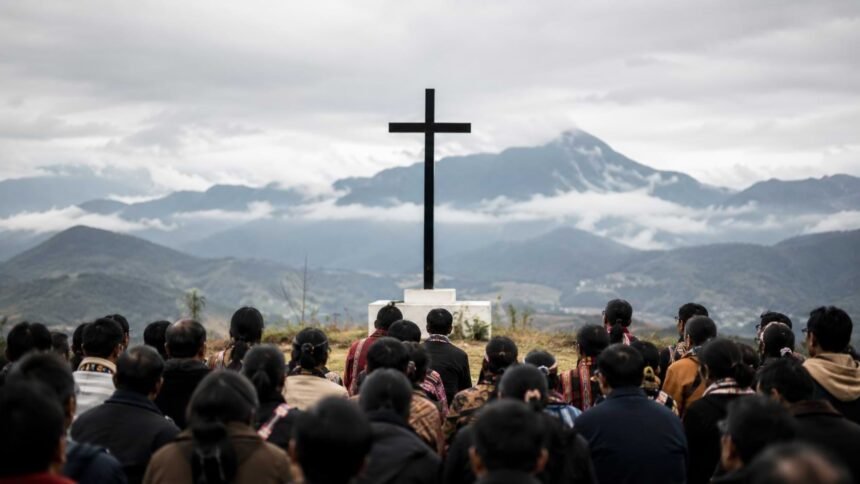
The state government says that APFRA is a measure to prohibit religious conversions through the use of force, deceit, or encouragement. Initially, such a goal may seem to be in line with the existing legal protection. But, to many Christian organisations, civil society groups, and community leaders, the reality is that the implementation of the law might result in a vibe of being watched and doubting the religious activities being carried out.
The issue at hand goes far beyond the realm of legality; it touches upon politics and society at quite a deep level. Opponents of such legal measures say that the laws in question, designed to control religious change, are frequently used against minority groups and at the same time make it very difficult for a person of faith to freely practise their religion. Apart from that, Christianity has integrated into the social life of a large part of population. For this reason, many people worry that the APFRA might be misused in a selective way or that it could be interpreted so widely that it would result in discrimination and do away with personal faith with state interference.
The Northeast’s Unique Reality
What puts Arunachal Pradesh situation on a different level is the overall setting of Northeast India. The area is very ethnically mixed, has lots of indigenous traditions and religious diversity, all coexisting within a very small social setup at risk of breaking up.
Most states of Indian mainland feature religious debates that revolve around narratives of the majority and in such a scenario the experience of the Northeast gets influenced by indigenous customs missionaries tribal identities and local self-government. Also, when policies are imposed without the consent of the people, they often give rise to a concern among the people about their cultural dominance and political marginalization. For the people of Arunachal Pradesh, it is not a question of a single law being on the books since 1978 anymore. Whether local voices and community concerns are really being considered before making major decisions on religious and cultural life has become quite a matter of debate. Failure of Consultation
Perhaps the biggest point of disagreement among the government is the feeling that the step taken came as in a move of minimal consultation. The ACF has again and again taken the stand that religious organisations, tribal bodies, community stakeholders were not only largely excluded giving their views but even discussions about the framing of APFRA rules didn’t engage them properly. Arunachal Pradesh is a multi-ethnic state where getting together consensus normally through long term discussions has been a significant way of governance Still deciding against consultation with the community goes on the way of the results that mistrust will be even more severe.
In fact, law about religion need a level of sensitivity that is beyond ordinary law because these surrounding their effects to legal administration spill over into social relations, community perception, political stability.
The Risk of Social Polarisation
The mounting deadlock between the government and the Christian organisations is indicative of larger problems facing parts of Northeast India, such as the faith becoming a key political player.
Several issues around the region have become so deeply interwoven with the matters of religion, ethnicity, and political loyalties over the last decade. The risk involved here That means is that such developments could cause the division of communities that have been able to live with each other despite their differences. In case APFRA is enforced without the whole society coming together in agreement, it might be the reason the society would stand divided and create frictions which otherwise would have been avoided between different religious and tribal groups. The possibility of protests at the state level and bandhs points to In reality the people have been quite agitated about this issue.
Arunachal’s Future Hinges on a Defining Test
At the heart of the APFRA debate lies much more than religion. Continuing in such harmony calls for transparent policies, dialogues with the people, and their consent, not decisions made by one side only.
As the time for the Arunachal Christian Forum’s ultimatum nears, the state government is put in a difficult situation: First, they can choose to go on with a potentially divisive procedure without opening their ears to the society, while However, they may decide to have real dialogues with communities whose ways of life will undergo change. It is likely that the long-term peace of Arunachal Pradesh will be achieved not through strict implementation of laws but through open and fair discussions about the laws, involving even the marginalized.