
The Northeast India that has always been viewed as a culturally rich and politically tricky region has remained at the center of both peace and turmoil. The region, which spans eight states, Assam, Arunachal Pradesh, Manipur, Meghalaya, Mizoram, Nagaland, Tripura and Sikkim, has in the past struggled with ethnic tensions, insurgencies and identity conflicts. Nevertheless, as of recently, there are signs of a subtle form of optimism and fragility, and peace processes have been progressing despite the underlying challenges that remain.
The question that can be at the center of discussion now is: Is the Northeast really heading to a permanent peace, or is fragility continuing to characterize its political and social environment?
The Chronicle of Insurgency to Negotiation: The Dynamics of Conflict.
Northeast India was characterized by the politics and security narrative of insurgent movements during decades. Such groups as the National Socialist Council of Nagaland (NSCN), the United Liberation Front of Asom (ULFA) and other groups in Manipur and Tripura struggled to achieve autonomy, sovereignity or protection of identity. Such armed movements frequently resulted in prolonged violence, security operations as well as civilian displacement.
This has changed in recent years however. There was a shift to political negotiation rather than armed conflict with a key move being the 2015 Framework Agreement with NSCN (Isak-Muivah) in Nagaland. On the same note, negotiations with ULFA groups resulted in ceasefire agreements and cadres dropping weapons. Security experts have claimed that these conversations have greatly decreased the cases of large scale insurgent violence in major states.
But still, peace is not even. Whereas some have joined the political processes, splinter groups and new armed groups still exist, especially in Manipur and in some parts of Assam. According to the Institute of Conflict Management (ICM), the number of deadly insurgent attacks has decreased in the past ten years, although, it says, that the violence still exists in certain regions, particularly where ethnic grievances have not been addressed.
A Case of Fragile Peace, Manipur.
Perhaps the best example of such delicate balance is in the state of Manipar. In 2023 the state was a witness of the ethnic conflict that lasted long and involved Meitei, Kuki, and Naga people. What began as demonstrations against reservation policies and ethnic identity quickly turned into outright violence and by the time it died down, more than 200 civilians were killed and more than 300,000 displaced according to government and independent estimates.
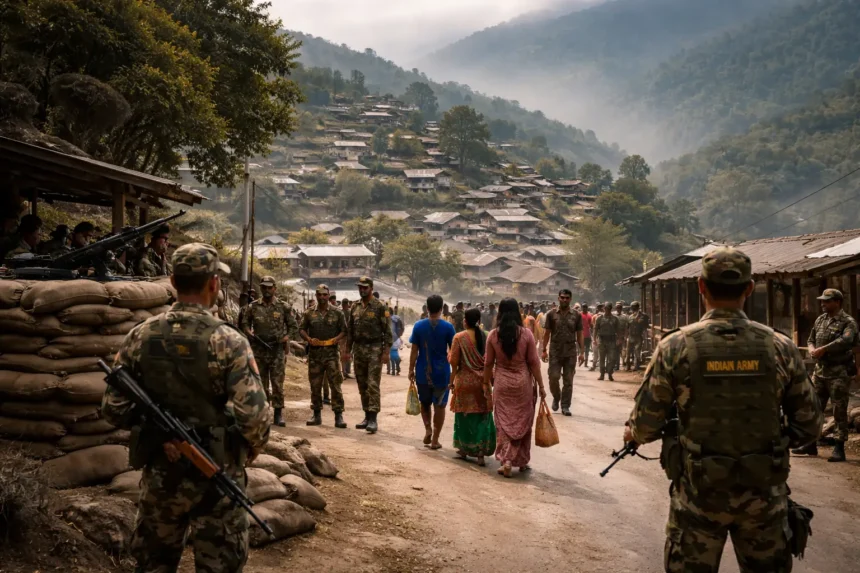
Despite the fact that the violence is no longer as intense as it was in the beginning of 2025, there are still occasional clashes and mistrust between the communities. Security forces are on high alert and life in war-torn areas is still characterized by checkpoints and regular curfews. According to reports by International Institute of Strategic Studies (IISS) peace normalization under such circumstances is a long term process which will not only demand troop placements, but also a full social reconciliation.
The political reaction has not been spared of its challenges either. The attempts to hold conversations between conflicting ethnic groups have not been very successful, and elections in some of the constituencies have been not held with security reasons. Analysts believe that without the proper resolution of the underlying land right, identity protection and economic marginalization issues, the peace of Manipur will continue to be on the brink.
Assam and Tripura: Moving towards Stability.
On the other hand, such states as Assam or Tripura have demonstrated normalization tendencies over the last ten years. Assam, which used to be marred by ULFA insurgency and factional bloodshed, records significantly fewer cases of violence. Negotiations, reintegration programmes and political assimilation has eroded the strength of operational ability of insurgent factions. The Ministry of Home Affairs (MHA) reports that the insurgent violence in Assam was reduced by close to 70 percent of the period between 2010 and 2025, which is a strong sign of stability.
Tripura, a region in the past that was a boiling pot of armed insurgency mainly based on ethnic mobilization and political disenfranchisement has to a large extent shifted to mainstream politics. Rehabilitation programmes of surrendered cadres, together with economic development programmes, have helped to curb violent outbursts significantly. According to university of calcutta research, the approach that Tripura has taken that is economic inclusion and political engagement has played a significant role in consolidation of peace in the state.
Nevertheless, analysts warn that these areas are not very stable. Problems on land rights, citizenship and cultural autonomy remain, and may rekindle conflicts unless they are addressed by long-term policy involvement.
Nagaland, Mizoram and Meghalaya: Confrontation not Negotiation.
The long-standing Naga insurgency entered a new phase with the 2015 Framework Agreement between the Government of India and the NSCN (Isak-Muivah) unit of this largest Naga insurgency group. Although an overall political resolution is still unattained, regular peace negotiations and ceasefire have brought active fighting to a minimum. According to security reports, insurgent attacks have gone drastically down and sociopolitical commentaries are increasingly pointing to Nagaland becoming a negotiation-based zone of conflict instead of a military battlefield.
Mizoram, on the contrary, is usually mentioned as a good example of conflict resolving. The Mizo Peace Accord of 1986, which was a peace agreement between Mizo National Front and Government of India, is considered to be one of the most effective peace agreements in the region. The agreement terminated the insurgency and led to a seamless integration of Mizoram in the Indian constitutional system with minimum opposition. Its success remains a topic in peace studies as the model of how to reconcile the autonomy ambitions with national unity.
The case of Meghalaya is comparatively not as volatile, and the insurgent acts are occasional and localized. The low-intensity conflicts have occurred in groups like the Garo National Liberation Army (GNLA), but the violence has rarely been on a large scale. According to experts, the relative stability in Meghalaya is associated with the enhanced community cohesion and more inclusive forms of governance.
Fragility Drivers: Identity, Economy and Governance.
Although these paths differ, some of these fault lines are common to instability in the Northeast:
Identity Politics
Grievances are still based on ethnic and tribal identities. The conflict of land rights and indigenous status of the tribal people in Manipur and certain areas of Assam have a long historical background, commonly associated with the administrative boundaries of the colonial era and the migration of people after independence. These identity-based tensions cannot be solved easily and need a long-term political bargaining and trust building.
Economic Marginalization
The Northeast is still below the national averages of economic growth in India. The region also has a significantly low per capita income which is way below the national average as reported by the World Bank, a factor which further contributes to the sense of economic exclusion. Scarcity of employment, lack of proper infrastructure and connectivity exacerbates frustrations and makes communities more vulnerable to mobilization on ethnic or political grounds.
Governance Gaps
Intense influence can be maintained by the weak governance structures and low presence of the state in remote border areas. In some of the regions of Arunachal Pradesh and Nagaland, the lack of access to education, health and legal services, weakens the legitimacy of state and strengthens parallel modalities of power.
Peace not as End but as Means.
Policy analysts and peace researchers warn that they should not see peace as a fixed state of affairs. The International Crisis Group (ICG) points to the fact that peace in the Northeast should be perceived as the ongoing process of negotiations, inclusion, and socio-economic change. Accords do not eliminate suspicion, but the long-term peace is built up by the endless dialogue, reforms of institutions, and comprehensive policy.
In this regard, the initiatives like the Northeast Regional Dialogue Platform, convening the leaders of the civil society, the government, and the representatives of the community, have proved to be significant in creating communication and minimizing misconceptions. Through encouraging grassroots level discourse, such forums contribute to addressing the gaps that sometimes cannot be accessed through formal political discourse.
Conclusion
It is difficult now to describe the Northeast India as either absolutely peaceful or as completely weak. The region is in an intermediate zone where the war-related politics are changing with major declines in armed opposition in certain states, although more fundamental structural issues are still unaddressed. Manipar is another bitter lesson that even where the outward look and the inner spaces coincide, the underlying tensions may be present.
Finally, the Northeast peace can be characterized as incremental, fragile and hard won. The future of the region will not be characterized by lack of conflict, but the ability of political institutions, civil society, and communities to work together to explore matters of identity, economic disempowerment, and gaps between governance.
Peace in North East India is not a place that has been reached but is a place of constant movement, a place of struggle.