
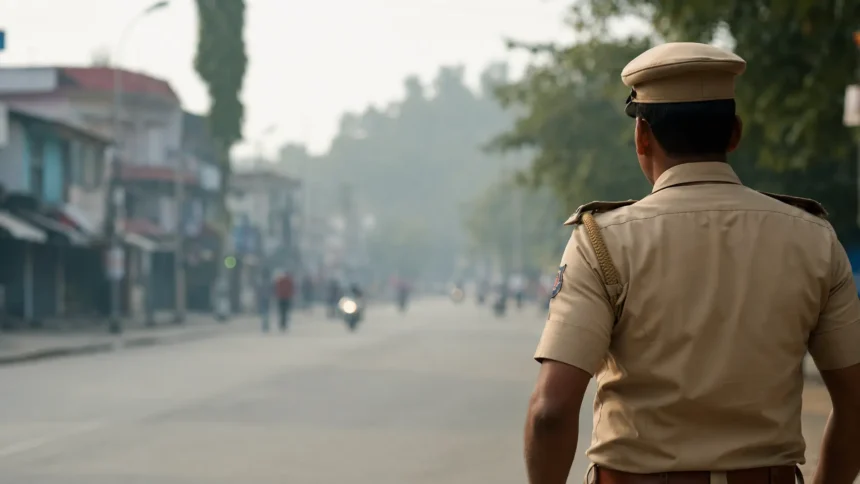
For a long time, Tripura was among the states mentioned as some of the safest in Northeast India, particularly due to a steady decline in insurgency-related violence in the early 2000s. Yet, after the political change in 2018 when BJP took over, the debate on law and order has been getting more and more disputed. Official versions focus on the reduction in crime, but bottom-up data and certain crime types reveal a more complex and even alarming situation.
Primarily, we must recognize that crime data in India mostly come from the reports published by the National Crime Records Bureau (NCRB). The data are significantly based on registered cases, which means they not only reflect the actual crimes committed but also the changes in people’s willingness to report crimes. Understanding this difference is crucial to grasping the changing crime situation in Tripura.
Government statistics indicate progress. The Chief Minister of Tripura, Manik Saha, informed that total crimes have fallen by 19.3% in the year 2024 as compared to the year 2023 in Tripura. Besides minor reductions in other categories, major drops have been recorded in property crime (45% decrease), physical assaults (38% decrease) and crimes against women (55% decrease) (The Times of India). Besides that, in 2025, the state allegedly witnessed a further 8% decline in reported cases, thus reaching what was termed as a “two-decade low.”(The Pioneer).
At first glance, the data depict Tripura as a leading State in India with respect to maintaining law and order. Official claims, in fact, indicate that Tripura is one of the States with the least crime rates in the country (tripurainfo.com). However, on a closer review it has been shown that aggregate statistics can potentially mask significant crime patterns in certain categories.
One of the most alarming problems is the persistence of serious crimes, particularly those that include violence against women. A study submitted to the state legislative assembly revealed that 144 cases of rape and 31 killings of women were registered during 2023-24 (Hindustan Times).These statistics dispute the story of a general progress and point to the fact that women are still at risk in terms of safety based on their gender.
Another consideration is the fact that crime statistics need to be interpreted in conjunction with overall national trends. Throughout India, there have been changes in crime figures, with total registered crimes exceeding 6.2 million cases in 2023 and a national crime rate of 448.3 per lakh population. When looked at from that perspective, it is possible that, even states with comparatively low crime rates generally, might yet see local spikes in certain types of crimes.
Another major problem is the reliability of crime data. Experts have warned for a long time that the drop in crime figures doesn’t automatically mean we are living in a safer world. Rather, it may be a sign of people not reporting crimes, police being less accessible, or social pressures preventing people from complaining. Research shows that crime data mostly misses the fact of the unreported things, and it is even more true for the rural areas or the ones with political sensitivities(India Data Map). In Tripura, a place where the political rivalry has got stronger since 2018, the chance of underreporting has to be taken into account for sure.
In fact, the very essence of what constitutes crime seems to be changing. For example, the violence that stemmed from insurgency has drastically decreasedone of the reasons is that peace agreement has been signed and more than 1100 militants have been disarmed and surrendered. However, the focus of the law enforcement is slowly shifting towards crimes against civilian such as physical attacks, domestic violence and clashes between different groups on socio-political issues. The move away from the era of insurgency to that of unorganized crimes reflects a fundamental change in the security scenario of the state.
Furthermore, lawmakers have pointed out that the unresolved problems of the administration such as unemployment, along with socio-economic hardships, might be turning into reasons for such incidents. It is not straightforward to establish the lines of cause and effect. However, it is well understood that high levels of economic insecurity typically go hand in hand with higher rates of small-scale crimes and disruptions of social order. Tripura is getting into a situation similar to other northeastern states due to its very limited industrial development and job opportunities mainly for the younger generation.
On the other hand, the geographical and demographic characteristics of the state become obstacles for the police. Being close to the border, the migratory flows, and the ethnic heterogeneity are factors that make the challenges of police work distinct and cannot be solved simply by improving statistics. Good governance is not only about lessening the crime but also about building the trust of the public in the justice system. Besides, the government’s claims of improvements such as very significant reduction (down 75%) in riots and assaults are some of the signs of progress in maintaining public order (The Indian Express). Nevertheless, these improvements must be considered alongside the continuing issues of serious crimes and the lack of transparency in crime reporting that raise concerns.
In the end, the discussion on crime in Tripura is hardly focusing on the question whether crime goes up or down. It is about the ways to measure crime, the aspects of crime that are given more weight/attention and the ways of evaluating governments beyond just the figures on the front pages. The overall drop in crime rates, though very good, does not definitely mean that everyone in the society will feel safe. The Tripura story shows the need for a greater policy understanding that one cannot express the reality just by statistics alone. To get a good picture of law and order, one must use not only numbers but also qualitative aspects such as reports from the ground, victims’ stories and accountability of the institutions. As Tripura makes its political and socio-economic changes, the policy makers’ challenge will be to go beyond just telling success stories and dealing with the foundational problems of crime and security. It is only at that point that the state will be able to say that it is a safe and just society not only according to the records but also in reality.


Mza agya