
The ongoing tragedy in Manipur is revealing a harsh truth: even after making numerous assurances of peace, stability and security, violence still remains part of people’s everyday lives. Twelve Kuki victims, including an unborn child, were among those who died because of several incidents reported during the period from March to June 2026. These killings have not only deepened the worries on the capability of the state government to ensure the safety of the weak groups but also the restoration of people’s trust in the government.
Many see these deaths as more than just isolated cases. They see them as part of a long drawn crisis that has continued through the time of the Bharatiya Janata Party (BJP). This has led to very serious questions on the issues of governance, accountability and how far security measures have been effective in one of the most troubled states of India.
The first reported case was on 11th March 2026 at Litan. The bodies of two men, namely Thangboimang Khongsai of Shangkai Kuki Village and Thengin Paite of Thawai Kuki Village, were found the next day. Their killing deeply distressed the local people who were already scared and living in a state of fear due to the ongoing insecurity.
Less than six weeks after that, On 24 April 2026, yet another tragedy happened in the Mulam-Shongphel area. It was reported that Letlal Siltou and Paominlun Haolai were the unfortunate victims killing which had a great impact on the residents who thought the cycle of violence was not ending. This event raised even more worries that the authorities were only giving the residents false hope that the situation was under control whereas these vulnerable groups were still at risk.
On 13 May 2026 the violence along the KotzimKotlen road escalated even further. Three well-known Christian leaders Rev. V. Siltou, Pastor Paogoulen, and Rev. Kaigoulenwere killed in an incident that sparked international outrage. The murder of faith leaders severely disrupted communities and revealed how the conflict was increasingly taking a human toll. To a lot of people, going after clergy members was a sign that social norms and the sanctity of civilian life were collapsing on a larger scale.
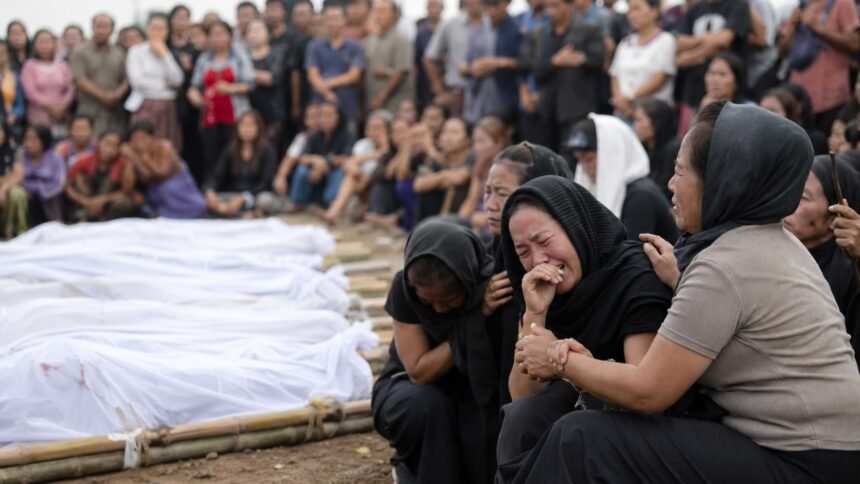
Without a doubt, the worst incident happened on 5 June 2026 at Loibol Khullen where four members of the same family were killed as per reports. Their names are Jangminlal Haokip, Letkhongam Haokip, Tinmary Haokip, and the unborn child who was seven months old in the womb. Sharing the death of women and unborn children is perhaps the most agonizing way to highlight the price of human life lost through continuing unrest. Besides victims, these tragedies also have long-lasting effects mostly generations and it is actually a source of great pain.
Only a few days later, on 9 June 2026, Haokhogin Lhouvum was declared dead in Lasan. This event brought the total tally of reported casualties for the March-June period to twelve, counting the unborn child.
The basic issue that emerges out of these terrible incidents is straightforward: why hasn’t the violence stopped even though the security forces have been deployed massively and the governments kept reassuring? Manipur is no stranger to innumerable top-level meetings, security review conferences and political statements. But for common people around, peace is still a distant dream.
The BJP-led government has not only failed to provide security to its citizens but also failed to perform even the most basic task which is protecting the lives of the citizens. Different communities are still living behind the fear, roads are still dangerous, and people’s faith in the government has been greatly shaken. Although the political leaders often talk about the situation becoming normal, the ongoing deaths of the innocent people tell a very different story.
The fatalities recorded in the period from March to June 2026 should be a wake-up signal to us all. A lot of stuff goes on outside the political talking points and formal declarations, the raw truth is that there are families mourning the loss of their loved ones, there are communities who are suffering from post-traumatic stress disorder, and there are people who are thinking about whether justice and safety will ever make a comeback.
The people of Manipur are entitled to more than mere promises. They should be provided with accountability, proper safety measures, and sincere dedication to peace that lasts. Without these measures in place, each death will only remind us of the situation that the governments have time and again said toc be resolving but which is yet to be ended in reality.