

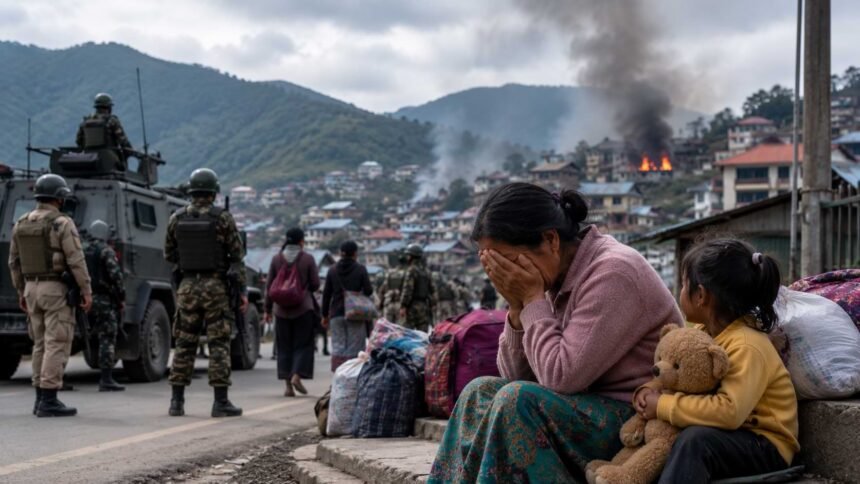
On 4th June, 2026 Amnesty International put out a strongly written statement in which the organization demanded the immediate and unconditional release of all the civilians being hostage in Manipur. Further, the organization cautioned that the persisting captivity of civilians is a manifestation of a human rights crisis that is deteriorating in silence, besides it is an indication of authorities’ failure in protecting vulnerable communities from ethnic violence that is going on escalating.
This statement is just one more reminder that even after three years the state of Manipur which was shaken by violence is still caught in this ongoing chain of insecurity, lack of trust, and displacement as well as political paralysis. Most of the time it is a officials’ focus on that things are getting better while at the same time family members are still finding their lost ones, communities are facing each other in the state of fear and at the same time armed groups are holding territories where the state’s authority is more and more deteriorating.
Abduction & Increase in Conflict
The human rights organization has stated that during the rise of the conflict in the hilly regions of Manipur, around 20 civilians from both Kuki and Naga ethnic groups have been abducted. The organization considered the hostage crisis to be one of the most drastic escalation after the violence that broke out in May 2023. The hostage-taking is a loud signal that ordinary citizens have been turned into pieces in a game of conflict that has been extended beyond the initial Kuki-Meitei confrontation. The ethnic clash between the two communities which was at first a event of violence has now enriched to a security crisis involving various groups and creating new rifts while also reviving old grievances. One of the leading human rights organizations at the global level has criticized the…
Amnesty pointed out that after the May 2023 violence, over 200 people have lost their lives and more than 60,000 people have been displaced. Such a call is based on a very elementary principle of humanity that, notwithstanding political and ethnic disputes, the innocent should never be used as instruments of retaliation.
BJP Governments Under Scrutiny
Amnesty, in its statement, among other things, castigated the BJP-led central government and the successive Manipur governments very strongly. Amnesty has highlighted despite continues try and repetition, the authorities have been still failed and neglected to stop violence and guard human rights towards minorities and people are continuously losing their homes, places of worships & everything they have.
This conflict right now is causing the government a huge problem. Is it fair that a democratic country is warning its citizens of displacement while some parts of the population have been living in displacement for years? How is it that the armed groups still exist when the civilians are constantly scared? What prevented the political leaders from proposing a strong reconciliation plan?
These are largely the questions that still need answers. In 2025, the Government of India declared President’s Rule in Manipur, a drastic step that practically admitted the failure of the state government to maintain law and order. Though, even this step toward direct central administration did not lead to long-term peace. Though many thought that a new cabinet led by Chief Minister Yumnam Khemchand Singh after President’s Rule was lifted in February 2026 would lead to a stabilization of the situation, in fact violence abduction, and economic blockades still prevail, indicating that a mere change of political leader cannot solve the deep issues causing the conflict.
India’s Northeast and the Politics of Neglect
Manipur’s turn of events also shed light on another ongoing problem that plagues India’s Northeast. For years, various groups of people there have been expressing their dissatisfaction with political neglect, lack of proper representation, and slow reaction to their security issues.
Generally, we only see the government stepping in or the police taking action when the violence has already reached scary levels. Afterwards, when the media coverage dies down, the main grievances are still there. This cycle has led to a further feeling among the local populations that their problems are considered as less important compared to the political matters in other places. Manipur is just a microcosm of the whole thing. Security measures cannot be a weapon to force peace. It is about talking, taking responsibility, delivering justice, and really working with the communities that have been affected.