
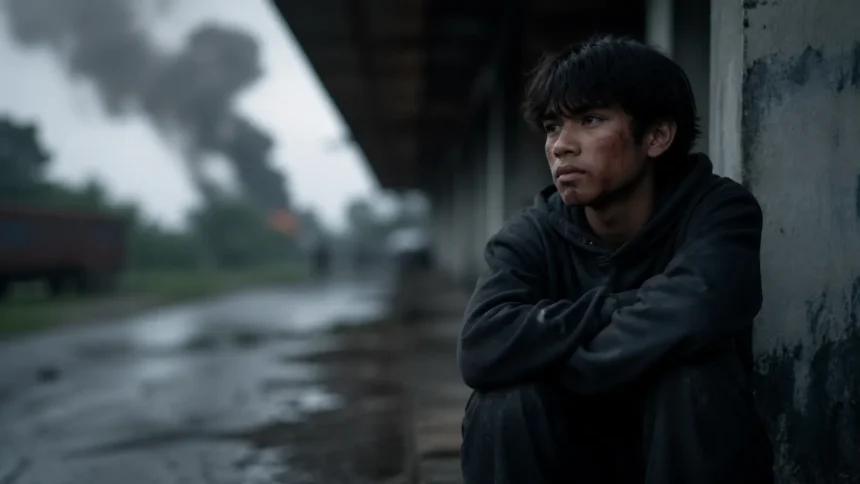
The barbarous assault on the Assamese boy in Andhra Pradesh does not represent an isolated moment of violence but rather a far more complex and disturbing narrative of the increasing sense of insecurity and vulnerability that the people of North East India feel upon traveling outside of their own states.
Migration for Survival, Met with Violence
Migration for many young people from the state of Assam and the Northeast is not a matter of willing choice but of dire necessity. Elsewhere in this paper, it has been pointed out that high levels of unemployment mean that young Assamese youth are compelled to undertake long journeys to different part of the Indian nation in search of employment opportunities.
Absent home and family contexts, migration from Northeast India also inevitably mean those migrating are subject to factors such as discrimination, exploitation and extremel violence and even attack.
The attack on a group of Assamese far away from home state raises several anxious questions of their safety and security.
A Pattern of Prejudice and Isolation
Such incidents unfortunately are not new. State residents from the Northeast had been routinely subjected to racial assaults, verbal abuse and even violence, from their metropolitan experience to distant states because they look different, because they either didn’t understand the local tongue or dress differently, because they had different customs and traditions.
No matter, the assurance they received, the hue and cry raised in the name of protected local interests: level heads uphold that systems of protection still remain weaker, and accountability is far from assured.
Although no motive has been established by officials, the sheer brutality of the attack is an indication in itself. Eight gunmen assaulting unarmed applicants say more than just “gunfire and blood” they say that people are operating in a milieu where such acts can go unpunished. The unexplained motive is also symbolic; most cases of this kind go unexplored.
The Broader Question of Internal Security
This brings to light a major lacuna in the internal security architecture of India. While large scale security concerns and narratives are being built around external security and the national state, safety for internal migrants from weaker provinces has been relatively ignored.
International travel by a minor and internal mobility for employment can’t be secured shows up the inability to govern and secure internal mobility.
Human Cost Beyond Headlines
More human tragedy resting behind the emotive headline. But all those other families who have given up their child for adoption, knowing that they’re going to be slaughtered today, are seemingly just sitting there waiting for their fantasies to come true, and dreaming their worries away. Words will not do it they are important, but simple expressions of support and concern are no longer sufficient.
The psychological effect on sub region’s populations reinforces those fears and retards their eagerness to seek opportunities elsewhere. This retards their economic upward mobility and makes them more isolated.
The attack on Gogoi should not remain a mere incident in the past to be forgotten. It calls for an impartial inquiry, sustained repression, and above all systemic changes so that the citizens of the Northeast are safe everywhere in the country.
It is illusory to think that we can afford protection differently for different regions. No region or country must be alien for the safety of their citizens.
There is a new need for additional legal protection, further inter-State cooperation and exhortation to tackle racial prejudice and discrimination. The authorities in the States concerned need to become more sensitive and attentive in order to act swiftly to the victims.
A Nation Tested by Its Treatment of the Marginalized
The true test of a country exists in its treatment of the most weak and defenseless of peoples. If those from the Northeast continue to face violence and insecurity within their own borders, there are hard questions that require answering about such things as inclusion, equality and fairness. A united future is not built on words but on protection, respect and equality.