
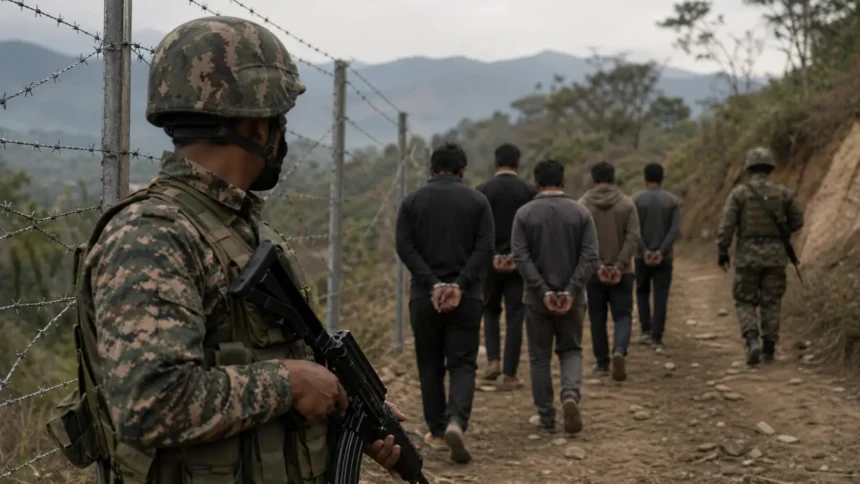
In April 2026 a series of militant arrests was announced in Manipur and Arunachal Pradesh. However, a thorough investigation of the situation indicates a much more worrying scenario. Instead of a sign of stability, these events reveal a continuous problem of border insecurity, lack of intelligence, and reactive administration in the India-Myanmar border areas.
The border between India and Myanmar runs for about 1,643 km and goes through some of the most rugged and forested areas of the Northeast. A big part of it is still unfenced and the old Free Movement Regime (FMR) which lets locals cross the border without visas up to 16 km has been a great enforcement challenge. Even though the government is planning to review or stop some parts of the FMR, in fact insurgent groups have for many years used this open border to have their safe havens across the border.
Security assessments and reports by various agencies including the Institute for Defence Studies and Analyses and the South Asia Terrorism Portal have consistently invoked the fact that insurgent camps are operating in Myanmar’s Sagaing Region. Militants such as the NSCN-K, ULFA (Independent) and PLA (Manipur) have not only been using these camps for their own training but also for their regrouping and logistics arrangements. Last year’s arrests which took place in April 2026 at Tengnoupal, Ukhrul, or even in some parts of Arunachal, are just fragments of this long established pattern which did not disclose any major rupture in the militant networks.
The data trends supporting it. The Ministry of Home Affairs annual reports show a decline in the number of insurgency-related incidents in the Northeast by 40 percent from 2014 to 2019, the BJP government has often cited this as a rebuttal to the critics of the ruling their policy in the region. Though violence was on the decline for some time, this decrease came to a standstill, and Manipur has been facing a series of new ethnic violence outbreaks since 2023, accompanied by some militant activities in the bordering districts. ACLED further points out that the number of violent incidents and armed clashes in Manipur in 20242025 was significantly higher as compared to the previous years.
Therefore, the bunch of arrests made in April 2026 doesn’t really signify a breakthrough, rather it indicates the continuous permeation of the problem.The reasoning here is simple: repetition of arrests means repetition of entries. If militants are caught in different districts within a few days of each other, it indicates that the cross-border movement is not only going on but in fact doing so to such a large extent that the operations inside Indian territory are sustained.
This is a direct refutation of the BJP government’s assertions of “tightened security” and “decisive counterinsurgency success”. Actually, a secure border would mean fewer arrests over time and not necessarily in big bursts. From the counterinsurgency point of view, arrests are simply one of the tactical outcomes; the real measure of strategic success is the breaking down of the networks and the denial of safe havens. This is why, according to that standard, the incidents in April serve to confirm the existence of the situation rather than point to a change.
Another reason of concern is lack of transparency of many of these operations. Official statements sometimes barely disclose the identities, affiliations, or the final legal/prosecutorial status of detained individuals. Without transparent follow-up on the charges that were filed, exposed networks, or disrupted supply chains, these announcements would likely become only isolated headlines rather than components of a comprehensive security strategy. At that time, the issue of managing the narrative is inevitable.
Governments that are under political pressure, especially in conflict areas like Manipur where ethnic tensions and civilian unrest have drawn both national and international attention, are strongly motivated to feature security “successes” prominently. The closeness in time of such reports and their dissemination through official channels raise the possibility that the arrests are employed as a tool to show the image/illusion of control rather than to substantiate the presence of control.
To clarify, this means that the arrests are not made up. The security forces, Assam Rifles, local police, and paramilitary units, are in very difficult circumstances and do real operations indeed. The problem is not with the staff but the political communication of results. If small counterinsurgency actions are touted as very big successes, it will give a false idea of progress. Besides, the underlying issues that lead to militancy have not been significantly addressed. The insurgencies in the Northeast cannot be solely attributed to the cross border factors; they are also a result of political non-inclusion, economic deprivation, and ethnic tension.
The continued violent clashes in Manipur in 2023 surely highlight that these old problems can very quickly lead to conflicts irrespective of how well the borders are guarded. Myanmar is a factor in this matter in several ways. The military coup in Myanmar in 2021 led to the significant loss of state control over the border areas especially the Sagaing region and/up borderers areas in general. This indirectly gave insurgent groups more freedom to carry out their illicit activities. In light of this, India’s ability to perform joint counter-insurgency operations beyond the border, like the 2015 surgical strike on the NSCN-K camps, has been greatly limited due to the changed geopolitical environment.
However, it is very rare for official statements to acknowledge that these external factors can actually be the main reason why a policy is failing. In fact, the arrest incidents of April 2026 point to a deep-rooted inconsistency in BJP’s policy towards the Northeast region. To illustrate, one party of the debate, simply by closely observing the surface events, continues to boast about peace agreements, citing statistics of reduced violence, and making arrests. Whereas, the other side of the coin, the constant problems of border management, regional diplomacy, and internal reconciliation continue to remain inadequately dealt with.
It is up to the person to decide whether the authorities really made the arrests or only used them as a propaganda tool. However, there is a point at which the two sides converge. If the authorities really made the arrests, then they will disclose the fact that the authorities still have loopholes in controlling borders and gathering intelligence. If the authorities only used the arrests as a weapon of propaganda, then they tried to manage the perception of people at the time when there was unrest. No matter in which case, the authorities have not proven that they have achieved a lasting security by the means of the arrests. The India-Myanmar border at present is a very much a place of transition and contest. Besides the nature of land and politics, the border is also affected by the government policy. Only when the government stops treating the enforcement of law as a one-time event and starts dealing with the deep-rooted issues of the conflict, the chain of arrests will stop prompting people to ask the same question: Is this an indication that we are moving forward or is it just a manifestation that the problem is still there?