

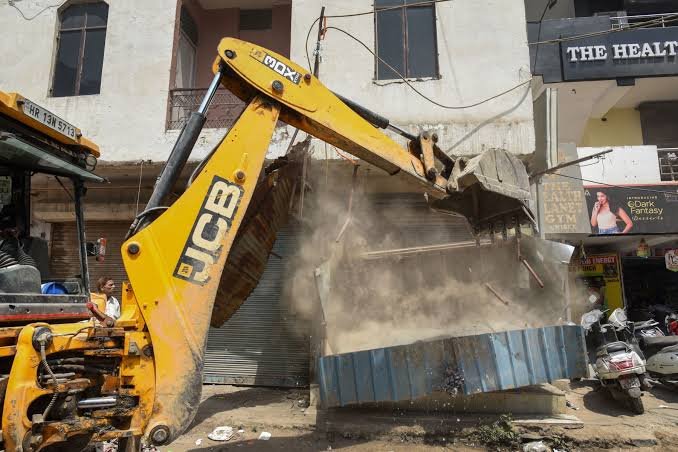
In BJP-governed Assam, the deafening roar of the bulldozers is a haunting echo of human suffering of the State’s eviction drive. Entire communities are being forcibly evicted and displaced by the State under the guise of government land reclamation by Chief Minister Himanta Biswa Sarma creating an alarming wall of silence in front of the suffering.
Over 1,100 Muslim families are said to have been displaced in this pocess while fresh demolitions at Hojai, Nazira, and Merapani have raised concerns of more displacement. According to figures released by the Forest Department, 152 families have been evicted so far from the Jamuna Maudanga Reserved Forest in Hojai. In comparison, another 59 families have been evicted from the Assam-Nagaland border at Merapani. The demolition of the only mosque in the area has further fueled anxiety over the religious and social implications of the ‘operations’.
The bulldozers are at work. Homes are flattened. Livelihoods are destroyed. Children’s lives are uprooted. Families are silenced helplessly, watching helplessly as everything they know is erased. And every time, there is a family with an uncertain future. The Himanta administration claims these sweeps as a legitimate attempt to remove encroachments and recover public land. But, they cannot justify the government’s failure to ensure due process, safeguard the residents, and lessen the aftermath of mass displacement.
What kind of development celebrates reclaimed land while families struggle to find a roof over their heads? What value does progress hold when its human cost is measured in homelessness, insecurity, and shattered livelihoods? Though the estimates of evictions in Muslim communities are alarming for another reason as well: are the land laws being implemented impartially in Assam, or are marginalised communities being burdened with the government’s policies?
Such worries must not be addressed through political commitments alone. They need transparency in eviction processes, effective legal mechanisms, verification of contentious land claims, and reliable rehabilitation solutions for families. But for those who are forced to move, the destruction doesn’t stop when the bulldozers pull away. Children are stripped of their right to school, families are left without an income and communities, having taken years to build, may be broken up and forced to begin again with few resources and little security.
A government cannot point to acres reclaimed as a measure of administrative triumph and ignore the human toll that made these lands available. Land reclamation cannot be an excuse for elevating the destruction of lives to the level of collateral damage. For Chief Minister Himanta Biswa Sarma’s government, the major challenge at the moment must be to face up to this question: If the state has the power to pull down the house of a family, does it not have the moral obligation to ensure that it does so within the boundaries of the law, with compassion and with respect for human dignity and the basic rights of the citizens?
As bulldozers embody state power and displaced families scramble to find refuge, the question should be less about how much land has been reclaimed and more about how much humanity has been lost.