
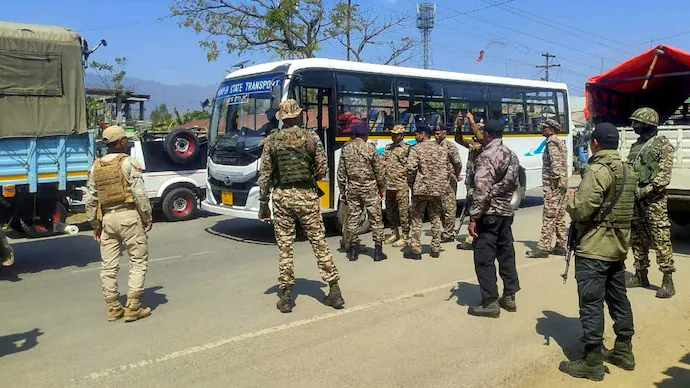
The cold-blooded attack upon, and murder of three members of the Thadou Baptist Association in Kangpokpi district of Manipur serves to illustrate how the dismal deterioration of law and order, inter-community trust and harmony, continues to accelerate in the violence-ridden state. They were reportedly on their way back from a church conference in Churachandpur, and they were defenseless civilians and prominent members of their community.
The National Socialist Council of Nagalim (NSCN-IM) condemned the shootings as “a devilish act “; they called on the authorities to apprehend, interrogate and bring the culprits to book. They also warned of “blame games” where “they are not attributed to innocent and innocent who found themselves under the gun” and accused “people whom vitiating the atmospheres in Manipur to keep alive the ethnic issue”. But behind expressions of condemnation there is a reality that is far more disturbing. Manipur is falling ever more precipitately into a fragmentation process that state authorities seem ill equipped to arrest or to restore confidence in.
The Question over Long Sustained Violence
More than one year after the violent clashes between Meitei and Kuki-Zo communities broke out, there are daily reports of armed violence ambushes bandhs or reciprocal accusations across most of the state.
The Kangpokpi attack is even more frightening because the dead were not combatants but church leaders. This killing shows how the violence in Manipur has seeped into areas which used to be safe churches, plying on public transportation, community hots and even sacred homes. Really unarmed civilians and religious figures are seen to be targets is an indicator of unstable security as well as a healthily dangerous acceptance of violence into everyday life.
Between Kangpokpi and Churachandpur districts, standard travel routes have seen numerous blood battles, barricades and attacks. The repeated closures after such incidents have also crippled everyday life even more, continuously affected access to medical, education and trade establishments and widened the ethnic divides of the already polarized communities.
The repeated closures after incidents like these further hampers the daily life and access to hospitals, schools and trade throughout the region, and also serve to widen the ethnic gap among the far-sided communities in the region. Politics, Militancy and Competing Narratives. The attack has further resulted in propelling the Armified organizations and political groups into scapegoatism. As the attack took place Kuki organizations in some reports accused Naga organizations and in other reports refuted to make any such allegation and warned to preponderate communalism. This aura of suspicion points to the perilous complexity of the Manipur conflict in which issues of ethnicity militancy territory and politics converge ever deeper.
Blame Shift: Justice Still awaits
Each episode of violence readily turns into a fragment of competing versions, with organizations accusing each other of seeking to browbeat popular anger to set traps for their rivals. The failure of the political leaders regional and national to politicize the reconciliation process is another criticism that local communities back into their ethnic camps protected by armies, volunteers, and local militias.
Since the eruption of violent clashes in 2023, Manipur has seen hundreds of deaths, mass evacuations and the virtual segregation of entire communities in a number of districts. Thousands of people remain displaced, and armed groups operate freely in many places despite regular deployment of security.
The Kangpokpi ambush also Reveals More Than the Violence in Manipur
Even if areas which are hyper-militarized are facing attacks and problems of such scale can be posed by extremists, then problems of governance paralysis and failure of state machinery in protecting civilians become critical issues. The disruption also makes worse the socio-economic fabric of Northeast India as a region. The church, tribal organizations, student groups and civil society group are being drawn deeper into ethno-political conflict and reconciliation becomes even less feasible. There is nothing new about these condemnations, yet the murders are still happening in Manipur. The killing of the religious leaders as they arrived home after a church gathering is exactly the sort of event that demands a swift and firm response. Yet the air is once again filled with counter-accusations and political infighting. The Mainly destructive nature of the crisis is its inescapability.
Fear is becoming routine. The fear that is traveling with people, the fear that causes people to choose care-fully which highway they take, the fear on which more than ever post-colonial subjects are maintaining their ethnic roots to protect them rather than the institutions of their state. The incident at Kangpokpi Because of this needs to be seen not just as one more tragedy in the long running Manipur conflict, but as a symptom of a breakdown in coexistence; a symbol of how suspicion, militarization and ethnic violence are dragging a constitutionally fragile state into anarchy.Without serious political engagement, accountability and civilian protection mechanisms a task that is Without a doubt urgent there is the very real risk that, as attacks continue to be met with mounting rage, and retaliation and division, Manipur could stay stuck in this vicious feedback loop.