

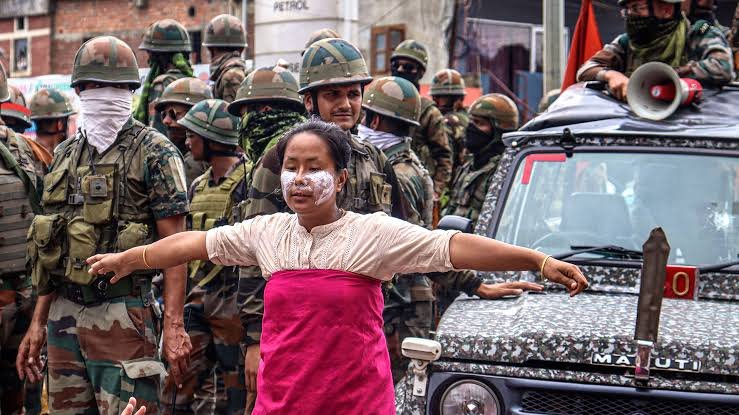
The killing of Hatneikim Haokip in a suspected militant ambush between Molnoi and Phaikoh in Manipur’s Kamjong district on 15 October is not an isolated tragedy. It is the latest indictment of the Narendra Modi government’s prolonged inability or unwillingness to restore basic security in a state it has effectively controlled for years. Haokip was shot dead while travelling with three others on two-wheelers to buy essentials; her husband was injured and escaped, while D. Paokhothang Haokip and his wife Boishi Haokip remain missing. The Kuki Inpi Manipur (KIM) has directly blamed NSCN-IM cadres and accused both the state and Centre of allowing armed groups to operate with impunity.
KIM’s statement is blunt: “The government’s continued silence and lack of decisive action make it complicit in every innocent life lost.” This is not rhetoric from the periphery. Since the Meitei-Kuki violence erupted in May 2023, more than 260 people have died and tens of thousands have been displaced. After N. Biren Singh’s resignation and nearly a year of President’s Rule (imposed February 2025 and revoked February 2026), a new BJP government under Y. Khemchand Singh was installed with Kuki and Naga Deputy Chief Ministers. Yet Kuki-Naga clashes have intensified in the hills, with reports of roughly 32 Kuki-Zo and 22 Naga deaths since February alone including multiple women and reciprocal atrocities such as the recovery of a Naga man’s severed head.
Prime Minister Modi has met the Chief Minister, offered assurances, and overseen massive security deployments. The results on the ground, especially near the porous Indo-Myanmar border, remain the same: civilians ambushed on routine errands, road blockades, and militants (including groups under ceasefire arrangements) striking with apparent ease. The Centre’s pattern periodic high-level meetings, claims of “decline in violence,” and selective political engineering has not ended the cycle. Each fresh body recovered is evidence that New Delhi still treats Manipur as a managed problem rather than a crisis requiring decisive, even-handed action against all armed actors and genuine political resolution.
Until that changes, Haokip’s death and the missing couple will not be the last.