


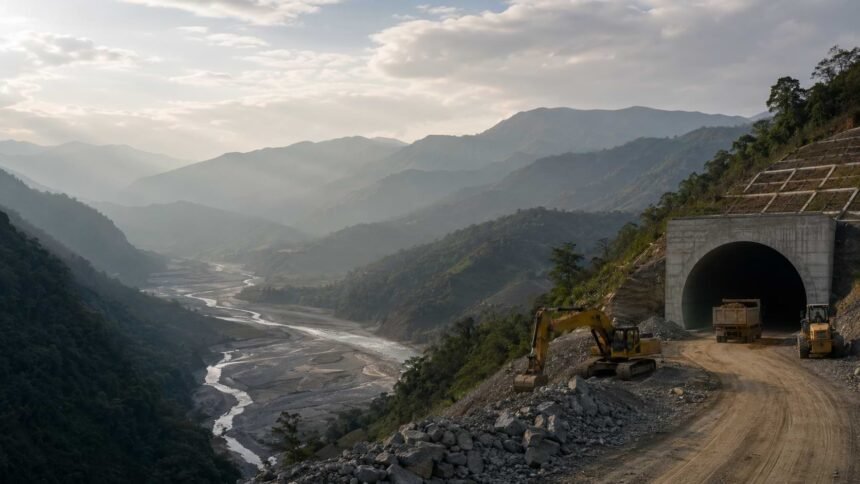
The Northeast is only known in flashes, for most of the country: a clash in Manipur, a festival in Nagaland, a new tunnel, inaugurated by a visiting minister. The area provides India with little more than a news cycle of attention. But eight states, with over 45 million people and about 8 per cent of the nation’s area, rest on the border with South Asia and Southeast Asia and have a strategic importance that is not fully appreciated in mainstream political discussion.
The Northeast should no longer be viewed as the country’s periphery – it should be considered as what it is: a frontier that will define the future of security, economy and identity of the country.
The area by distance not geographically only. It is not just that the northeast is marginal to the national imagination; it is because that is the case. The region came into being because of a variety of princely accessions, colonial administrative boundaries, and post-independence negotiation processes that have resulted in many communities feeling neither included nor absorbed in the Indian Union. The Siliguri Corridor, which is only 20 kilometers wide at its narrowest point, is physically linked the Northeast to the rest of India, but it has also served as a metaphor for the thinness of the administrative and economic and emotional links:
That was a distance that fed cycles of insurgency for decades. The reasons which gave birth to these movements — such as alienation from Delhi, slow development, weak governance — were genuine, and resulted in the evolution of ethnic and separatist demands by Naga, Assamese, Bodo, Mizo and Manipuri movements, etc. Over the past half-century, over fifty-armed groups have operated throughout the region, with some seeking secession, others, recognition or resources or a handful just doing insurgency as a business when the initial cause of action had been reduced to a low priority. The human price is high: generations growing up with curfews, schools closed in war regions, an economy that failed to gain momentum in the way of the rest of India.
The subtle shift since 2014. The security landscape has drastically changed. Extremist violence in the region has decreased by about three-quarters since 2014, and fatalities of security personnel and civilians have declined even more dramatically, according to government figures. For over a decade, more than a dozen peace accords have been signed during which insurgent warring groups have been placed in political negotiation, not armed conflict. Envisaged infrastructure has started materializing: Mizoram’s first rail line, Sela Tunnel connecting with Arunachal Pradesh, and roads and aerial connectivity have been steadily coming in through schemes designed specifically for the Northeast.
This development is good news and shouldn’t be lost in the area’s historical reputation for volatility. Of course, a decrease in violence is not interpreted as a solution to these questions. One of the starkest examples of the ethnic crisis in Manipur which needed to be highlighted is the sharp deterioration in the state in 2023 and the ensuing instability since then which is unaffected by better regional figures. Peace agreements do not necessarily address the conflict over land, identity and political representation that gave rise to the violence, and instead merely lower the number of violent incidents. The risk is to think that the Northeast is a tranquil place.
From the front lines of war to the front lines of resources. A second, less talked about shift is taking place: the Northeast is more and more being read by policy makers as a resource than an insurgency. In order to explore the mineral resources of the region, the Geological Survey of India has stepped up its mineral exploration activities in the states of Manipur, Arunachal Pradesh, Meghalaya, Mizoram, etc., where lithium, cobalt, graphite, nickel and rare earth elements (REEs) – the raw materials of the global energy transition – are in demand. Dozens of exploration projects have been conducted throughout the region in the last few years alone.
The change holds real promise as a region that has been a security risk may now become an economic asset. The language of this change, however, calls for investigation. Official language has started to address several Northeastern States as ‘frontiers’, a term that historically has not been auspicious for the people residing there. In the colonial mindset, frontiers are places that can be appropriated by someone else, rather than places that can be consulted with. The Northeast is in danger of becoming another region in India to experience the kind of marginalisation that has come upon coal and oil – extractive, undemocratic, and environmentally destructive – in green terms.
The test will be simple: Can local communities feel they own this wealth and is the wealth creating the roads, schools and hospitals that the region has waited decades for or is it just going out of the region again?
So, what does it take to reimagine? None of this is an excuse for the real improvement that has taken place over the last ten years. It’s a criticism of insouciance over its accomplishments. Three changes are more important than an individual new scheme or summit announcement.
First, the gains in security must be commensurate with the continued political dialogue with communities whose grievances have never been about violence itself but rather about their representation and land rights, along with their autonomy. Right now, the best way to prove the Indian state can do this well is to watch how it’s working in Manipur, and the results so far have been mixed. Second, there is a need for regulations to protect the resource boom from going overboard. If minerals are mined without the consent of the people and protection of the environment, then it will give rise to a similar alienation that resulted in prolonged insurgency with the added dimension of an environmental cause. Third, connectivity to Southeast Asia must be backed by and implemented at the same speed as the rhetoric of the strategic vision calls for, rather than the speed of bureaucratic momentum. A gateway with minimal to no operational delivery is not delivering for anyone!
The Northeast is not the backbone of India. It’s the land where the nation’s internal unity, economic destiny and regional agenda towards China and the Southeast converge. Reimagining it means doing just that: thinking of it not as a problem to be managed from Delhi, but as a region that is worthy of its own aspirations, communities and geography in shaping how India thinks about its own future.