

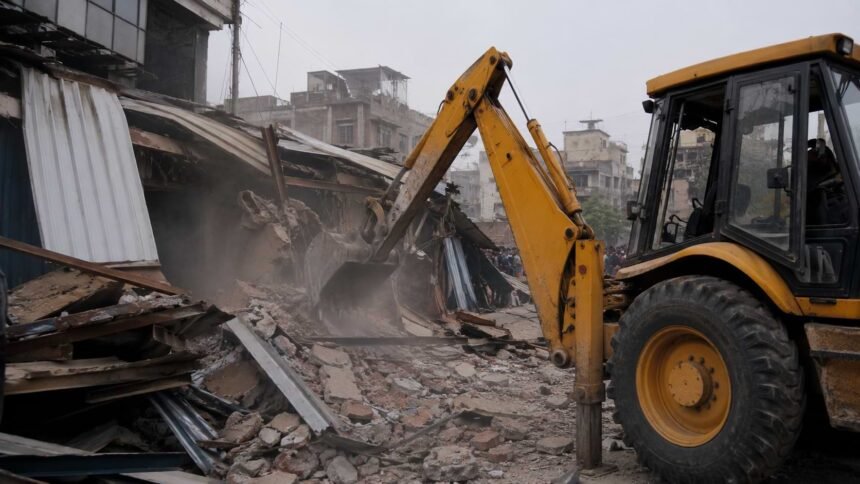
Just a month since the Bharatiya Janata Party (BJP) formed its first-ever government in West Bengal, the state is going through the classic scenario that has been a feature of several BJP-ruled states: demolition drives, heavy-handed policing, and political confrontations. Besides, what critics term the “bulldozer governance” is the new landscape of West Bengal.
Having won more than 200 seats and brought an end to the 15-year rule of the Trinamool Congress, the BJP pledged “Poriborton” (change). But for many ordinary citizens, Mainly street vendors, small traders, and residents of informal settlements, the first month of change has been characterized by very little development and a lot of apprehension. It is being reported that the demolition drives against encroachments and unauthorized buildings are turning out to be the new symbol of the administration. In fact, opposition parties have already accused the government of importing the controversial “bulldozer model” that is being seen in other states like Uttar Pradesh.
The Rise of Bulldozer Politics
Demolition vehicles, i.e. bulldozers are increasingly being used as political symbols rather than simple administrative tools. Across India, such demolition drives are often portrayed as evidence that the government is capable and decisive in its governance. In West Bengal, this development seems to be escalating quite fast.
Just a few days after the BJP-led election win, newspaper and TV channels started showing scenes of the bulldozers in Calcutta’s New Market area while at the same time some allegations of demolitions and political tensions were being made. People criticized BJP illegal bulzoder politics throughoput West Bengal. However, it is continued, this brings up the question: why do these operations normally targeting small vendors, poor people and marginalized groups fall barely on the radar while larger violations getting away with hardly any scrutiny?
West Bengal’s Poor Are Paying the Price Generally, in India such anti-encroachment drives are mostly targeting those who have lesser means to get their point through to the government. Street hawkers, informal workers, and small business owners are often the ones getting hit by sudden demolition drives. Despite these, many West Bengal people are still struggling. Unemployment of young men is one of the major issues and the rising prices of essentials are making it harder a lot of households to meet their needs. Instead of focusing on job creation, industrial development, and public welfare, West Bengal’s political debates have recently been mostly about demolitions, arrests, and political score-settling.
Many of those who voted for change were rightly full of hope that this would bring more and better jobs, better education, healthcare, and the like. Instead, the change they have got is a government that wants to show it is strong through the very visible deploying of police and other law enforcement personnel. Political polarisation is going even deeper
The Story that Countinues
The first 30 days of BJP rule saw sharply rising political tensions in the country. Post-election violence led to fatalities, the police detained hundreds over riots and altercations after the polls. If anything, instead of calming down an already divided scenario, the political environment seems to have become even more threatening. The language of governance is officially increasingly a mirror of the language of political victory and defeat.
Democracy cannot function well if every single administrative decision is looked at only from a partisan/party perspective. West Bengal, notorious itself for political violence, could have used the election as an opportunity for healing. Yet, the state is witnessing another round of violence and political rivalry. Development cannot be equated with destructions alone
BJP during the inaugural month of its government, has cited welfare programmes, elimination of corruption, and border protection as the principal programmes. Its advocates argue that such a bold step was needed after the opposition’s years of alleged mismanagement. But, real development is not evaluated by the number of bulldozers or the extent of demolition.
The people of West Bengal deserve a government that puts the main emphasis on economic revival and social cohesion instead of mere show of power. A government that has won with a huge majority has a chance to bring the whole state together and work on the problems which have existed for a long time. Using a bulldozer as a symbol of power is a sure way to lose that chance,