

A recent probe by Enforcement Directorate into a 142-crore drug laundering racketeering in Mizoram, Tripura and West Bengal has revealed an unpleasant truth: Northeast India is being used as a hub for transnational crimes but remains barely considered when it comes to India’s national security.
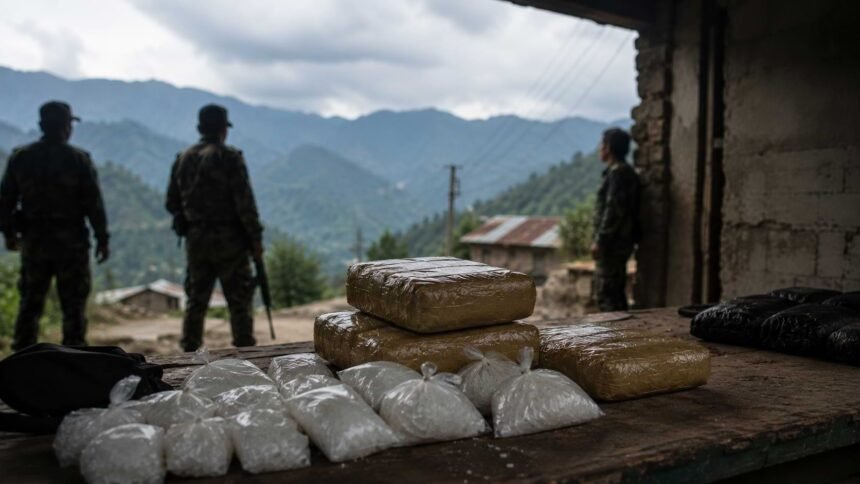
Investigators say that methamphetamine, coming from Myanmar, was first brought into the Champhai-Zokhawthar border route of Mizoram and then trafficked through Tripura and the financial networks linked to it. The cases of seizure of over 49 kilograms of methamphetamine and heroin represent just the tip of a massive underground fuelled economy operating all along the eastern borders of India.
The scale of this financial network is what makes this instance very disturbing. If the authorities are right, then 142 crore were cycled through shell companies and multiple bank accounts. This points to a drug trafficking operation that is very well organised and is spanning over a large area, not isolated activities of a few criminals.
The Northeast Pays the Price
For a long time, the Northeast of India was mostly seen as a strategic buffer zone rather than taking it as a region that should get regular economic investments, develop its institutions, and get social protection. So, the border areas of the states of Mizoram Manipur Nagaland, and Tripura have become the most exposed to various illegal networks as these are allowed to operate freely due to the weak governance structures.
Drug trafficking is not only a problem in itself. It also results in organized crime, arms smuggling corruption human trafficking, and the financing of militant groups. Every narcotics trafficking route that continues to be successful is a new way for criminal networks to strengthen themselves, networks that harm local communities and destabilize already fragile regions.
The main victims are the indigenous communities who most of the time are caught between the criminal syndicates, the insurgent groups on one side, and the security forces on the other. While the politicians in New Delhi are constantly bragging about development projects and election results, the local people are still suffering from insecurity, drug addiction, and economic marginalisation.
The Policy Vacuum of Myanmar
Myanmar, India’s neighbor, underwent a military coup in 2021, which has quite a bit deteriorated the condition of the country. As certain sources, the disturbances at the India-Myanmar border have, in fact, led to the expansion of illegal trafficking and smuggling networks. But, India’s approach has mostly revolved around security measures only without really addressing the underlying socio-economic and humanitarian dimensions of the problem.
Mismanagement of the borders continues to be erratic, sharing of intelligence is mostly done so that responds to situations rather than anticipates them, and communities on the ground keep raising the issue of being left out of the loop as far as security policies that impact their lives are concerned. There is this alarming situation where illegal enterprises are so well run that they surpass even the capabilities of the government agencies.
Just Security Measures Will Not Suffice
The cyclic character of the situation all over Northeast India is quite apparent. Each time a problem arises like communal violence in Manipur, insurgency in Nagaland or drug trafficking in Mizoram, the default reaction is to rely heavily on the police and the army. Even so, on their own, arrests and raids tackle only the aftereffects of the disease and not the disease itself.
If there are no jobs, if there is no development of infrastructure, if there is no investment in education and if there is no transparent governance, then criminal economies have all the time in the world to go on finding new recruits and facilitators. Youth who are already struggling with lack of economic opportunities are the easiest targets for the networks engaged in trafficking that dangle quick monetary rewards before their eyes. When a region is plagued by unemployment, political instability and ethnic conflicts here and there it becomes really easy for organised crime to set up shop.
Highlights from a tragedy-stricken region
Maybe the most disturbing thing is that Northeast India is only talked about at the national level when there are problems. Conflict in Manipur, insurgency-related violence, or big drug seizures are just some examples when the attention is there for a short while before moving elsewhere. Northeasterners shouldn’t be given attention only during crises. Instead, they should get the kind of policies that see their region as a real part of the country rather than a far-off frontier that is managed by security operations from time to time.
Drug cases involving 142 crore is the kind of alert one should get. It explains that the trafficking networks have not only become more cunning and financially stronger but also more ingrained in the border regions. Besides the issue of the drug dealers being arrested, this drug trafficking case has raised questions that the respective state government as well as the central government are being grilled over. How come such a huge financial network running across different states went undetected for so long?
The point of concern is how theses trafficking routes are still used? Why the government has done nothing to stop the drug trade? Northeast shouldn’t be put in the same position of being ignored again just to be followed by emergency crackdowns. When law enforcement agencies are targeting organized crime & if they really want to succeed, then bare symbolic enforcement actions wouldn’t do for them. They would have to come up with a well thought out comprehensive strategy that will include border security, financial oversight, economic development and community engagement.