

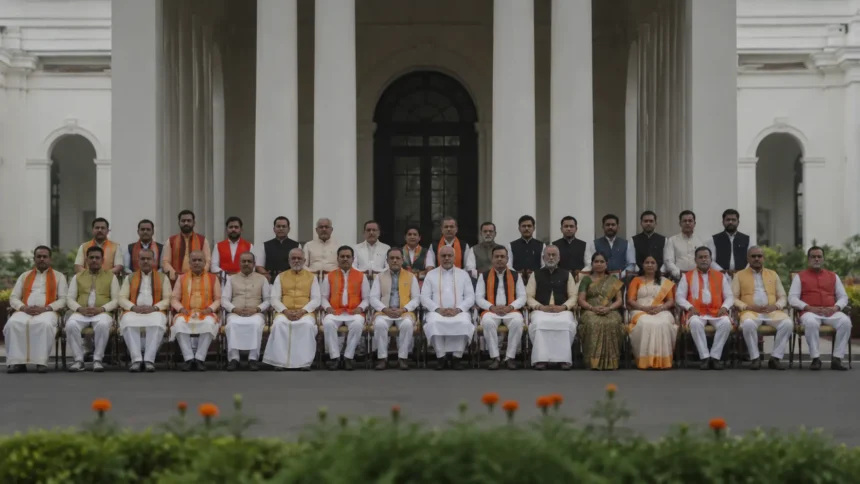
When 35 new ministers took their oaths at Kolkata’s Lok Bhawan and the BJP government led by Suvendu Adhikari’s Council of Ministers, totaling to 41 members, was complete then the occasion was being used for a strong declaration of administrative promise. That But might be the clearest sign so far of a govt that is having trouble balancing its ideological image with the demands made by 10 crore citizens of Bengal at the ground level.
The BJP came to power in West Bengal for the first time on 9 May 2026 and the Chief Minister, Suvendu Adhikari, was sworn in as a symbol of the party’s victory in the 2026 Assembly elections. This was regarded by the party as a turning point. But, after barely three weeks the govt is characterized by confusion, volte-face and unoriginal ideas being sold as new.
Take the transition of welfare schemes as the most pressing issue. Before the poll in Bengal, the BJP had announced a slew of welfare schemes that included 3,000 per month for women thru Annapurna Bhandar, 3,000 per month for unemployed persons and 3,000 per month for senior citizens and widows. These were not BJP’s own ideas they were exaggerated versions of the very TMC schemes which Suvendu Adhikari had years ago called “freebies” and “fiscal irresponsibility”. A senior BJP leader, ahead of the 2026 election, privately admitted: “We made course corrections after initially opposing such schemes, they are clearly working as an election tool across the country.” The confession is damning: the party that ridiculed welfare politics now governs by it.
The shift has unfortunately been very poorly handled. The West Bengal Doctors’ Forum sent a pressing letter to the chief secretary, Manoj Agarwal, and expressed their concern that the uncertainty of whether Swasthya Sathi would continue or be replaced by Ayushman Bharat has already led to a decrease in the availability of very sick patients including those on haemodialysis, undergoing chemotherapy, receiving cardiac treatment, and undergoing life-saving surgeries. The forum pointed out that “illness does not wait” for administrative decisions.” To us, this is not just a minor bureaucratic issue but a governance failure with life-and-death consequences- a failure that happened only a few weeks after assuming power.
The numbers tell an even grimmer story. The amount of public debt that is yet to be paid by the state of West Bengal is about 6.9 lakh crore in 2025 which was only 2 lakh crore in 2011. As plan, expenses on Rams under TMC were about 1.8 lakh crore every year almost 45% of the projected total expenditure during 2026-27 of 3.95 lakh crore. The BJP inherits this fiscal time bomb and, rather than reforming it, has chosen to expand it. Economists have consistently warned that this model starves infrastructure and industry, yet the new government’s first act was to double down on cash transfers.
Then there is the question of who fills these 41 ministerial chairs. CM Suvendu Adhikari announced that approximately 30 lakh current beneficiaries of the Lakshmir Bhandar cash transfer scheme are ineligible under the new criteria, effectively stripping millions of women of benefits overnight, even as new ministers are sworn in to govern them. That 30 lakh women face abrupt exclusion while a 35-member cabinet takes oath is a grotesque juxtaposition that no amount of ceremony at Lok Bhawan can obscure.
The inductees themselves raise questions. Several of the new ministers are party-switchers and career opportunists who rode the anti-incumbency wave. Arjun Singh, one of the headline inductees, offered the platitude that he would “rise to the occasion” for party, government, and public — in that precise order. The sequencing was unintentional but honest.
A cabinet of 41 in a state already drowning in debt, with welfare schemes in chaos and critically ill patients uncertain of their coverage, is not a show of strength. It is a performance of governance in place of governance itself. Bengal’s voters deserve more than political theatre at Lok Bhawan. They are waiting — some literally in hospital beds — for the BJP to move from oath-taking to accountability.