
The “Act East Policy” has been a key plank of India’s geopolitical and economic relations with Southeast Asia for almost a decade. The heart of this vision is the Northeast, which is strategically significant and linked to the Indian mainland by the narrow Siliguri Corridor and has over 5,000 km-long international boundaries with China, Myanmar, Bangladesh, Bhutan and Nepal. The Indian capital saw the Northeast region as a gateway to the ASEAN markets and a connecting region for South Asia and the Indo-Pacific.
But today that vision is very much at risk. The Kuki-Zo and Meitei communities have been embroiled in an ethnic conflict in Manipur for a long time, highlighting the fragile nature of India’s eastern border. More significantly, it has posed a crucial question – can India realistically talk about regional connectivity and strategic expansion in the presence of a most important state on its borders, riding a wave of instability?
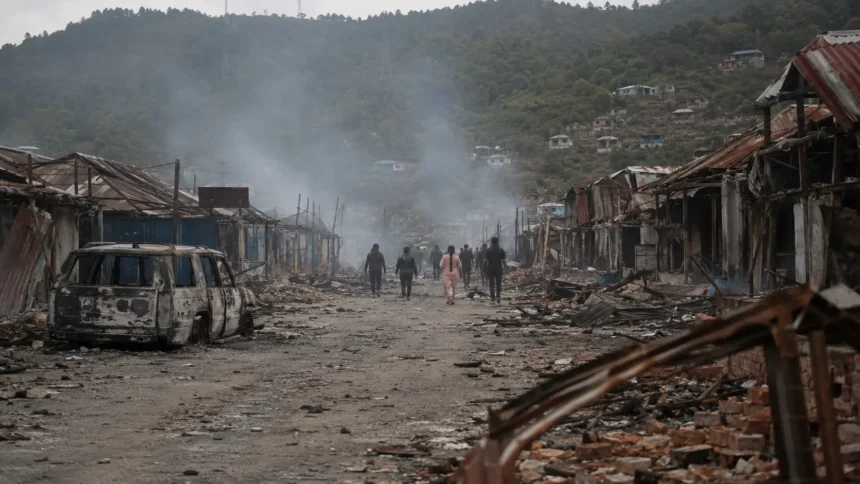
The violence which erupted in Manipur in May 2023 escalated into one of the worst ethnic conflicts in the recent history of India in a very short period of time. By official count, at least 220 people have been killed, 1,500 wounded and almost 70,000 forced to flee their homes since the conflict started. Thousands of public buildings and religious buildings and houses have been destroyed. Villages have been stripped, with people taking shelter in relief centres, as communities scatter in the wake of violence.
The demand for Scheduled Tribe status by the Meitei community was the immediate reason. Kuki-Zo groups protested the plan, saying that it would compromise tribal land rights and increase the marginalization of hill people. What started off as a political problem quickly escalated into a violent ethnic conflict driven by decades of mistrust, conflicting claims of territory, and unaddressed grievances.
In fact, today, significant portions of Manipur continue to be divided between ethnic groups. Most of the land in Imphal Valley is under the control of Meitei community and most of the hill districts are under Kuki-Zo control. The conflict has caused very low levels of mobility between these areas.
It is estimated that India-Myanmar-Thailand Highway will span about 1360 km connecting the Northeast of India with Thailand via Myanmar. It is one of the most ambitious connectivity projects of New Delhi under the Act East. But political stability and security are essential for the success of infrastructure corridors. These efforts risk being undermined by ongoing violence in Manipur, which hampers travel, deters investment, and drives up security expenses.
Predictability is the name of the game for foreign investors and multinational companies. Any region that is seen unrest for a long period is considered as a high-risk zone. This effectively negates New Delhi’s plans to make the Northeast an economic gateway to ASEAN whose GDP is more than $3.8 trillion.
The crisis has been complicated further due to developments over the border in Myanmar.
Since February 2021, when there was a military coup in Myanmar, the country has been engulfed in a wide-spread civil conflict. There have been relatively significant battles between resistance groups and ethnic armed groups and the military junta in several states, including Chin State near the border with the Northeast of India. Thousands of refugees have crossed into states in the Indian Union like Mizoram, Manipur etc. since the coup.
The Indo-Myanmar border is about 1643 kms in length and is porous. Ethnic and linguistic kinship and relationship also exist between many Kuki-Zo communities of both sides of the border with Myanmar. These linkages have created a transnational character of the conflict making it very difficult for the Indian authorities to deal with security issues within India only.
The security apparatus has voiced numerous fears on illicit traffic in arms, militant movement and new armed networks taking root on the border. This instability in Myanmar has consequently exacerbated the ongoing communal tensions in Manipur and thus added to the complexity of security and instability in the region that goes beyond the border of India.
Of greater concern is the rising feeling of ethnic division. Schools, communities, markets and local institutions that were once mixed have increasingly become segregated. In the wake of the conflict, there are parallel realities, with communities consuming different narratives, having different perceptions of victimhood, and deep mistrust for each other.
Examples of such divisions, in history, can last long after the violence has ceased. Bosnia, Northern Ireland and some regions where wars over ethnicity have broken out in Asia show how social disintegration can last for generations without proper attempts at reconciliation.
Economic losses are also high. During the heightened periods of violence, several business associations in the region reported a major disruption in commercial activity in different areas of Manipur. One of the more promising sectors in the Northeast, tourism, has taken a significant hit. There were frequent disruptions to supply chains, transport networks and local businesses.
The Act East Policy was never just an economic policy. It was also a geopolitical project aimed at bolstering India’s geopolitical presence in the Indo Pacific region and offsetting increasing Chinese presence in the region. This was to be the physical and strategic gateway to make these dreams come true in the Northeast.
But connection can’t thrive in the middle of war. Social stability is as important as physical infrastructure for highways, trade corridors and investment projects. The Kuki-Meitei conflict raises an issue that is central to India’s regional policy and that can be divided in two: geopolitical goals must go together with domestic unity.
Now New Delhi is left with a challenging task. Security operations will not be enough for the restoration of peace. It requires political dialogue, trust in institutions, equitable development and a credible system to deal with ethnic grievances. Sustainable stability can only come about when all communities are represented within the political system and confident in their identity.
India’s larger presence and enhancement in the Indo Pacific and its deepening relationship with Southeast Asian countries will continue to be a key focus of the future of the Northeast. But the incidents in Manipur serve as a reminder that strategic corridors can only be as resilient as the societies that they traverse.
The Northeast was supposed to be the entry point for the Asian continent in India. It is a warning today that unhealed in-fights can compromise the most ambitious of geopolitical schemes. Unless a durable peace is secured, the Kuki situation could turn into one of the most challenges not only for the country, but for India’s Act East dream as well.