

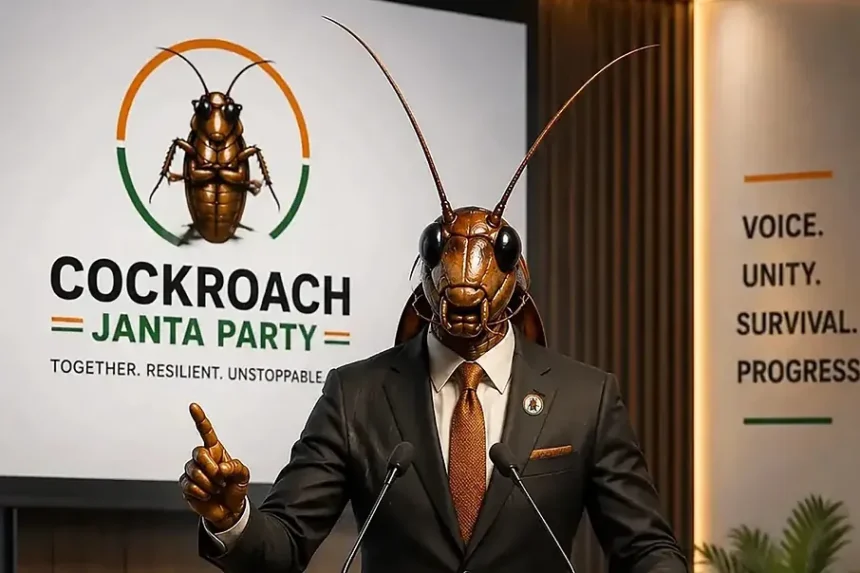
India ‘s northeast has always been looked as another soft, far away frontier from the center by New Delhi Politically convenient in elections, militarily useful for territorial issues and connectivity, but always failed to deliver and pay attention on issues of unemployment, human rights, corruption or participatory democracy. The premiere comedian of that so-called “Cockroach Janta party” might make a joke out of it, but there’s a raw political anger behind it that strike a chord with many young people across Northeast India.
The viral movement was launched in response to an apparently insensitive comment made by then Chief Justice of India S.K. other says that he compared unemployed youth to “cockroaches”. What could have been easily dismissed as a callous remark by the establishment was quickly redefined into a political rallying call by young Indians. The Gen Z of India, in particular, transformed the insult unleashed by authority into a metaphor for living the current political system. In Northeast India, this symbolism takes on an added significance.
Northeast India’s Long History of Neglect
The region has been suffering from chronic unemployment underdevelopment militarization, ethnic conflict and political alienation for decades. Though, the Narendra Modi government keeps propagating messages of integration, development corridors and ‘Act East, ‘ these continue to be elusive for the commoner. Infrastructure projects may be getting bigger, but effective economic opportunities, quality education and secure employment are still lacking. Northeast now abounds in combination of economic despair and political chaos. States such as Manipur are caught in a continuous cycle of ethnic bloodshed, shifting camps homelessnees insecurity, while Delhi seems more preoccupied with managing stories rather than roots of the trouble.
Thousands continue to be homeless, protests continue to take place and sections accuse the state and security forces of partiality and supineness. In this context, the Cockroach Janta Party popularity is a reflection of more than internet humor. It is a reflection of rising frustration among youth that the established political mechanisms have neglected them. The very political ascent of the BJP in the northeast was predicated on promises of peace, progress and integration but it is questionable if these were fulfilled to the same degree by all communities. In Manipur, young critics believe that the government failed to prevent law and order from breaking down in ethnic violence.
The Worse Situation of Assam
In Assam unemployment detentions, communal polarization and aggressive identity politics are engendering resentment among some sections of youth and minorities.
Across the region, anxieties about cultural erasure, demographic changes and intense securitization are common. The Cockroach movement by directly subvert the political image-building machinery under Narendra Modi.. Compared to traditional opposition movements, it uses memes, satire, and online rebellion to mock government on unemployment, media manipulation, crony capitalism and anticlerical decline.
A key reason for the appeal of the movement is that it brings to light issues that are often veiled by government and which So hit home all the more: unemployment, leakages of exam papers corruption distortion of the media agenda, increasing inequality. They are not distant, far away, but immediate and personal.
In Assam Manipur Nagaland and Tripura, educated youth persist in navigating reduced employment prospects, enforced transience and political instability. Whereas the BJP government to the world puts forward strong narratives about India as a dominant global power and thriving economic story, campaigns like the Cockroach Janta Party highlight the divide. Increasingly, angst-ridden young Indians seem to be unhappy with merely feeling nationalist, in an environment where employment, safety and responsibility are yet to be unraveled.
The Northeast has a rich history of protest politics and youth mobilization.
Student wings, tribal councils and civil society networks have played a decisive part in the development of a political discourse in the region, and the new digital satirical occurrence could that means become more politically rooted in Northeast India than many other areas in the country.
For many young people, the movement represents a valuable forum where marginalized groups can make their voices heard in national politics without relying exclusively on established political parties that tend to neglect regional interests. Meanwhile, the state’s response to criticism is also quite worrying. Accounts on social media were also reportedly barred or blocked by authorities in India, suggesting closing of democratic space and growing.
Concerns Over Democratic Space
The happenings of the states against criticism are alarming. News of social media accounts of the movement being closed or their access to the internet being blocked in India, affirmed doubts about erosion of democratic space and intolerance to dissent. Yet, critics say that rather than listening to the angry youngsters, the powers that be are busy controlling the storylines in cyberspace. This is part of a larger democratic crisis that is unfolding in India where criticism is labeled anti-national, the press is under pressure, private media is struggling to survive while challenging voices are targeted in trolling, through surveillance and prosecution.
The emergence of Cockroach Janta Party is So more than a satirical bit. It is a reflection of a generation. A generation that is no more willing to be ignored. But, it remains to be seen if the movement will last politically soon. It could well stick around as an online protest thing or turn into something broader, like youth activism. But, its speedy popularization already indicates a significant development: that India’s youth (yes, even in the northeastern states) are now questioning the authorities, saying no to political judgements and pushing for accountability.