
Nothing is crueler than a government that takes from one what it owes, while its cameras film ribbon-cutting ceremonies for others. The same is the strategy followed by the Modi government in systematically withholding payments owed to West Bengal under the constitution; chasing its employees from the BJP-led states and then making a triumphal entry to the state with the rhetoric of ‘development’. The people of Bengal aren’t duped. And they should be angry.
Let us begin with the numbers that the BJP doesn’t want you to consult. Since March 2022, funds for the Manchester for West bengal, which is a rural employment guarantee programme relied upon by millions of the state’s poor to combat dry seasons and economic shocks. This blockage has been confirmed by the Union Rural Development Ministry in Parliament, due to “non-compliance”. A bureaucratic fig leaf. In reality, the Centre is using a welfare scheme as a political weapon, and is blackmailing a state for the crime of not voting Bharatiya Janata Party in the 2021 assembly elections.
Bengal has demanded more than ₹1.7 lakh crore as unclaimed central dues under various schemes, claims Trinamool Congress. The Centre challenges the number. But even the BJP’s own ally-state chief ministers have quietly acknowledged that the formula for central fund distribution consistently disadvantages non-BJP states.The moral arithmetic is clear, regardless of the amount: If a state as populous as India’s, with 99 million people, is denied money for MGNREGS, Awas Yojana and road infrastructure, the poorest suffer the most. Not on politicians. On the farmers and daily-wage workers and rural women, who were promised a home and were given nothing.
The per capita income of people in West Bengal is 20 percent lower than the average level in the country. From 2012 to 2022, its GSDP increased by only 4.3 percent every year compared to the national average of 5.6 percent. These are not the failures of the States, they are the outcome of a decade of conscious under funding by New Delhi. Economic multipliers are created from infrastructure investments. Give it a bit of time and you’re creating the underdevelopment you’re going to deride from a campaign platform.
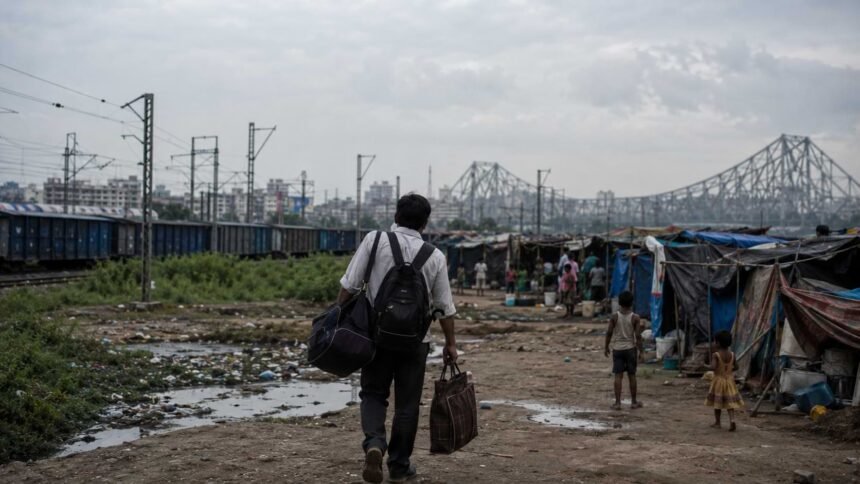
The inadequacy of jobs at home jobs has estimated to push 22 lakh Bengalis to move to other states of the country because of not having proper investment from the central government in home jobs. They travel to Gujarat, Maharashtra, Delhi, Odisha, Rajasthan and Tamil Nadu. They construct roads, sew clothes, work construction sites and work in factories that fuel the very “Gujarat model” that Modi was trying to sell for 10 years to the nation. And in return? They are arrested, profiled, assaulted and blamed for being illegal Bangladeshi immigrants by the states that are always run by the BJP.
More than 100 Bengali labourers were detained in Maharashtra last summer on suspicion of being Bangladeshis. The legislators of TMC were forced to go there on foot to get them released. Bengali speakers have documented experiences of forced deportation processes in India as foreigners infiltrating their own country in New Delhi, Gujarat and Chhattisgarh. A formal resolution has been tabled in West Bengal Assembly demanding the government to ensure the safety and dignity of these workers. Typically, the Modi government responded in silence.
The constitutional provision of free movement of persons under Article 19(1)(d) to any person of India to move freely to any place in the country is being ripped up in BJP ruled states as the Prime Minister touts about ‘Ek Bharat Shreshtha Bharat’ at rallies. Hypocrisy is not subtle. It is structural. The BJP that accused Bengal of “importing” the Rohingyas has created a situation in its own states where Bengali Hindus, the daily-wage earners are getting treated as suspect every day with their voter ID card and Aadhaar number. This isn’t a failure of the law and order. It is policy.
Drive anywhere in the rural heartland of Bengal – in Murshidabad, Malda, Birbhum – and you will encounter a tale of roads that suddenly come to an end, projects for drinking water that are written into election pledges and never built, and schemes for roads that are included in speeches in the Union Budget. In 2019, the BJP contested 18 Lok Sabha seats in Bengal and got 18 seats. These constituencies were targeted with great enthusiasm in the campaign. There was very limited follow through on the infrastructure. Then by 2024, the party had slipped back to 12 seats, as voters saw the pothole between promise and pavement.
In a self appraisal report for the state, NITI Aayog admitted that West Bengal had suffered a structural loss of economic dominance in the country from 6.8 percent in 1990-91 to 5.8 percent in 2021-22. For decades, Kolkata has been in relative institutional decline, once the most important commercial city in South Asia. The downtrend picked up pace during BJP government, when the central investments priorities went firmly for Gujarat, Maharashtra and Rajasthan where show-cases were available, states which were available.
The defenders of the Centre would argue that the economic crises in West Bengal are due to governance issues such as corruption, mismanagement, and political violence in the state. This is only partly true and it’s a topic for discussion. It is however a discussion that demands a degree of honesty on the issue of causes; you cannot cut off the supply of funds for MGNREGS and Awas Yojana in a state and then accuse the state government of not being able to provide jobs to the migrant workers in its backyard. That isn’t governance. That is gaslighting.
In May, 2025, Modi visited Bengal. It’s the “migratory bird” before 2026 elections, TMC described it. The description is appropriate. The Prime Minister doesn’t come to rule Bengal. He arrives to campaign in Bengal where his government has been systematically cutting its funding for four years. The Bengali migrant workers, who themselves came back from Gujarat and Maharashtra at great peril to vote in the last few elections, speak for themselves: they feel their lives are on the balance because they know the stakes are high. They are experiencing political abandonment at first-hand.
A government that does not allow jobs to be created for four years; does not mind the ethnic profiling of its citizens in BJP ruled areas and is lagging behind the national average in infrastructure development is not ‘neglecting’ West Bengal. It has decided what it wants to do. And when the 99 million Bengalis take the vote in 2026, they will take one also.