
Officially, Northeast India isn’t India’s lost frontier anymore. The region has emerged as a hub of strategic significance in the Act East Policy, a buffer zone for security reasons along the international border and a priority zone for infrastructure development. But for various communities in the eight states, the development process was stalled between announcement and implementation. Roads are approved but never completed, bridges are being built for years but few square meters end up with a bridge, while large amounts are being allocated and the results are insufficient. The dilemma Northeast India faces today is not lack of money; it’s a problem of execution.
In the past decade, the Government of India has made substantial investments in the Northeast region with a marked increase. The Government of India has made substantial investments in Northeast India with a marked increase in the last decade. The region, which includes Assam, Arunachal Pradesh, Manipur, Meghalaya, Mizoram, Nagaland, Tripura and Sikkim, accounts for almost 8% of the geographical area of the country, and has an approximate population of 45 million, bordering more than 5,300 km of international borders with China, Myanmar, Bangladesh, Bhutan and Nepal. The significance of its strategic role has grown significantly, in the backdrop of geopolitical competition, connectivity vision and India’s Act East policy.
This has been reflected in development spending. The region has seen unprecedented allocation of resources under Northeastern Council (NEC), Ministry of Development of North Eastern Region (DoNER), PM-DevINE, Bharatmala projects, railway expansion, and special infrastructure packages. In the past few years, more than ₹5 lakh crore has been invested in the completion or implementation of infrastructure projects in Northeast India, according to the government’s estimates. Investments in road connections, railways, airports, waterways and digital infrastructure grew significantly between 2014 and 2024 in the centre.
The size of the ambition is reflected in the size of the road infrastructure. The Ministry of Road Transport and Highways announced the construction or upgrade of thousands of kilometres of national highways in the Northeast region. Bharatmala Pariyojana sanctioned several strategic corridors and Border roads for connectivity enhancement internally and externally. Railway infrastructure also saw significant growth; states like Tripura, Mizoram, Manipur and Arunachal Pradesh did broad-gauge conversion. In the decade between 2014 and 2024, the investments in the railways in the Northeast are reportedly ₹70,000 crore, which is much more than what they were in the previous decades.
These investments have been made, but there is variability in implementation outcomes. There have been repeated reports of infrastructure projects being delayed and funds haste not been used in the states to the north-east. There are several centrally funded projects that remain ongoing beyond the scheduled duration, because of administrative and governance delays. Some approved projects never get completed for an adequate number of years.
For instance, parliamentary discussions, and audit observations, have pointed to delays in infrastructure projects of thousands of crores in the region. Big pending liabilities and stalled projects, in transport, public works and connectivity sectors have also been reported. Road and bridge construction in several states continues to be plagued with repeated deadline extensions due to land acquisition issues, environmental clearance, the difficult terrain, inefficiencies in the contractors, and the lack of interdepartmental coordination.
It becomes much more apparent when it comes to connectivity infrastructure. Accessibility has been an issue in Northeast India since times immemorial. Despite accounting for nearly 8% of the landmass of India, the region is characterized by the developmental asymmetries of only having had around 3–4 % of the road network density of the country in several remote areas. Lack of internal connectivity persists and exacerbates transport costs and access to markets.
There are significant economic consequences. The geography, lack of transport corridors and weak infrastructure integration in some states in the Northeast continues to raise logistics costs. In rural areas, costs of transport have a direct impact on food prices, access to health services, school education, and investment.
The irony is profound. While Northeast India is expected to be the gateway of India to Southeast Asia, the connectivity within the region is still a challenge in many districts.
It’s not just roads. Infrastructure projects tend to work in isolation with a lack of supporting infrastructure. Nearby healthcare institutions can be understaffed whilst the highway project is finished. Railway expansion can be unaccompanied by the necessary logistics network and industrial ecosystem. Better airport connections can be achieved without the allocation of adequate economic spillovers at a local level.
As a result, development takes an aesthetic rather than transformative turn. Hence, the development is fragmented, not transformational.
One key explanation is in governance structures. The development of infrastructure projects in the Northeast states often requires participation from several actors – including central government ministries, state government, district administration, environmental agencies, security agencies, contractors, and local governments. There may be multiple approvals at multiple levels before a large project can be implemented.
This is a “fractured governance” environment which slows execution. Administrative capacity also is uneven throughout the region. There are ongoing labor shortages for technical staff, project management and procurement professionals, and monitoring systems among several northeastern states. Departments with a large infrastructure portfolio often have low institutional capacity.
Development assessments indicated that states with smaller administrative units often have trouble making efficient use of significant amounts of financial resources. This results in a development absorption gap, the gap between the spenders and financial commitments.
Thus, the challenge now becomes the ability to implement, not to finance. The political situation further complicates matters. The symbolic importance is attached to the infrastructure in the Northeast region. Rather than being just economic assets, roads, airports, bridges and railways are also elements of inclusion, state presence and national integration.
Thus, project announcements are given significant political visibility. But it is often at the approval stage not completion. Implementation falls to various agencies, and governments are recognized through announcements. Where there are delays, it is hard to hold anyone accountable.
This results in a cycle of announcement-led development with projects becoming visible in public, but behind delivery of operational services. There is an increasing focus on outcomes of governance rather than promises by communities.
In isolated communities, development is not considered to be achieved if only the approved budgets are met but if the roads can be traversed on a regular basis during the monsoons, health clinics are operational, schools are accessible and transport can be afforded.
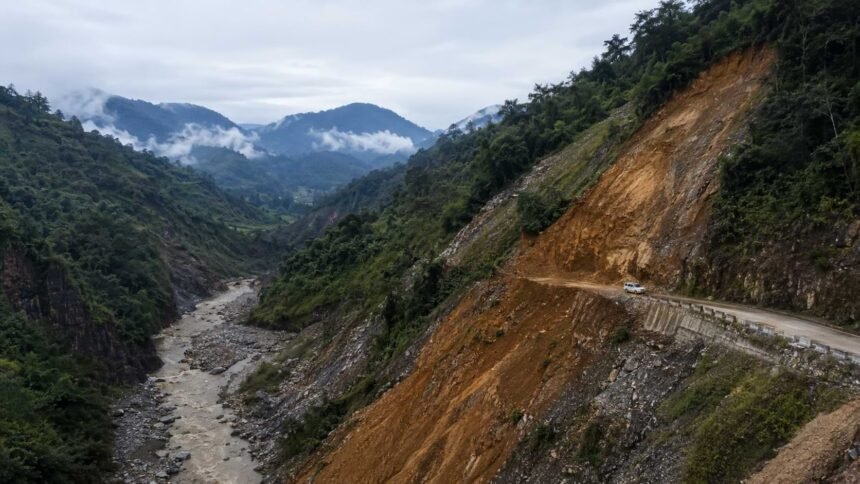
Delays are unarguably caused by factors relating to geography. Northeast India has some of the highest rainfall in India, frequent floods, landslides, seismic vulnerability and intricate mountain ecosystems. In the hill states, landslides pose a threat to infrastructure and settlements, while in states like Assam, annual flooding has a similar impact.
However, it is not simply a matter of geography alone that prevents failures in implementation.
The ministries of transport, environment, defense, rural development and tribal affairs can all have an interest in large infrastructure projects. Delays and cost escalations are greater with weaker coordination mechanisms.
Another complicated factor comes into play when considering borderland development. Northeast India has almost 98% of its borders crossed by other countries and a small land corridor with the mainland India. This strategic position has led to a boost in infrastructure development under security and connectivity requirements.
Development planning is increasingly being influenced by projects associated with the border trade, strategic roads and international corridors.
But participation of the local people is often restricted. There are also many infrastructure projects that have been ongoing, using the top-down approach with strategic priorities over community consultation. Village involvement in decision making processes may be very low in cases of roads, industrial projects and land acquisition.
This poses a problem with the legitimacy of the government. But in a region where ethnic, land rights and identity politics are important, the exclusion of local communities can further delay implementation.
The financial impact of delayed development is great. The economy of Northeast region is still a small share of the Indian economy despite its rich natural resources, hydropower potential, tourist attractions, biodiversity, and geographical advantageous trade location.
Youth migration is still rising, and jobs are still out of reach outside the region. There is ongoing educational ‘mobility’ to the metros. Private investment growth is still lagging with several other regions of India partly due to incomplete infrastructure ecosystem.
Therefore, delays in infrastructure have secondary developmental impacts that go beyond the building of the infrastructure. Growth of allocations is not the only answer. Policy focusses and funding for Northeast India is already very high.
The challenge is in governance reform. It is important to have transparent project monitoring systems, real-time tracking of expenditures, independent audits, better technical staffing, and better interagency coordination. Project progress and delays could be made transparent with the use of public dashboards.
As importantly, shifting from announcement politics to outcome-driven governance. Success should not be a project sanctioned, but a project completed, maintained and running. There’s nothing lacking in ambition in Northeast India. It does not have conversion capacity (the capacity to convert allocations into outcomes).
Roads have been publicized. The budgets allocated. The strategic visions that have been expressed. It is unclear whether governance institutions can deliver development at the region’s speed.
Not everything is a development that is delayed. It means development denied for many communities in the Northeast part of India.